I oiled a lock
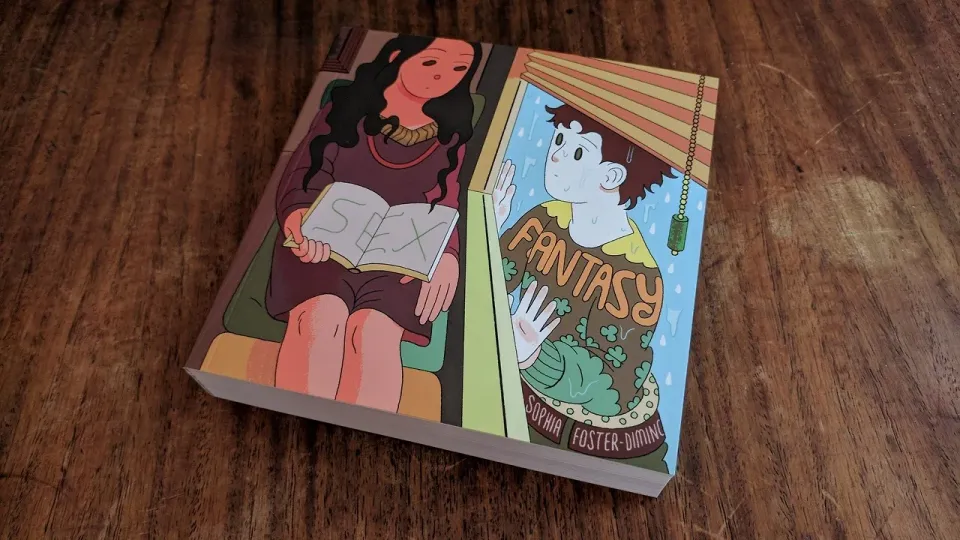
I love Sophia Foster-Dimino's comic collection Sex Fantasy.
Like, here's #3. Click on that link and you can read it, now. A lot of others are on her Tumblr, too. But I recommend the book.
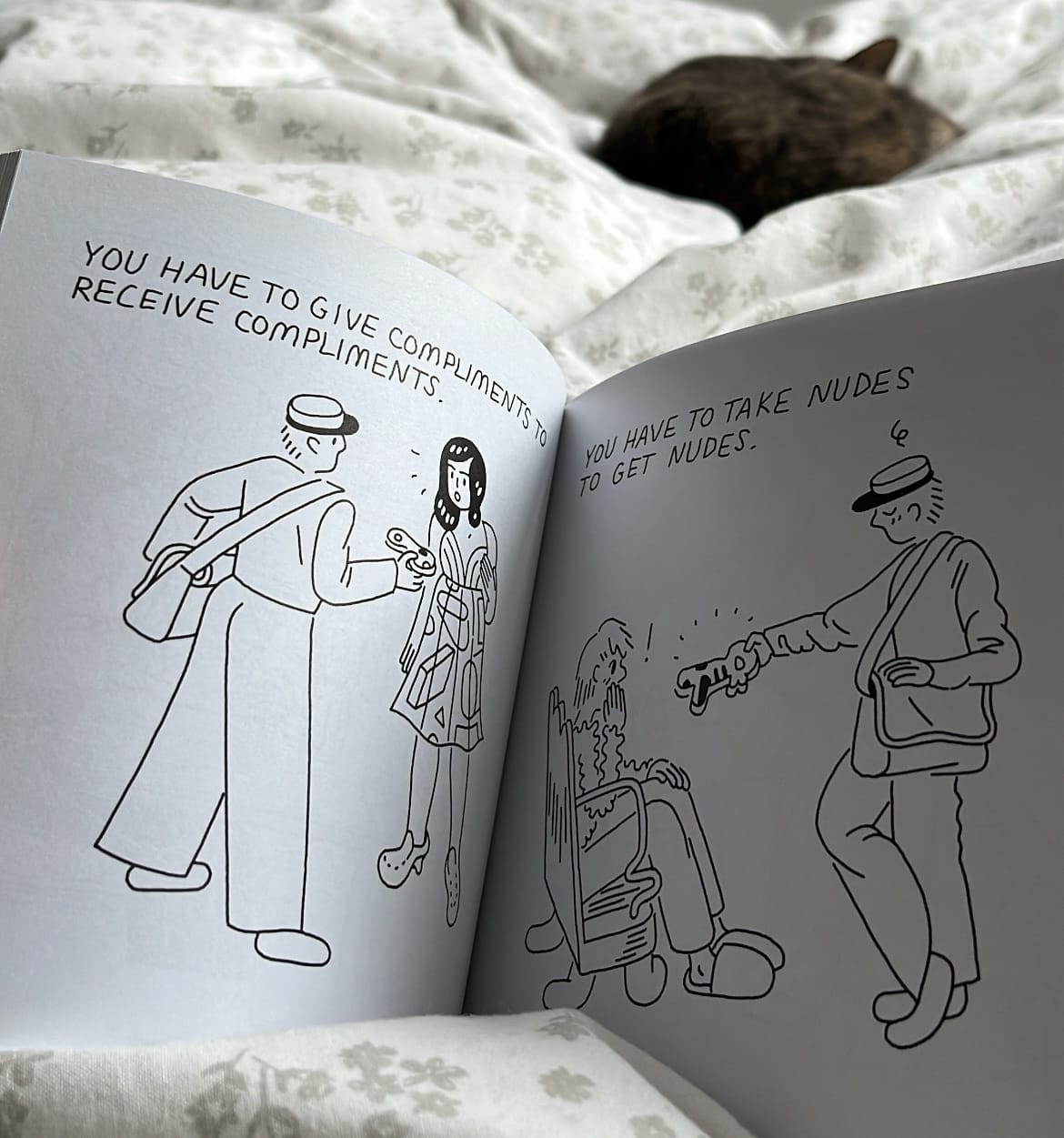
I don't think any other comic has given me an earworm the way this has. The title of this post is "I oiled a lock", and it came to me when I was... well, oiling a lock. And it came to me in the rhythm and cadence of the comic. That feels rare.
And thinking about other times this has happened... music can do this, of course. But that's not a book. Poetry can, too. A cadence, a rhythm, an inflection. Read enough Shakespeare and you find your brain trying to put things into iambic pentameter (put things into iambic pentameter enough and you find yourself being able to improvise in it).
But mostly, I think, and most relevantly, it happens with children's picture books. Each Peach Pear Plum (I spy Tom Thumb). That's explicitly poetry, too, all rhymes and rhythm. We're All Going On A Bear Hunt (we're not scared!). Less so. But still I hear the call and refrain, just from the title.
And these books also have images. I mean, there's a reason they're called picture books. I guess Sex Fantasy is a picture book? It's the same format. One image per page. A single line of text. Oh, fine, it turns into comics near the end, the characters start speaking, there are speech bubbles and multiple lines of text. It's not a strict adherence.
Sex Fantasy 4 (also readable at this link) is probably the best one. I mean, it's the one that won an award (the series has also won awards). But it's also the one straddling the line between comic and caption. It's the one with the strongest sense of rhythm. no but do you ever feel bad sometimes.
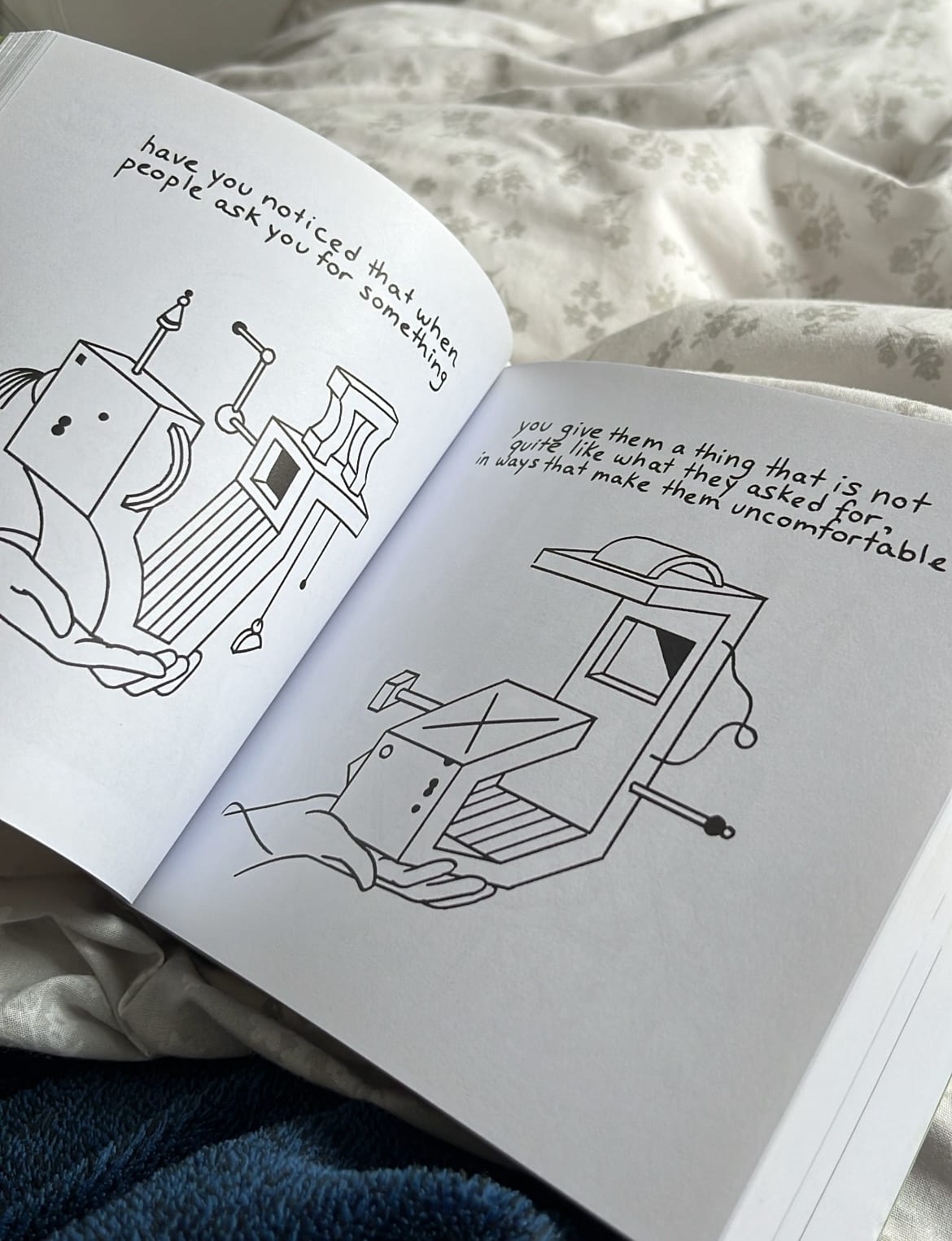
And I think you could make an argument that it's a children's picture book for adults? I mean, that's a dumb name but "picture book" doesn't quite work. Because picture books are for kids! And, well, you can't have a picture book called Sex Fantasy, can you?
Or maybe it isn't a picture book, maybe this is a dumb thing to assert. Maybe it's a comic. She calls it a comic, it's published by a comics publisher. It's probably a comic. But... could you have a picture book for adults? I mean, not that lots of picture books don't have a lot to offer an adult reader - I was talking about this with Eleanor earlier and I started describing the board book Your Truck by Jon Klassen and she was like... are you crying?? (I was). But can you have a picture book that is explicitly not for children? Does this exist already? Please, write in if so.
What's special about picture books? The thing about picture books is that they're intended to be read aloud. The intended audience hears the words, and they also see the images as the words are read. It's a performance. They are the script and the stage and the special effects for a theatre show with one performer and one audience member. So: the page turns are critical. The exact language, how it sounds when it is spoken. The first read of the images, and the subsequent ones. And what the expectation is for the audience - sometimes they are interactive.
(An aside, here, to recommend the John Klassen and Mac Barnett newsletter Looking At Picture Books. Yes, even if you don't care that much about picture books. It's just rare to come across creators at the top of their game talking about craft in the way they do)
So now the question (for me, because this is what I like to think about - you can go in other directions if you like), the question becomes... how can you create the conditions and context for one adult to read to another adult, a reading experience where they are also showing them images at the same time. I think this is a powerful format? I think it is enjoyable to perform, and enjoyable to be performed to. I think that hearing words and seeing images, and the ways that these two things can combine – I think there are a lot of powerful things you can do with this.
But reading picture books to each other is a weird thing for adults to do. We don't generally sit next to our friends and read aloud to them, while showing the the pictures of the book we're reading. For one thing, people don't make picture books for adults, so we'd be reading children's books to each other. So... maybe this doesn't look like a picture book! What could this look like?
To me it looks like a slideshow? Like a Pecha Kucha type format? You can do the same thing with words setting up a reveal with images. Or images can pop up and then words can contextualise them. This comes out of Serious Business Communication, there is an assumption it's here to tell you Facts – but it's now normal enough that it can also be used for pure entertainment. TV shows that are built around this idea!
Or, okay, maybe you drop back from the images being critical. Maybe you focus in on the performance. Now you're at something like a reading. I used to gather with friends to read poems to each other (we'd then discuss them). Again, it's fun to perform. We had a nice time. (One time someone recited A Ramble in St. James's Park entirely from memory. We hooted and hollered.)
Or maybe you drop the part where there's only one person reading. Now you've got something more like a table read. In a sci-fi project I'm working on, this is a thing! In the future, a popular form of socialising is clubs where you get together and just... do table reads. Except it's the future, so instead of holding a script you're reading off AR glasses which follow the play automatically and prompt you when a cue is coming up. It makes sense to me as something that both feels like a plausible fun time and also quite alien to our present habits.
Or, less alien - this is an aspect of many Jubensha. There's little bits in many of those where you have a script, you read your bits out loud. It works great for getting you into character without asking players to actually, y'know, improvise. Core part of the genre, even. (You probably haven't heard of Jubensha, but I promise you it's big in China).
Or, I mean, we're now into the universe of role playing games. Lots of ways to construct a situation within a tabletop game where a picture-book-ish experience can be normal. A controlled and scaffolded performance. Here's the bit you read, here's the ritual to set the scene. Can you do the voices? I like it when you do the voices.
So have we found an answer to making this kind of thing normal? No. All of these are still scarier than reading to your children. Because one, they're your kids, and they're still young, they don't properly understand shame yet, and they definitely don't understand it as something that applies to you. And they don't have a context for what a Good Performance is. And there's a cultural norm about reading to your kids. It's a normal thing to do. And even with all this - it's still scary for some people! Just to perform at all, even in the lowest possible stake environment (are kids ever low stakes?).
But... even if these don't make this kind of thing normal and not-scary... they are ways to reach towards that. And if they become more common – if this kind of experience is something people enjoy – then the level of scariness also drops. But it feels like there's some design space here. Even if just for sickos for now...
Anyway. That's what I was thinking about when I oiled my bike lock this morning.
Member discussion