I played TRANSMISSION
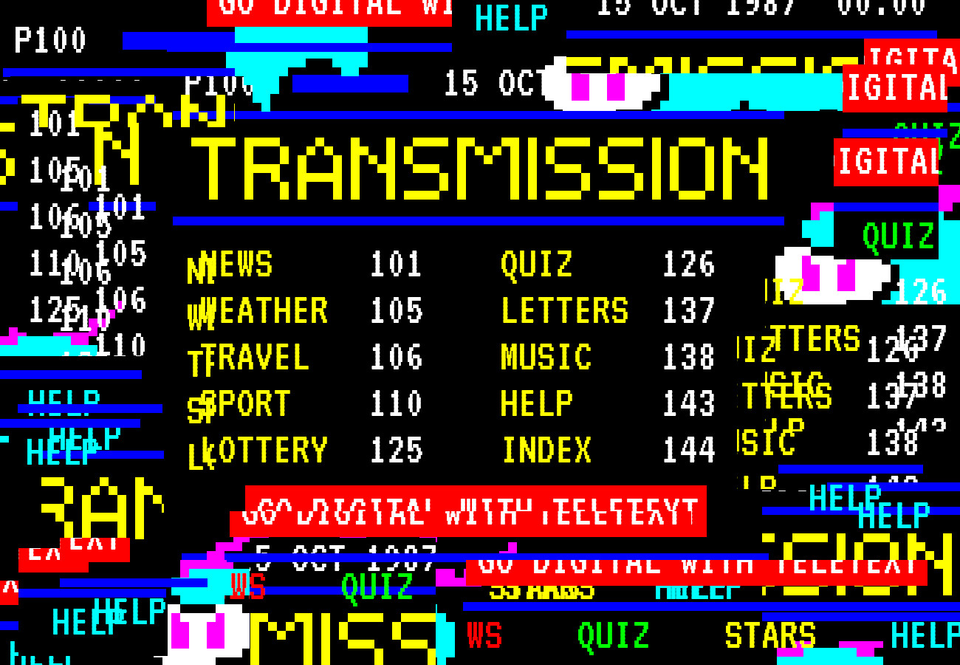
TRANSMISSION is an online larp designed and run by Chloe Mashiter. I think there's two tickets left for the current run, both in the late night run on Thursday.
It's set during the Great Storm of 1987. You're a group of 30-somethings, all old university friends, all getting back together for a reunion in a country house in Norfolk. Then the power goes out. You're isolated, in the dark, no way to contact anyone else. And then the TV turns itself on. And there's Teletext on the screen. And then things start to get weird...
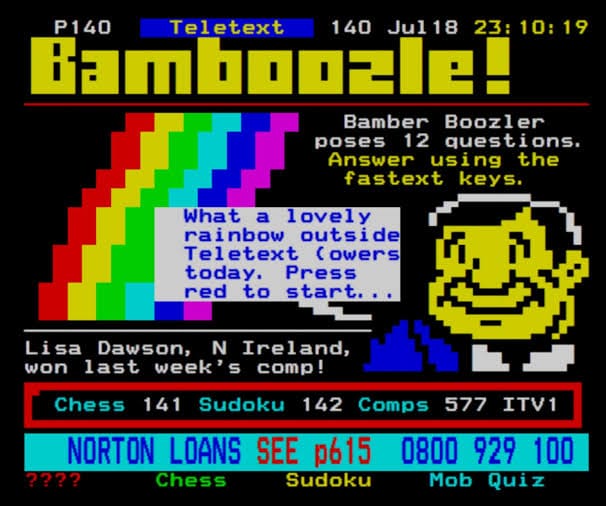
Wait, actually I should explain Teletext. Teletext was like the internet, but on your TV, with really blocky graphics, and you couldn't respond, just read it. Looks something like this:
So, like I say, it's an online larp. Eight of us were playing, all of whom I was friends of, even if not everyone knew everyone else. It's played over Zoom, although in the fiction you're all in the same room as each other. It's structured in the format I find familiar from chamber larp. It starts with an intro to the game, here's what it's about, here's some safety mechanics. Then, here's some prompts to create your characters from. I was Bex, an ambitious estate agent from Suffolk who had got fired a few weeks back, but hadn't told anyone. Teri Drummond was playing my sister, Sophia, also part of this friend group — she worked as a bouncer but wasn't really happy with her job — she was a bit more up for a drink and a laugh. And so on for the rest of us, some pretty everyday characters with a nice knot of relationships holding us together. And then there was Barry, Jules' partner, who was also part of the group, but she hadn't told him about the trip - their relationship was in a bad place because of his drinking, and she just needed a break from him.
And then the game begins — a bit of scene setting, a kind of montage of arriving, the evening progressing, the storm builds, the power cuts out. And the screen shows — Teletext. We could write into the chat to use the remote — enter numbers to tune into different pages. (Behind the scenes, Chloe was presumably frantically entering stuff to switch between pages & trigger various effects & in some cases improvising content live).
The arc my character went was — I started off kind of brash and overconfident, butting heads mostly with my sister. When things started getting weird, I played them off as nothing. Dismissive, joking. Til it went past a certain point, and suddenly the dread hit me, no, this is real, or at least serious. What's happening? No don't go to the page that has [REDACTED] on it. I thought it was a prank but this isn't a prank. I'm here for you, Soph. Hold my hand, Soph. I'm scared.
And after the climax — the end. And then... thanks folks, that's the end of the larp, thanks for playing. I often find myself buzzing with lots of pent-up energy at the end of a larp. Big laughs to get that out. There was a bit of space to talk about the experience, a bit of comparing what happened to us versus what other sessions saw... and then we logged off, and were all back at our respective homes. I futzed on the computer a bit and went to bed.
So what I am left thinking about is — well, it worked for me. By which I mean, I entered into that world, I roleplayed, I was able to let go of my conscious thinking[1] about the game and enter into the mindset of the character I was playing, we formed a shared imaginative space together. The game works.
There's a bunch of things here that would be easy to take for granted. The way the Teletext aesthetics managed to drag us into this shared vision of 80s Britain, a time that I don't think any of us have more than childhood memories of. The way that the Teletext actually works — the content, the way the storytelling builds up over time, the way that Chloe can manage to both think about the storytelling that we're doing together and also operate a presumably quite intricate technical system (I've seen them do this live on projects I've worked and honestly it's quite intimidating to know how well they can do this). And the way that the characterisation is structured — for us, we had these dramas and tensions across the group, and then when things got Weird most of them melted away — and, yet, that scaffolding meant that we had relations to each other that did persist. For example: my character had some doomed property deal she was gonna try to do with the help of one of the other characters. It never got mentioned, but holding that knowledge within myself meant I related to the others a little differently.
The main sign that it was working, though, was that, even though I was sitting in my deskchair at home, the same one I'm sitting in now to write this blog post and do some emails... I was holding myself differently than I usually do. I was clutching my hands together. I was rubbing my face. I had my shoulders tense, up by my ears[2]. The emotion, the character, the situation, these things were held in the body.
And this is one of the big things I think I want to think about, and explore through making, over the next few months. How can you create this kind of embodied experience but do so in a way that is digitally mediated? That happens remotely, or within the player's everyday rhythms. How can you make that offer? It feels like a kind of quixotic quest, or a bit of a contradiction — shared experiences of embodiment, but mediated through technologies in which we don't have a body. But I guess that's the thing — we always do have bodies, no matter what technology we use. And the experience of using that technology is always affected by the bodies we use them with, and by the embedded context we bring to the experience.
Tiny example: this game feels like it would be different played with a cup of tea versus a glass of wine. At a desk versus on the sofa versus in bed. With over ear headphones or with earbuds or computer speakers.
Anyway, as you might imagine, I'm brewing more thoughts on this subject, but I'm in no rush to crystallise them as yet. I have at least one project I'm working on (with a pal) that directly engages with these questions. But I wanted to use this blog as an excuse to document how this game worked, and how it made me feel — by which I mean, specifically how it made me feel within my body.
I say I let go, but what I really mean is that my conscious thoughts about the game and our characters and my fellow players could run in parallel. That's the beautiful, characteristic, thing about roleplaying, for me. A sense of double consciousness. ↩︎
Shoutout, by the way, to George Voss's character, Araminta, and her attempt to do a guided breathing exercise while doing panicked shallow breaths. Fantastic bit. ↩︎
Comments: