New project: Lacuna Connect

I have a new project! It's a new type of video calling software. Personally I think it's best experienced if you click through and try it out for yourself now, and only then come back and read this. So you should now click on this link:


Still reading? That's okay. Here's how I've been pitching it to people:
So you know video calls, right? Where you can talk to people over the internet, and it also sends moving images of you as you do so. And you know how it has this feature where it tries to remove the background noise, so that you can be on a call and someone says "ah, sorry about the construction noise" and you can't really hear what it is that they're saying. Or sometimes you're on a call and someone is trying to play you music and you can't hear that either? And, as well as that, with the video part - if your room is messy or whatever you can blur it out, or you can replace it with a fake background, like an image or whatever so you can pretend to be in an office or in space or whatever?
This is a service which does the opposite of that. It only sends the background noises, and filters out the speech. It only sends your messy background, and it removes you. So you're just a silhouette of a corporate office.
That's what I've built. It's a little service you can use to make video calls, in the browser, and it filters out those things. You can pick your background, choose the settings, make a meeting, share the link, join it, whatever. It looks like this:
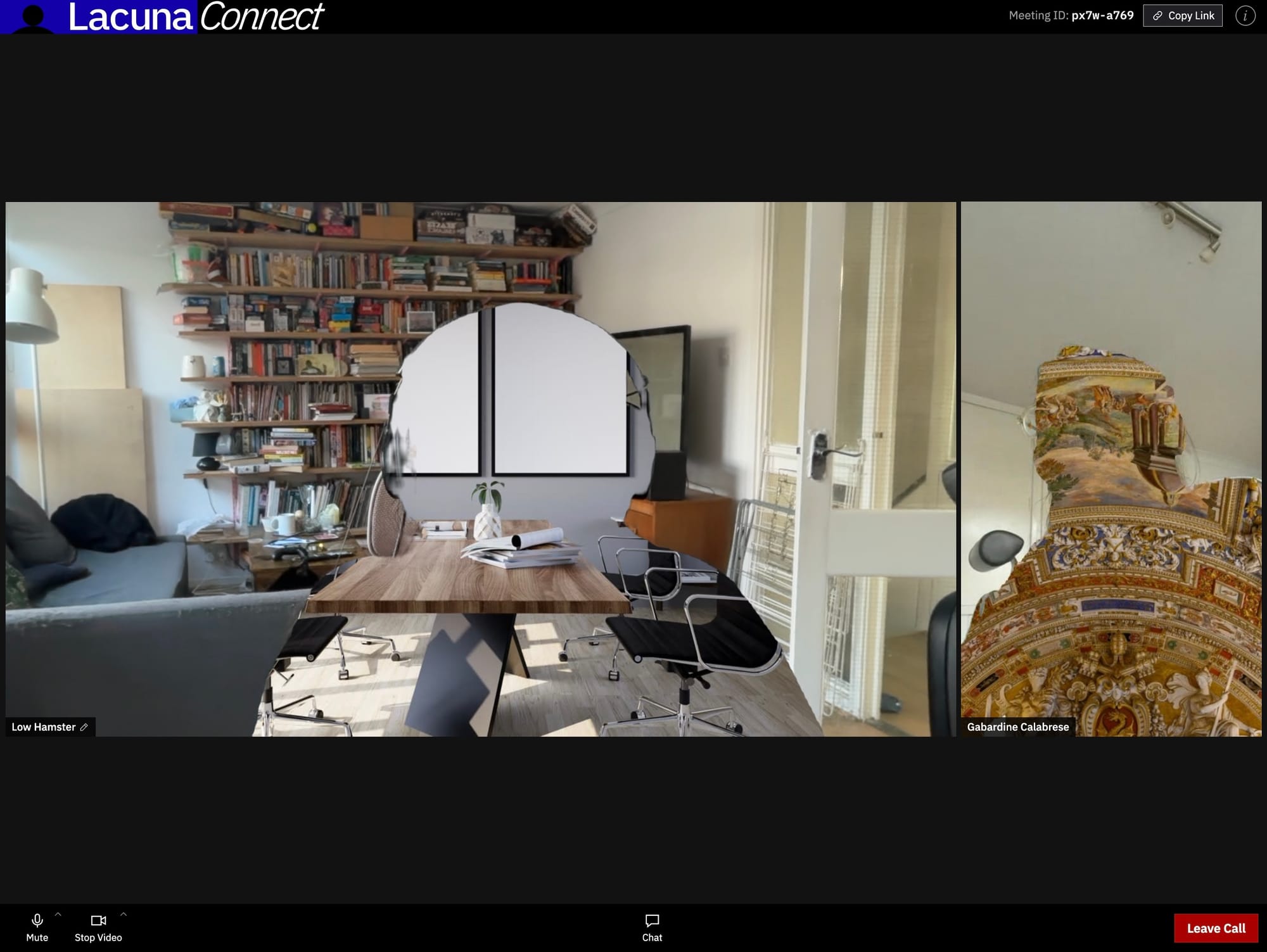
Now personally, I think this is a great joke. It's clearly an amount of work carefully put together to achieve something that is the opposite of useful. I thought about it, and I was like... this is interesting. There's something to this. And I seriously set to work. And when I had a first prototype, and I actually tested it, I was like... hm. Yes. And then I cracked up laughing at my own joke. The way it casually works to defeat your attempts at communicating.
But! The original impetus for the idea didn't come from the joke. It came from thinking about this idea of how to make experiences that are about embodiment, but which are played in geographically disconnected form, over the internet. And I guess this thought is the one from my previous blog post - when you're making a video call, you're still a body in a room, but the video call tries quite hard to remove you from that room, and put you into a virtual room. It even uses this language. So what if we... did the opposite thing. Emphasised the background noises, the construction, noisy cat, pipes clunking, background music and chatter at the coffee shop, de-emphasised your important things you want to say. And removed your face, but left your body, left the way it relates to the space and how it moves within the space. Someone compared it to Cage's 4"33, which, yeah, sure, I'll take it. Or to dance — bodies moving in space, yes, that's what dance is about.
And it's also playful. What can you slip through the filters? What does slip through? Where do the filters break down? Where you can cut your face off frame and show through a bit of it? How can you interact with the backgrounds? There's some scope creep in there where I put in a bunch of features for backgrounds - adding custom ones, or animated ones, or sharing your screen - but really this is because I thought that there might be opportunities for play I hadn't properly thought of and I wanted to make this a useful tool for someone to take places I hadn't thought of.
On scope creep: yes I should probably talk about how I made this. Yes, I used an LLM. The core of the project is basically two ML models stapled to some fiddly networking code, wrapped up in a site design that is consciously trying to look corporate. Claude quickly extruded the networking code — WebRTC with a Rust signalling server doing STUN, and websockets for sending connection info and chat messages. This means that only metadata is going to my server, not videodata, which means it's not ruinously expensive to host. But there will be some cases where clients can't connect to each other directly, because both of them are behind firewalls which only accept incoming connections, and obviously someone has to go first. The proper solution to this is to have a server in the middle which relays traffic between them both ("a TURN server"), but then that does get expensive to host. So I'm not doing it, and in those cases it will just fail.
By the way, WebRTC is a beautiful thing — it was designed for this use case, for allowing videocalls and so on to happen in browsers, but the fact that it exists means that browsers now can, with caveats, talk directly to each other. Which, if you're trying to apply your brain to the problem of how to make useful things on the Internet which don't put all of your data onto servers run by large evil corporations, suddenly seems quite exciting. A straightforward example of this is Pairdrop, which is a service for transferring files directly between two computers. I have thought a bunch about WebRTC for this reason, so it feels kind of novel to be using it purely for the use-case it was actually designed for.
Oh, yeah, on the machine learning models - there are obviously off the shelf models for removing backgrounds and for isolating speech. These run in the browser, using WASM so they run nice and fast and don't have to be made out of Javascript. For the vision ones, it's pretty simple to run the process and then invert the mask. The blur idea is kind of fun I think - it shows the bits the blur removes, so you only get the fine detail and not the colour, not the flat shapes. I love convolution. And for the audio — the way sound works means it's harder to say this bit is speech and this bit isn't. The model I ended up with finds particular frequency bands which accord to speech in real time, and then we take frequency bands which aren't that. It does keep in this idea of ducking - when speech is detected, then it grabs most of the audio, and when speech isn't, most of it is let through. So you can hear the negative shape of the speech, even in the continuous background sounds. I do like that laughter slips through, it makes me wonder how much laughter I have been deprived of in normal video calls by noise-filtering technology.
Anyway, both of those parts, the networking and the models, Claude had on lock. Just worked from the off. Kind of task it's good at, connecting together things that lots of people have done before. But what it isn't good at is making something which aesthetically looks, well, like something.
So what I actually have been spending most of my time on this project working on is graphic design. Fun to design a logo. Fun to try to think about the aesthetics of existing video call solutions. Which... mostly they're just the Google or Microsoft aesthetics, this time applied to calls. But I've always had a bit of a soft spot for the hard functional aesthetic of Zoom, especially in the core of the interface. It just really feels like it was made by C++ people who were mostly thinking about how to make it fast, and then how to have particular features, and only third about the ~user~experience~.
The name, too — I knew I wanted this to be structured like the joke it is, and that means giving it a name which makes sense in retrospect but doesn't explain the core concept ahead of actually landing on that preconnect page and seeing it work for real. Lacuna, meaning a void or omission, yes that works, this project is all about absences. And Connect, which is actually what this is trying to do, the project is about finding for real a different kind of connection which doesn't normally come about through video calls online. And put together in this wordmark, trying to get the feeling of a single product category for a larger brand, something done with a little bit of corporate indifference. The vibe of 3 hour meetings about product strategy, held in a room with processed air and artificial light. Trying to give the sense that some of that feeling has leeched into the product.
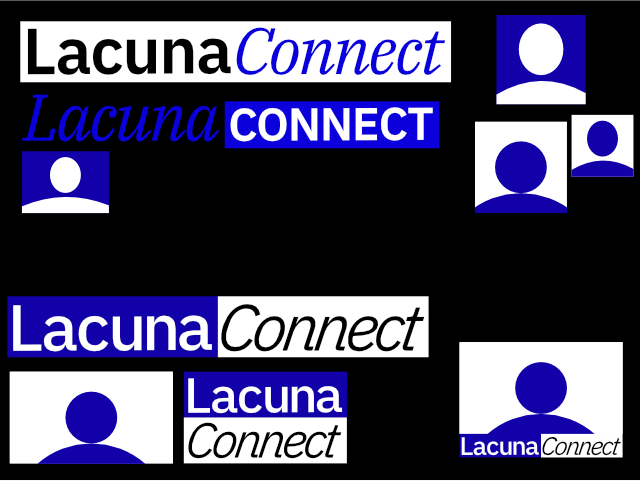
And picking backgrounds! This was maybe the most fun part. Just trying to find things which were:
- freely licensed
- felt like Zoom backgrounds. square on, frame the face, etc.
- properly artificial and anonymous feeling
I bent the rules on freely licensed a little by including images I ripped from the IKEA showcases of particular rooms. They just have this perfect vibe of every element having been overthought, styled meticulously, and designed to both suggest a lifestyle but also have any actual personal details scrubbed away. In lieu of a license to use them I offer this suggestion: if you want your room to look like one of these backgrounds, please consider shopping at IKEA. Now it's user promotion and they shouldn't get mad.
And a good distribution of the different types of background:
- realistic places (offices)
- realistic places (aspirational)
- landscapes
- nature
- abstract shapes
- animated
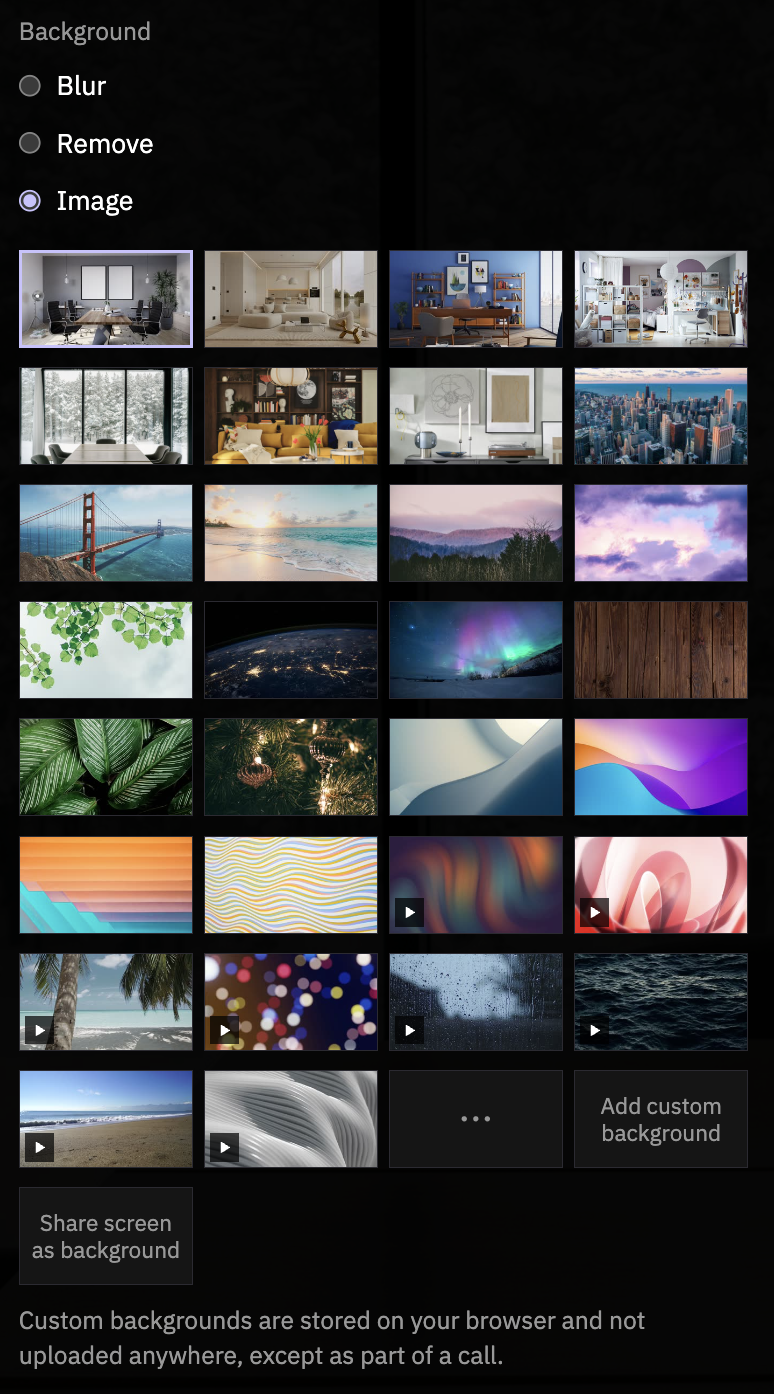
And then, too, I couldn't help myself, so I put some more interesting ones behind a little expandy button. Some of these are from my personal rotation of Zoom backgrounds (the r_g_b one, and the Susan Kare Tapestry image). And also things with some fun detail to uncover by moving, or just things I think look a little too beautiful to fit the worldbuilding. My headcanon for this is that these are the things that the user of this software has uploaded for their own personal use?
What else? Oh yeah, I used generated names (which are changeable) rather than asking people to set their names. Again, there's a design rule here which is to ask of everything: does it serve the joke? In this case, asking people to set their own usernames takes up space on the screen which is the punchline of the joke, and which does not add to that joke. But then you can change your name because of course in a normal video call app you'd be able to do that, and because setting a serious name for the call makes it funnier. The names themselves are pulled from the prefix and suffix lists I compiled for making the autogenerated Downpour usernames, which are themselves mostly pulled from tables from Darius Kazemi's corpora project. They're probably a little bit too fun for the corporate vibe, but while everything should serve the joke, also you gotta give yourself a little space in the corners of the design to do things that amuse yourself. So we have names like: Nylon Weasel or Reticent Damson or Thrilling Causeway or Big Bassoon.
Anyway, yeah, I think that's everything. Go try it out! Find a friend to call and make shapes for them to interpret and make weird noises and see if they can hear them. Show off your cat! They're visible now!
Comments: