a friend was like "i really like your blog" and also was like "i like how upfront you are that your current rate of posting will not last, and is in fact early January energy"
well, guess what? it did not last. i got ill instead. i think it's the flu? lots of snot, developing into a cough, with a stretch in the middle there where i think i was a little feverish. yesterday i did some really heroic amounts of napping, before (and i was worried about this) sleeping through the night. today is a little better, but i did not make it to clown class.
and this is the worst thing about getting ill, in my book - it's the sense of isolation, it's the way that i feel disconnected from all the stuff i had happening in my life beforehand. my POTS means that hitting a crash or getting some other illness that incapacitates me for a few weeks now happens kinda often (a few times a year), and while i am grateful for the reflex that makes me just immediately dump all my ongoing responsibilities to focus on getting better (it's the response that's best for my health, for sure), the situation of getting a little better and going... what was i doing? how can i catch up on all this? i feel lonely and isolated and i don't have any plans planned... it's not my favourite.
anyway, i do seem to be on the mend, so hopefully in a day or two i can start picking up the things i have committed to doing. i'm finding myself making lists already, so that's encouraging. and also writing blog posts.
The Tainted Cup by Robert Jackson Bennett - started this, seems good so far, enjoying the worldbuilding & the energy between the protagonist & his boss
A City On Mars by Kelly and Zach Weinersmith - continues to be entertaining & factual. although there's a bit where they take against the entire concept of auto-ethnography, i think unjustly.
the first hour of Barry Lyndon - a good film but too many people doing foolish things to be an easy watch
random snatches of Games Done Quick - great as always, but a bit too hectic for my struggling brain
First Blood - right at the start when i still had brain, Letterboxd review here. fantastic film.
I like to do a post to wrap up the year - it's good because I always start going "eh, but what did I do, anyway?" and end with "oh, that's a lot of stuff". So with that, here's 2024's. What did I do last year?
Released Downpour
This is the big thing. The project I was working on for years came out! If you're not familiar with Downpour: it's an app you can make little hypertext games with. And it has hosting and social features built in. It's cute, it's easy to use, go try it out already.
Look, here's a big logo you can click to go to the site:
Anyway, it would be too much to do a proper retrospective on it here (though that is a good idea), so let me just say that it was great to work with Susie Buchan to get it actually launched into the world, with nice press assets and everything. It got a lot of good coverage! Enough that I'm going to skip trying to compile it here.
I continue to work on it - there's a lot of stuff I still want to add - but progress on that has slowed down as I have been distracted by other paying work. Speaking of which:
Other work
I also did a bunch of other work. Most of this is on stuff that's NDAed! I write these posts as much for future me as for anyone else reading, so let me elliptically refer to some stuff in a way I'll recognise and you hopefully won't.
It was great to work on The Device with Arlo Howard - a joy to finally work with you, Arlo, and a shame we didn't get greenlit to take our thing forward.
Did a lot of map thinking for the wildlife project - I'm excited to see where that goes. But I hope it's not too rude to say the highlight was coming up to visit and going for a swim in the Wye.
I returned to do a bit of consulting with Weiwei & co - exciting to get to dig my teeth into social design in a whole new context.
And finally there's a real exciting thing I've been working on with Marie, Dick & Angus. I'm still on this going into the new year, and it's such a dream team to work with. More maps!
To be more general and less elliptical - it's nice to look back and see the patterns in what this work involves. To see what niche I've found for myself. It's doing game design and early prototyping in spaces at the edge of traditional gameplay. Games which involve weird hardware, or using real world data, or that from another angle are social media. Games where the context is as important as the content. And it's being able to take a real holistic look at the problem, rather than narrowly focus in on "game design" - thinking about the tech stack and the business case and the team dynamics just as much. If this sounds like it could be useful for your project, please do get in touch!
(Because despite doing all this work, I don't really know how to find any besides happening to talk to a friend who says: hey I heard about this thing, are you interested? But then I gather that's probably the normal way, so...)
Things I didn't do
I wanted to go to the US, and even had tickets booked. And then I got Covid and had to cancel. Bummer. (also, I still need to chase up that travel insurance claim...)
I also wanted to go visit my friend Kaho in Japan. But I didn't get as far as booking a ticket on that one. Maybe this year. Similarly, I need to go over to Denmark to meet my new niece (I'm waiting til my brother has a roof over his head. By which I mean he's having renovation work done, not that he's homeless).
I didn't start a podcast, but I did think about it. I didn't start a blog either (until after the year was over).
I didn't get into a romantic relationship. But I did fancy some people, and was fancied in return. There's hope.
Trips I did do
Lots of travelling to talk about Downpour! It was nice! Please do keep inviting me places!
I spoke at EMF Camp at the start of June about making creative tools like Downpour
Again, I'd love to run more - do get in touch if you're interested in having me come to run them for you!
I also have a setup for showing Downpour as a drop-in kind of thing - you can make a game with a particular hashtag in the title and it'll get collected up and can be played on a kiosk at the event. Here's the collections from showing it at EGX Expo and at EMF Camp.
And I also had a chance to go on a trip that was less work focused - the fabulous Possibility Retreat in Crete, organised by Kate Compton. Lots of interesting talking, and creative collaboration, but when I look back the first thing I think of is holding a little sea anemone on a snorkelling trip. It seems very possible there will be similar shenanigans in the Danish countryside...
Other nice things
Gotta say what a joy it was to watch my friend Holly Gramazio's book come out and absolutely smash it. A real delight to be at a party and have someone ask her what she does, and she says she's a novelist, and they say anything I'd have heard of, and she says well it's called The Husbands, and they say I'm not sure I know that, and then I get to interject and say well did you know it's a New York Times bestseller.
I made a bunch of pottery. Lots of different things, and I even put some of it on sale at the studio open weekends, and a bunch of it sold! It continues to be a joy to make things with my hands, and to be able to get on my bicycle and within 5 minutes be in a studio filled with creative people I know and like.
I got an official diagnosis for my chronic illness! Well, kind of official, the doctor told me I was "POTS-y" and showed me a wiggly line from an expensive machine that backed that up. Some hope for getting some treatment that might help a little... but mainly it's just such a feeling to have some validation.
I went to The Smoke LARP festival and had a great time. I'm into larp now.
Saw some good art - this Emma McNally exhibition, this Charlotte Mei exhibition, that Hetain Patel one, and loads of stuff in Bilbao, all of which hit somehow. Probably the best was the upside down camp fire at EMF. I should probably make more of an effort to see more art this year? Or just to lean fully into being a hippy.
I went to the sauna a good few times. A great reminder to do things for the sheer pleasure of it. And they're opening a new one even nearer my house!
And just - good times with friends. I'm pleased to know the people I do.
I was recently at The Smoke, a festival of chamber larp in London. There I played the beautiful non-verbal larp "Westwind", designed by Mo Holkar. Today at lunch I watched, quite arbitrarily, a talk he gave on the way that players cooperate to avoid holes appearing within the logic of the larps they're playing:
(it's a good talk, and short)
And this got me thinking about the idea of playing with two brains - an in-game brain and an out-of-game brain. The in-game brain is trying to win*, the out-of-game brain is thinking about what winning would consist of, what kind of person the in-game character is, the social rules of the play, and how to facilitate good play for other people. Or, sometimes, how other people ought to be facilitating good play for you. I find this is a particularity of role play - the need to exist on these two levels simultaneously, to exist within a role and also to determine what that role should be. It's beautiful, if also tiring.
Compare this against David Sirlin, a designer who typically works within fighting games, and his idea of "the scrub". His book "Playing To Win" revolves around the idea of the scrub, someone who is attached to limited ideas of what play is considered valid and therefore does not play as hard as it would be possible to play. A player who has a goal other than winning. I think ultimately David Sirlin's ideas come from an aesthetic place - he finds these social metarules fuzzy and ugly, he finds the appeals to these social metarules contemptible, and he finds a pure beauty in deep exploration of the actual rules of the game. A depth of exploration which is inhibited by these social rules. I guess a classic example of this would be the Fosbury Flop - finding an entirely new way to jump over a pole, a way that is unconventional and against custom but nevertheless superior. Would high jumping be as interesting if discovering such a thing was not permitted?
And I do feel compelled to make the obvious statement: role playing games and fighting games are different types of game. I mean, it's not even clear to me that a larp and a videogame are both the same category of thing in a fundamental sense - the nature of what a "rule" is is fundamentally different if it is enforced socially versus whether it is enforced programmatically (different again if it is enforced by physics, to return to high jumping for a sec). But also worth thinking how depth can extend in different directions, and how beauty can be found in many places.
* This word "win" is tricky. I don't know that I think it's correct. I considered "achieve their current goals", which is vaguer but I think also wrong in a fundamental way. When you are embodying a character in role play, the character can have many contradictory desires and impulses, many not even known to themselves. What are you trying to do with your life? What rubric guides the actions you take? Why should the answer be any simpler for a fictional character?
Today is the 7th of January, 2025, and yesterday evening I moved my phone charger so that my phone can charge overnight on the other side of the room. Some people would say that it is too early to give an update on how this is going, but I am not some people.
Effects I have noticed, so far:
My bedside lamp is in a dumb place - I need to dig out a longer extension cord so it can go back to the taller bedside table rather than the stool I have on the other side of the bed. That's okay, though.
I forgot to take my pills before bed last night. I guess I was riled up from all the excitement of dealing with plug sockets (I'm normally alright at remembering... I forget let's say once a fortnight on average. Not great but not the worst)
Last night, I read before bed! A reasonable amount and then I fell asleep with the book still open. I generally don't let myself read before bed because either it'll be a book that compels me and then I'll stay up too late to finish it. Or it'll be a book that doesn't compel me and in that case I'll stop reading it after a few stabs at it. I lack persistence in these things and an easy relationship to doing things habitually.
But this book was fine to read before bed, because it is a 1957 book on the chemical composition of clay. A subject I find fascinating, but learning that clay is typically primarily composed of fine crystals of feldspar does not have me hooked to find out what happens next.
I'm now considering making a special pile of bedside books, where every book has been prefiltered for being a little bit too much effort for me to be keen to read it.
I then woke up earlier than usual, and had a nice reflective hour or so as the sun rises compiling my intentions for the year. I don't know if I can ascribe this to the phone thing, but it was nice.
What I have really been hoping for did happen, although it is again too early to credit this change - I woke up, I acknowledged that I was awake, and then I got out of bed. I did not check what was happening in the world and what messages I'd received for approximately one hour longer than I would have intended to.
I was thinking about this reflective time, and how I wanted to maybe use some of this time around bedtime not on a device, so I moved a couple of spare notebooks down to sit beside my bed.
And going to bed this evening, I find myself in bed at 11PM, a whole hour earlier than I usually am! Incredible! And I'm looking forward to learning about how different types of clay differ in crystal formation.
The punchline is, of course, that I am currently writing these words on my laptop. Probably it isn't a positive step that, in the absence of little computer, I find myself on the big computer instead. On the other hand, I am using it as a typing-words device, not a checking-up-on-the-world device. But I do understand how a slippery slope feels underfoot.
But still, it seems like a good change, we'll see how it goes over the longer term. Arguably worth it even if it only gives me a week of vague benefit, it was not a lot of work to do. I struggle with setting habits, with valuing """self-care""", with sitting with myself. So it's better, where I can, to shift the way my environment works instead. Forcing functions & ways to lower activation energy for things I want to happen.
One example of this is that I have always been bad at opening and closing my curtains at the correct time of day. I know I'll just have to do it all over again, and besides, once I'm up I'm up. And before I am... well, it's dark, do I really need to get up. So now I own my place, I bought some expensive and complicated "smart blinds", the selling point of which is supposed to be that I can operate them from my phone, but the real point of which is that they go up at 8AM and go down some time after it gets dark. I wake up so much more reliably now that the sun shines across my face at the right time of day. (There is a downside, however).
Anyway, time for bed actually going to sleep. Thank you to Holly for inspiring this positive life change. And to that particular mood that comes over a person at the very start of the year. Here's to good intentions!
i've been thinking about games which make use of an already existing design, the way that they can be more interesting and lumpy than design which has been specifically designed
some examples:
[[fr0g] clan official server 24/7 zk map (for stranger)
The thing about making a game involving route-finding is you can't really get there by designing great routes. No matter how good your level design skills are, if the player is following a path you laid out for them, they aren't really route-finding at all. The player becomes too aware of your intentions, and their own autonomy becomes subsumed in them. As mkapolk explains: My process for making the levels was to scatter geometry more or less randomly and then try to traverse it. Sometimes when I was going down a map if I thought that an area shouldn't be a dead end I'd add some more stuff to it, but that's about as far as it went.
You can construct a level that players can route-find through, but you can't design it... or to put it more precisely, you can't crack out the Good Game Design if you want players to experience route-finding. To pass through a well-designed level is a hike, not an expedition.
this technically isn't a case of pulling from the world but from randomness. but it feels kindred, and gets to a similar place.
OS map jigsaw
i was doing a jigsaw puzzle with my mum at Christmas. we played one that my aunt had given her, where the image was an Ordinance Survey map centred on her house. i suggested we played without consulting the map itself, which made the puzzle more interesting. the process went:
finding the edges and the corners
finding pieces that contained landmarks we knew the rough location of
finding pieces which contained major arterial roads, and trying to put those together in ways that connect across the map in the places those roads are
finding other routes that connect - train lines, marked footpaths, the run of the ridge across the left-right sweep
finding the numbers that label the gridlines, and putting those in order
filling out the green for parkland
doing all the fiddly little bits
so many of these steps are satisfying in themselves but more satisfying when you know that no-one designed them for you. that no-one else has done this puzzle. that the order you are uncovering is truly being uncovered.
i think it's also that i like noticing details about the world or about a work, and this means there's more of them. the ugly copyright line at the bottom right, and how it confirmed some pieces. a designer probably wouldn't've put that there as a game element, but it worked as a game element.
Nico's jigsaw game
and of course i have to talk about Nico's jigsaw game, which we have been playing with a group of us on a Sunday morning (slash evening, half of us are Australians). it's an online web browser thing, still in development, where we do jigsaws together.
the way it's different from a normal jigsaw puzzle is that you just swap the tile positions. which leads to interesting stuff in terms of - you have to manage space, you have to shift completed sections carefully, you can get annoyed when someone loses a bit you just put together.
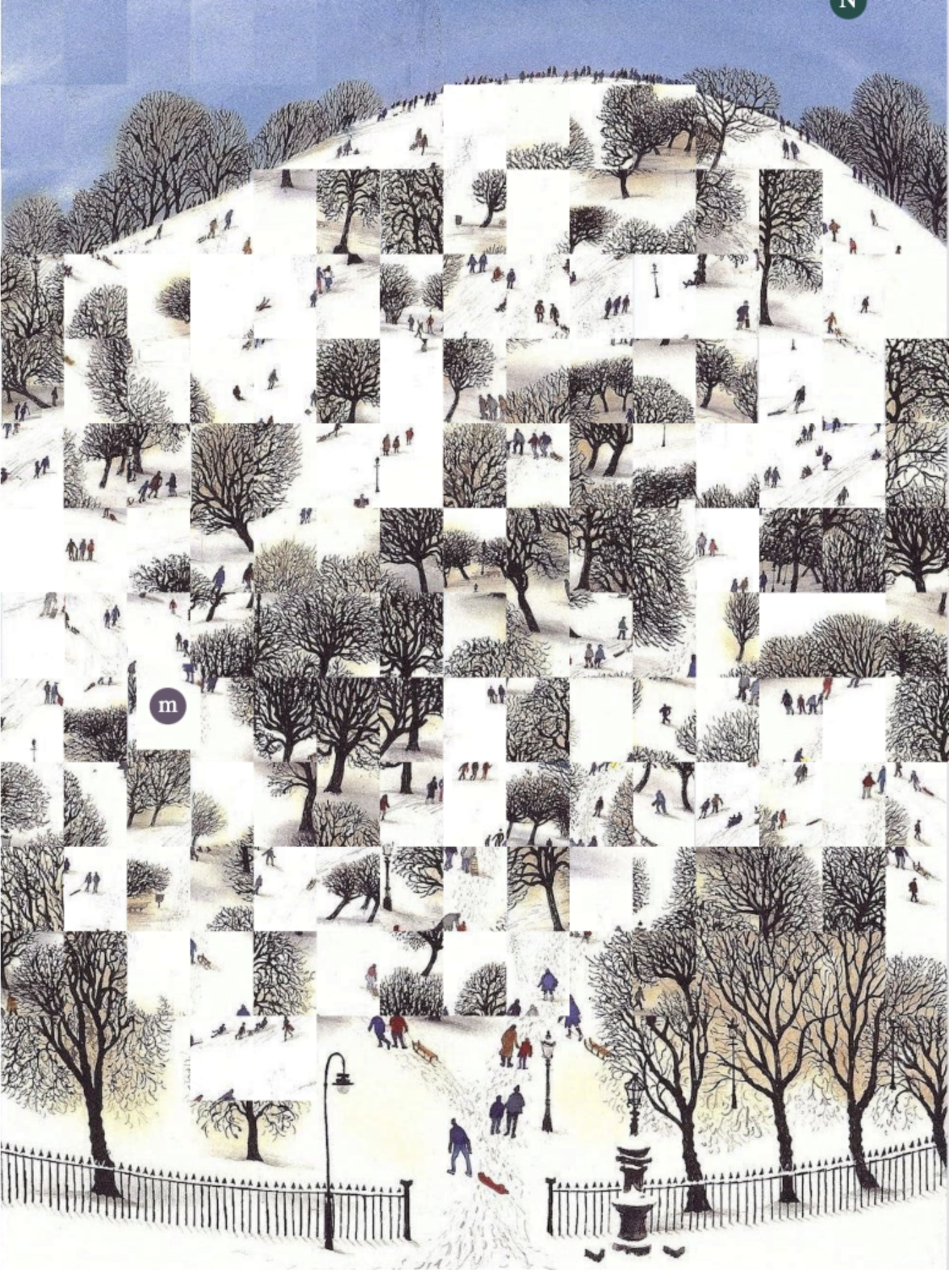
but the bit that's even more interesting (and relevant to this post) is that we're doing jigsaws of paintings, and the paintings are not designed to be jigsaws. it's great to look closely, to think about the texture of the chunks, to think about brush strokes. opening a new one and groaning at how brown it is. but then when the composition is completed, marvelling at how awash with colour it is, the macro structure absolutely informing the colour structure. thinking about planes and perspective and meaning, and all of this feeding into the puzzle solving while also not being designed to do so.
and the metagame of choosing pictures that would make good puzzles. or terrible, annoying puzzles, that too (still remembering Goldie picking that picture with disjointed tiles and then getting the splitlines just right so that they matched).
the game as a way of looking at a painting, not the painting as a way of finding cheap content for the game.
a half completed version of David Gentleman's painting, "Primrose Hill under snow"
Untitled Goose Game
And since Nico & a bunch of the other people who play jigsaw game are the devs of Untitled Goose Game, it feels natural to mention it here. they did a whole talk about how the level design for UGG came out of doing location scouting - finding real locations and repurposing them for the game. finding details that would be extraneous if you were designing from scratch but... help give it an air of authenticity and specificity when pulled from a real place
(there's also a lot of interesting stuff about the relationship between Australia and the image they have of England, and of using references from the other side of the world)
but also it's fascinating, having played the game, to go visit the locations in real life and recognise bits. that path to the corner shop, that weird metal thing on either side of the door, the actually very nice fish restaurant that isn't in the game but you can see where it might be.
found videogames
we never actually finished it, but a good number of years ago i was working with some friends on a zine about the idea of "found videogames", the idea that the formal properties of a videogame, something like:
has electronics
has input and output and a relationship between the two
has a sense of challenge
affords "play"
is something that does not need to be created as a videogame, but is instead a set of properties that can be found within the world in many systems, which can then be viewed as a game. and so the idea was that we would create an imaginary catalog for a impossible exhibition of these games. one of my favourites was "using a subway system in an unfamiliar city". it has feedback loops, it has electronics, it has a system to engage with and gradually come to master. it does potentially have the lack of optionality, the unavoidable stakes, the ability to quit, that is possibly characteristic of games... but still, an interesting frame to see.
in this case, we are not just repurposing geography or architecture or an image as content for a designed system, but instead adopting a system wholesale and instead imposing a particular frame upon it.
some others
I don't have much to say about these right now, but I feel like I should include them: - Geoguessr - Audiosurf - Scrabble - most folk games - football (soccer) (by which I mean, how big is the pitch?) - mods which recreate existing places within game engines - gambling on horse races
in conclusion
i don't know that i have a conclusion. it's something i've been thinking about, it's something that applies to a lot of the things i've been recently working on professionally (but can't talk about). most of my work within games has been on games which have one step into the "real world" - whether that is using map data or responding to social contexts or the hard constraints of making physical components. the examples i've pulled from generally sit more within a traditional game framework, but still pull in the world within them, with all the texture and rich context that provides. maybe i just like noticing things, and this is a technique that gives me more things to notice!
comments
there's not a proper comments section on here, but let me link some stuff people have said:
Ooh I like this! It's the same thing that I've liked about hacking around and glitching classic games. You come up against obstacles and devise strategies that nobody ever intended. They just naturally occur in a system designed for something else.
which in turn makes me think of plunderludics - this stuff is kind of the opposite of what i've talked about here, using the found texture of videogame as raw material for... sometimes more game, sometimes something else
It often makes me think of rock-climbing. There's lots of rock faces that are really interesting to climb. Nobody designed it this way - it's just erosion. You have to figure out the solution, for your specific body, from first principles.
This is the kind of thinking behind why I like making the Magic Box.
The way I like to hack games is to create situations nobody could have seen coming - naturally-occurring challenges within the game.
That way any solution/strategy belongs to you because nobody even knows if it's solvable.
"the game as a way of looking at a painting, not the painting as a way of finding cheap content for the game." <3 I love this: game structure as a way of inviting attention (I guess this is also "school")
(Marie is the "m" you can see, busy assembling the painting)
Was actually just thinking how Google Sheets Parties are kinda like these found/emergent games since we just did a couple of them with Playtest Zero, and also relations between TTRPGs, LARP and folk games.
step 1 is not to start writing a blog post instead. but let's ignore that part for now.
step 2 is to do nothing. just sit. no, sitting is too active, lie down if you can. close your eyes. do nothing.
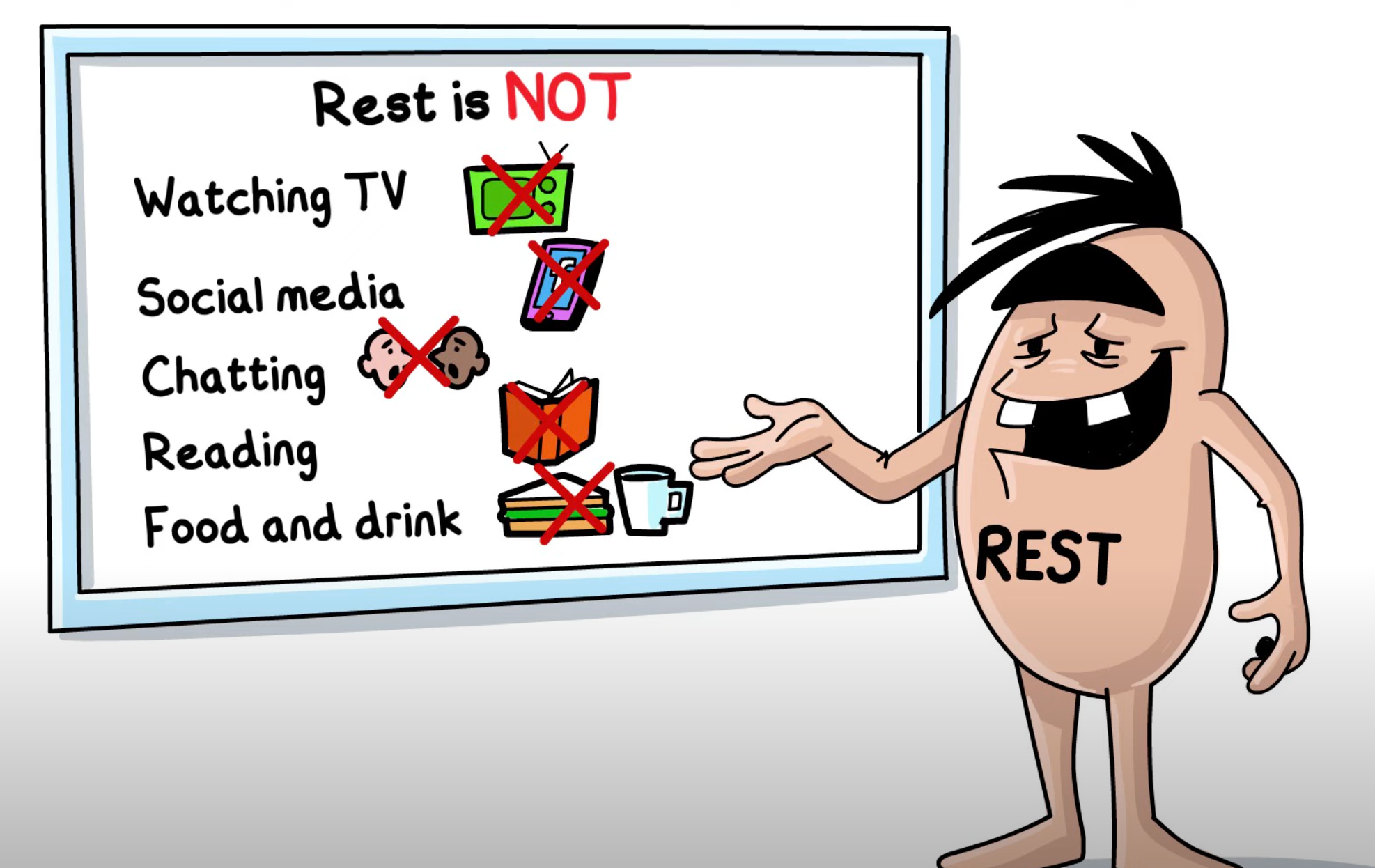
step 3 is: that's boring isn't it? i find i immediately get agitated. but agitation is one of the things that is the opposite of rest - rest is not exerting yourself either physically, mentally OR emotionally. so
step 4 is: try that again, knowing that it's useful to do even if it's boring and even if it's confronting. you're not meditating, it's fine for thoughts to wander through your head, but try not to solve anything. if you're reading this then you probably do really need to do some resting, so: this is more important than the worrying you have to do.
step 5 is: okay this is still difficult. so let's set a timer. 15 minutes. it's a game now, can you lie there and not do anything, not try to solve anything, for fifteen minutes. if you fall asleep then that's fine - but it's also not the goal here. it's like having insomnia and lying there, knowing that you won't get some sleep but trying to gain the benefit from some quiet lying down anyway.
step 6 is that your housemate starts making some noise and you try to ignore it because the timer hasn't went off yet. you can hear the plane outside. this would be easier if it was warm and you were in a hammock. a bunch of time has passed, i wonder how much. i think i'm doing it!
step 7 is more of the same. worrying is also exertion, so try not to worry that you're doing this wrong.
step 8 is that your timer goes off and wow! you did it! you rested!
step 9 is that you probably need to do this again soon
step 10 is: i guess i should rework my attitude to this, try to make this necessary thing not something i actively dislike. better to enjoy it if it's necessary. better to do it sooner rather than waste a lot of time failing to do it but also not doing anything enjoyable either.
for more information on resting, please see this video:
In case you don't know, Downpour is the game creation tool I have been working on for the past few years. I started it after I left Niantic in October 2022, and I have been working on it ever since then (with breaks for illness and freelance work and going on trips and so on). I am proud of it. I hope people make good things with it! And also, of course, I hope they subscribe and make this retrospectively not a kinda dumb financial decision. But also I very sincerely hope they make good things that they wouldn't've made otherwise.
The aim when I started working on Downpour was to make a tool that makes making an interactive game-like thing quicker and easier than any other. There's a lot of parts that go into that, but this, and a secondary goal of making it expressive, remained my north star throughout development. Here's some examples:
The simplest kind of game is one where you just make choices. So that's what Downpour gives you - just choices. Lots of other stuff can be added in a kind of hacky way on top of that.
What are the choices made of? Well, you can write text, of course. But also we want to be expressive, so let's also allow pictures. Where do the pictures come from? Let's let people draw on paper and get them into the game. That's the quickest easiest way to make a mark. Or they can take pictures of other things, and use those. Or they can draw using some software, or they can import images they find online. Any of those things.
It's an obstacle to fire up your computer, and maybe you don't have one. So let's make this a thing you can use on your phone. And as a bonus, it has a camera built in and easy to point at things you're looking at (laptops have cameras too but they face the wrong direction).
Some people have iPhones, some people have Android phones. We want this to work on both, so let's make this cross-platform.
And we want this to be fast to start up. So when I was looking for a framework to make this in, I tested how quickly various tools took to start. Unity was very slow, React Native also pretty slow. Native obviously had the capacity to be fastest, but it would have meant making it twice. But Flutter was cross-platform and also pretty quick! I just tested launching Downpour on my phone and it starts in under a second. Happy with that.
Endless bits of UI design, thinking through how to edit an infinite canvas on a phone, trying to make it so you can do all the common things holding the phone one handed (important tip is to put stuff at the bottom of the screen). And also looking enviously at computer software like tldraw where they get to use hover states and right clicks.
A tutorial, to teach you how to use all this UI.
There's also a psychological angle to all this. What stops you from making a game? Maybe it's that it's hard to come up with an idea, hard to get started. So let's also bundle in some games that are unfinished, that you can open up and see how they're made and just mess with or add a single thing to. Much less intimidating than coming up with a whole game by yourself. (This is actually an area I should do more work on)
When you think about the process of making a game, it's important to consider the whole thing. Which means making a game also includes sharing that game. When I started, people would ask - so you can put these games on itch.io? And you can put Downpour games on itch.io - but uploading a game to itch.io means filling out a long form and maybe even picking some colours. It's a lot of fuss, it takes at least a few minutes to do. A good choice for them, as they focus on games that have taken days, weeks, years to make - but we're focusing on games that have been made in minutes or hours. So instead, there's a button inside Downpour, and when you press it, the game is uploaded onto a server where anyone can play it. That button took a long time to make - it needed a server, and hosting for images, and an account system, and conflict resolution, and DDOS protection and...
But also having to make an account slows people down, and makes the tool more fragile. So let's let people make games without needing an account - just if they want to use the upload button.
On the other hand, you want people to play the game you've made, that's also part of making it (and of getting the motivation to make it). So other people should be able to play your games inside the app, and follow you so they can get a push notification when you've added or updated a game (they need an account for this bit, too)
Of course, most people won't have the app, and you want lots of people to play your games. The best way to let anyone play it is to make the games playable in a web-browser. Which seems pretty possible - we're just displaying images, text and links after all, and browsers are pretty good at those things. So there's a second version of the code that can play games, made in HTML and Javascript. The end result is that when you upload you get a little link you can share, and people can click on it to play your game.
Looking over at Bitsy, I can see a nice little opportunity for expressiveness here - there is a thriving community of hacks for Bitsy, things that take the HTML that Bitsy produces and extends that. So there's also an export button that downloads your game and the webpage that plays it. And let's open source that browser code, and make it so it's separated from the game data so it's easy to change one part or the other separately. Then if people want to add weird new features to their Downpour game, they can do that without being dependent on me. Or they could modify the game data and upload it back into the app!
I've joked through development that it's not been an especially fun or creative process, and while that's mainly a joke – there's plenty of fun problems I've faced along the way – it's also true that the bulk of it has been trying to take on the tedious work so that other people can make games without thinking about it. Making a Downpour style game without Downpour would be pretty easy for people with reasonable technical chops. But it would involve a lot of faff and a lot of figuring out and it would almost certainly involve a computer and firing up an image editor and thinking about web hosting... It would not be worth all that to make a game that is a single stupid joke. And I like games that are single stupid jokes, and so I guess I have spent a few years in the hopes that I can let more people make more of them.
So if you want to make a game - a quick game, maybe it's a joke or maybe it's a poem or maybe it's something else - Downpour comes out today. I think it's probably the quickest, easiest way to make a game from end to end. Here's some links for you:
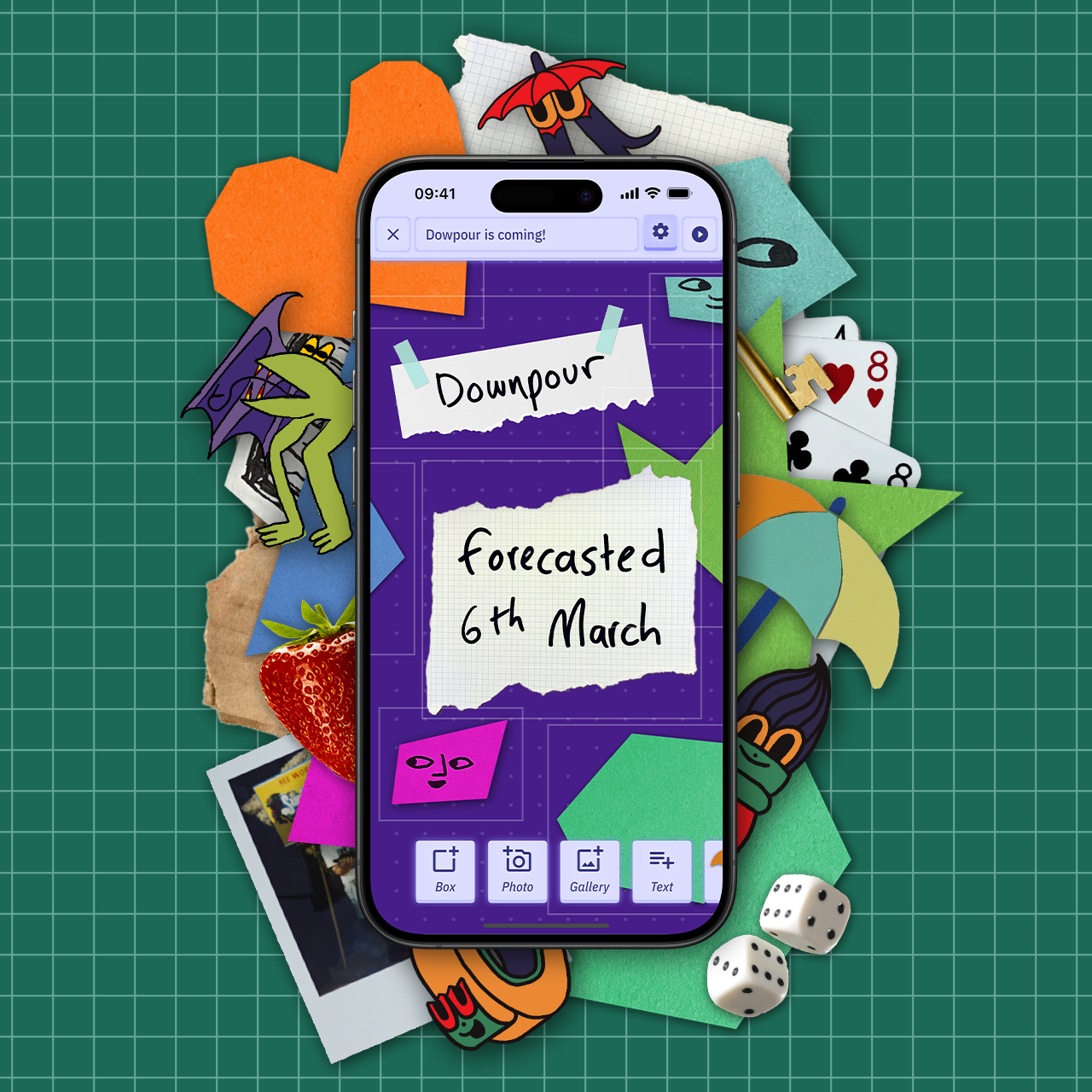
I am delighted to announce that Downpour, the game making app I've been working on for the last few years, is coming out on Android and iOS on March 6th!
So what is Downpour? It's a tool for making videogames and websites and other kinds of collage-y hypertext-y things. Think Instagram Stories but you can easily link to other stories and they don't disappear after 24 hours. Or, if you're coming from indie games, think Twine except it works on your phone and it's way easier to make images work in.
And the other half of Downpour is that it's also a platform for hosting these games. Because what's the use of making it easy to make games if it's still a pain to actually share them? So instead, if you've got an account, you can just press the Upload button and it'll upload to my server. And then you can share the link, and anyone can see it by going to that URL in their browser.
I've been working on this for a while now, and as a result I would quite like to make some money from it. So there are also subscriptions within it. The main appeal of these, to be completely honest, is that you want me to keep working on the tool and keep the platform alive. But also they gate access to adding hyperlinks to places not on the Downpour platform (because I'm worried about moderating spam) and they also gate access to how many images you can upload in a month (because I'm worried about hosting costs). We'll see how this plays out - I'm hopeful that I will be able to dedicate serious time after the release to working on it and improving it. But that's always the exciting/scary part of releasing.
Anyway, yeah - it's coming out soon. I've put some shiny new screenshots on the website. I'm gonna be yelling about it loads more over the next month or so. If you're press (or, to be quite honest, just friends with me) then please do reach out and I can give you early access. It's happening!
This is a talk given at the Pervasive Media Studio for their lunchtime talks series. It is therefore written to be read. You can also watch the recording of the talk if you like - it takes the rough form of this post, but I think I landed a joke or two more than are on the page.
Hello, hi, I'm v buckenham, I'm an artist & game designer, and general person who uses the internet and thinks about the internet a lot. I make a lot of software tools that let people make other things, and I think a lot about how people interact online. As a plug for later, I'm currently making a game making tool called Downpour, which is super cool & you can playtest if you stick around for First Fridays later on.
But that's not what I'm here to talk about today.
I'm here to talk about how to get the carrot cake from Otis in The Secret of Monkey Island.
So, it's 1991 and you're playing The Secret of Monkey Island. It's a game about walking around and clicking on things and hearing funny dialogue and trying to solve puzzles by combining various objects. It's a pretty cool game! It's very funny. But the puzzles are... sometimes obtuse. So you're stuck, and this is a time before you have an internet connection. So what do you do?
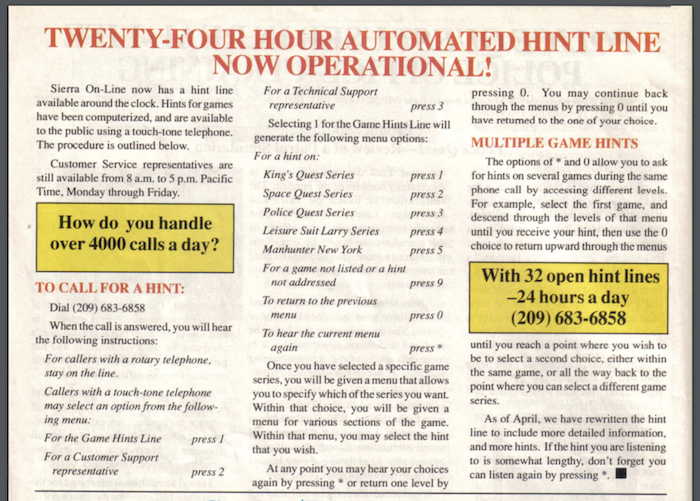
Well, if you were in the US, you might call a hint line! You ask for your parent's permission (because it's expensive), and you dial the special number, and then you either talk to a real person on the other end, or else you go through a little phone tree. And then it tells you to give him the gopher repellent to get past.
So this talk was billed about being about AI. I'm gonna get to that in a bit. But I'm using games as a framing device for this kind of history of how people could find out information as the internet has progressed. And how that information came to exist in the first place. Just keep that in mind that when I am talking about the gopher repellent, maybe I'm actually talking about, like, identifying a bird. And when I talk about the hint line, maybe I actually mean buying a strategy guide, an encylopedia, a telephone directory, talking to a librarian or putting an ad in the local paper.
So, in this example, we don't yet have the internet. But information still exists! People know how to get past this puzzle. And if you didn't know this information, if you couldn't figure it out yourself, then what could you do? You could ask a friend. If you knew someone who knew this information, then they would probably tell you. And they would do this because people like to be helpful. If we wanted to get reductive about it it's because providing small bits of assistance to other people is a way that people bond and form social relationships with each other. And forming social relationships is a thing that people love to do. It makes people feel good, and it means when they get stuck later on maybe you'd help. Reciprocity.
But maybe the person who knows how to get past doesn't want to tell you, maybe this is a playground power games thing and they wanna keep this knowledge secret to exercise some power or because they think it's funny to watch you struggle, or because you didn't tell them how to beat a different game. Or you just don't know anyone else with this game.
Well, then you could phone up the hint line or buy a guide to the game down in WH Smiths or write in to a magazine. And these ways will answer your question, and they will do so for a fundamentally economic reason. They want you to give them money, and in exchange they will provide a service to you. Even if the hint line was free, then it would be run by the games company, and they'd do that so that you're more likely to buy their next game.
Okay! So. The Internet. Or "the World Wide Web".
The founding of the Internet is a complicated story and honestly we don't really need to get into it. Even the distinction between the web and the internet is kind of complicated. To summarise, let's just say that people invented websites, and they were academics, and they were the kind of people that made logos like this
I think that's beautiful. It's that impulse from before, about the kid on the playground who tells you how to get past the puzzle. Why should they want to? Because they want to help, and they want to share what they know. And this urge online is a bit more abstract, it's not just helping one specific person who you know and who you hang out with at lunch break. It's helping... anyone. Without having to know who they are. They can ask their computer to make a HTTP request to your computer and your computer will automatically respond with a document, and then they can read this document, and answer their question. Gopher remover.
And like, this is not all there is to it. The people who made the internet did not do this purely out a love of humanity, although that was definitely a factor. They did it because they were academics, and being an academic means that you are paid to share knowledge. And you are rewarded for having your knowledge used. And since the invention of the Internet, people have invented things like "impact factors" and h-index scores, which measure how often other academics use your knowledge by which we mean cited your papers in their papers. Which of course is a similar thing that has become a totally different thing since we started measuring it and rewarding people for it.
But, anyway, the academics who invented the internet did not do it to share solutions for Monkey Island. But the good thing about the internet is that you can put whatever you like on there, and pretty soon the kinds of people who like games about saying clever insults to pirates got on there, and of course they were going to help each other get past puzzles.
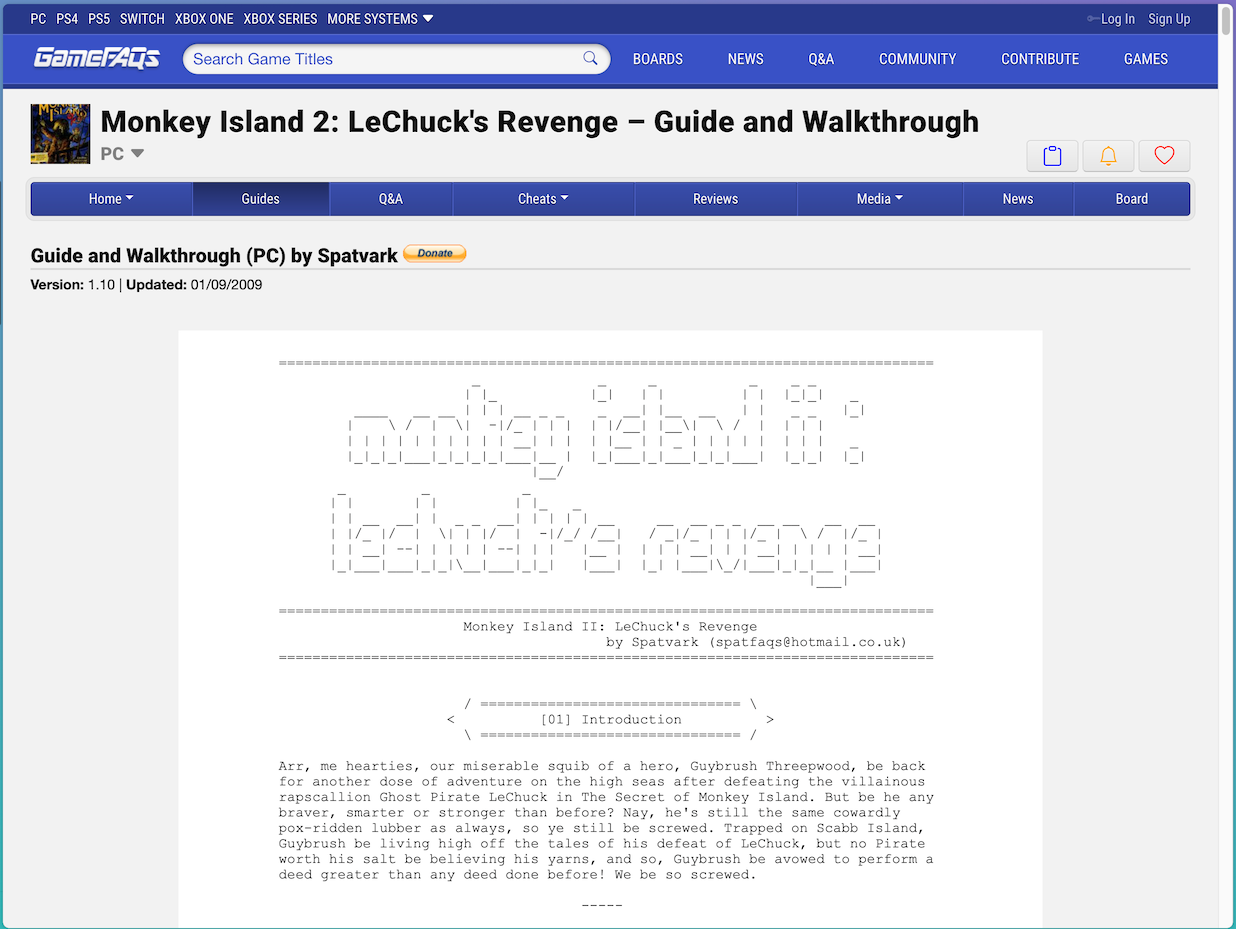
So now it's 1992, and you're playing Monkey Island 2: LeChuck's Revenge, and you got stuck on the waterfall puzzle. Then how would you get unstuck? Maybe you'd ask a friend who was also playing it, maybe in this hypothetical you are now at university and it's someone who you're in some student society with. But also, maybe you have the internet now, and so, pretty likely, you'd go onto GameFAQs and you'd look it up.
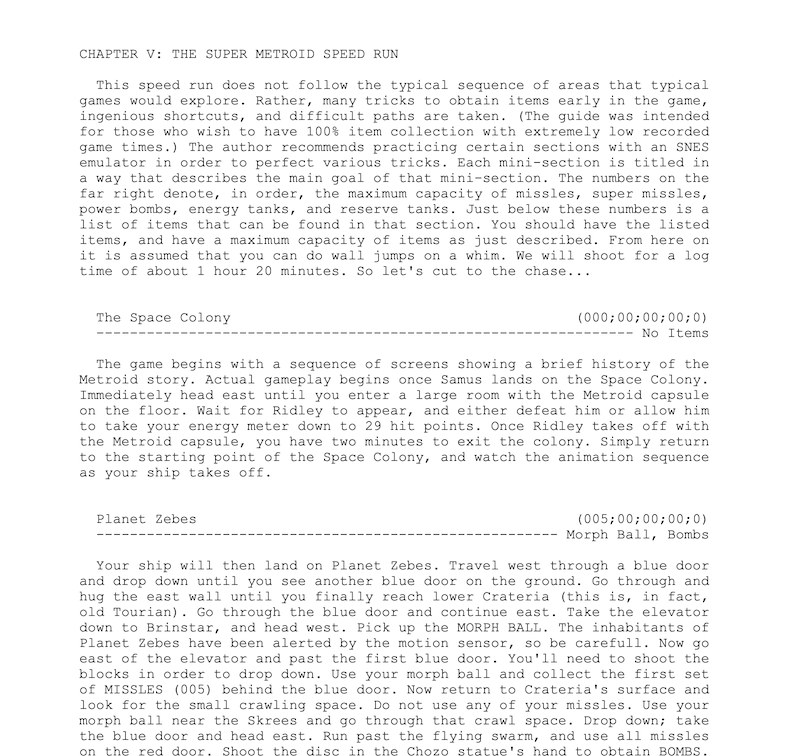
And GameFAQs is incredible. It's this huge website, full of text files, and each text file was submitted by a particular person. Giving a walkthrough for a game, or for a section, or giving advice on strategy. I love it in part because each entry so clearly shows the hand of the person who made it. Like this one
which is a fully justified monospace document. Which seems kind of boring until you realise that in writing this, he had to choose words so that each line would have exactly the same length. And also describe how to speed run Super Metroid at the same time. Incredible.
And of course, I'm gonna turn to why he did this. Because he could. Because he wanted to show off. His name is on it, thousands of people have seen this and been impressed. And that's why people wrote walkthroughs for GameFAQs. For status, to be helpful, to share their love of the game.
Now, where we are chronologically is up to the first big dot-com boom. And GameFAQs was founded by a guy called Jeff Veasey, who ran it for the first 4 years as a side project, a thing he ran as a hobby while working in tech. But it brought in some money - there was a sponsorship with IGN, a network of games sites, and after that ended there were banner ads that brought in some money. And it kept growing, and in 1999 it became his full time job.
Which... good for him! He's performing a valuable service, and he's getting paid to do it. Other people are doing the work of writing the walkthroughs, but he's doing the work of keeping the servers on, doing moderation, upgrading the code, generally all the maintenance work that is needed to keep a machine constantly working. The internet is a place, but it is also a process, a set of responses that happen to particular signals, and he was keeping that going.
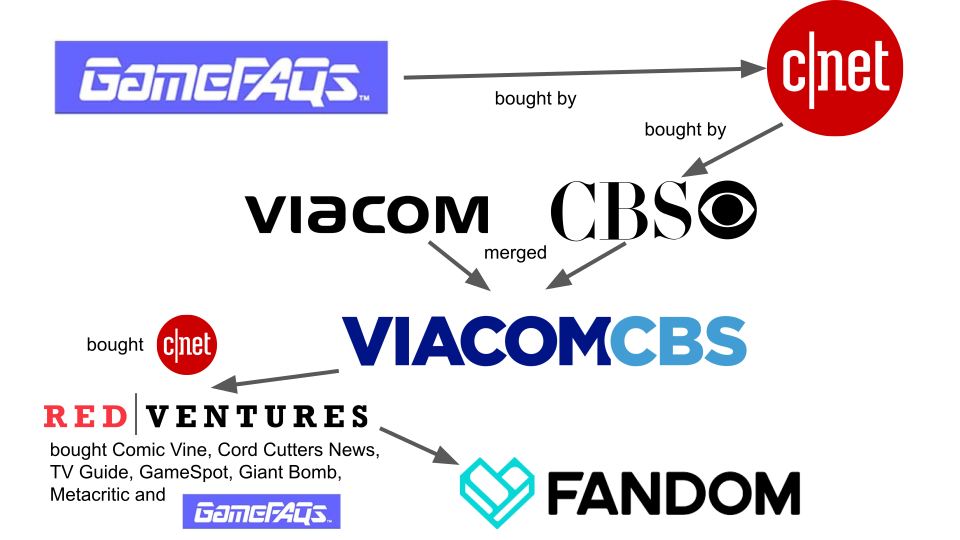
And now for the bit of the talk that is just a confusing barrage of corporate acquisitions. So, GameFAQs was bought by CNET in 2003. In 2007, Jeff Veasey left the site. CNET was bought by CBS in 2008. Nothing happened for a while. And then in 2019, CBS and Viacom merged to form ViacomCBS (which is now known as Paramount Global, and which owns Paramount Pictures). And then in December 2020 Red Ventures bought all the CNET properties from ViacomCBS, including GameFAQs. And then finally on October 3, 2022 Fandom acquired a bunch of websites from Red Ventures, including Metacritic, GameSpot, and of course GameFAQs.
And I should say that throughout all of this, GameFAQs has trundled on, less and less central in terms of videogame info, but keeping a committed core of users who liked to hang out in the message boards. Once a community gets going somewhere, people will hang on, making the space their own through all kinds of neglect and disuse. What are they supposed to do, go somewhere else and lose the community that has been a part of their lives for years?
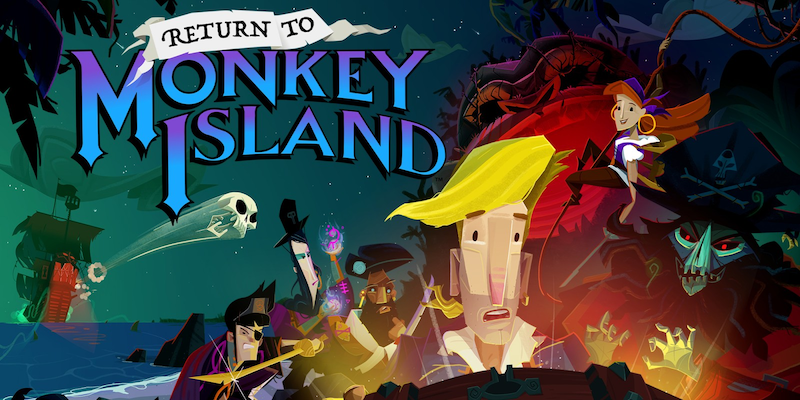
Okay, so we're up to last autumn, and... what do you know, there's a new Monkey Island game!
Now, I should say that, in accordance with modern design sensibilities, the puzzles are less obtuse and there's an in-game hint system. But nevertheless, let's say you want to find out how to get past a bit of it. Where would you look today?
I can think of a few answers.
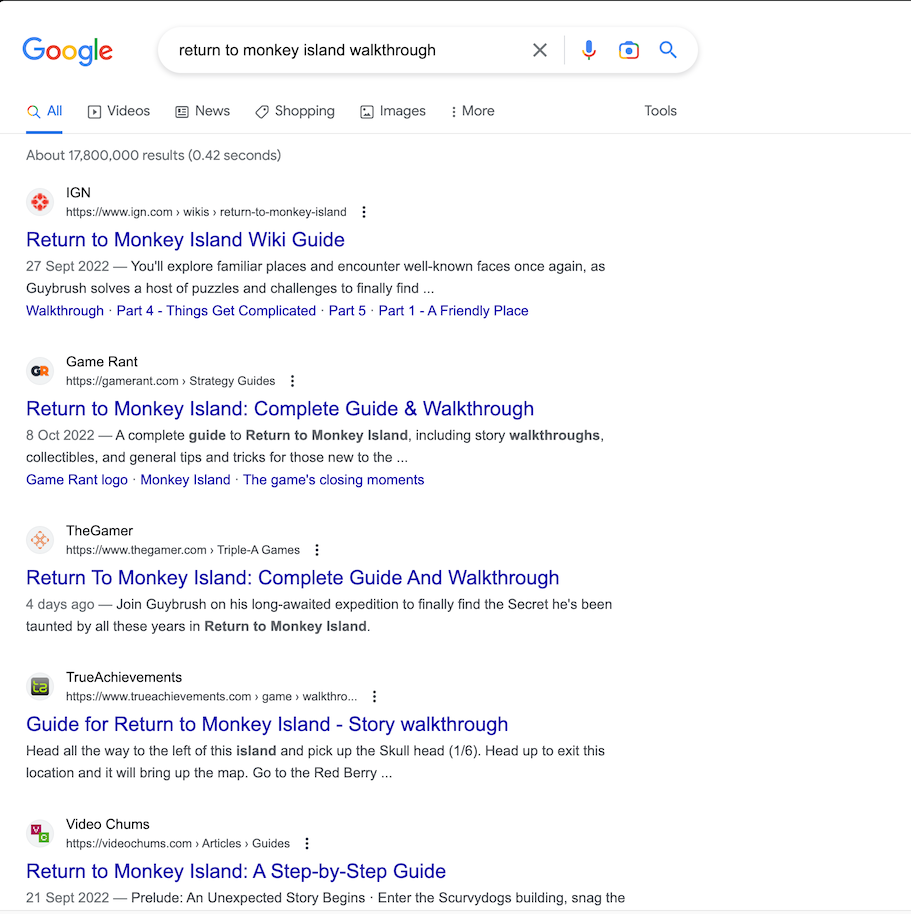
If you google it, you can find several websites that work in much the same way that GameFAQs did. Including our old friend IGN, which has survived through all these years.
For games websites, which are businesses, a large proportion of their traffic is stuff that comes through search. So, SEO, search engine optimisation, is important. Making sure you have the right keywords, trying to get backlinks, that's a big thing. And just building out content that fits the stuff people are searching for. So most videogame news sites now have dedicated guides writers - people search for it, so they provide it. It's basically the worst paid job of a badly paid industry, with the least focus on the writing quality/judgement.
And games websites are competing with companies like Fandom, who started out as "Wikicities", set up by this guy:
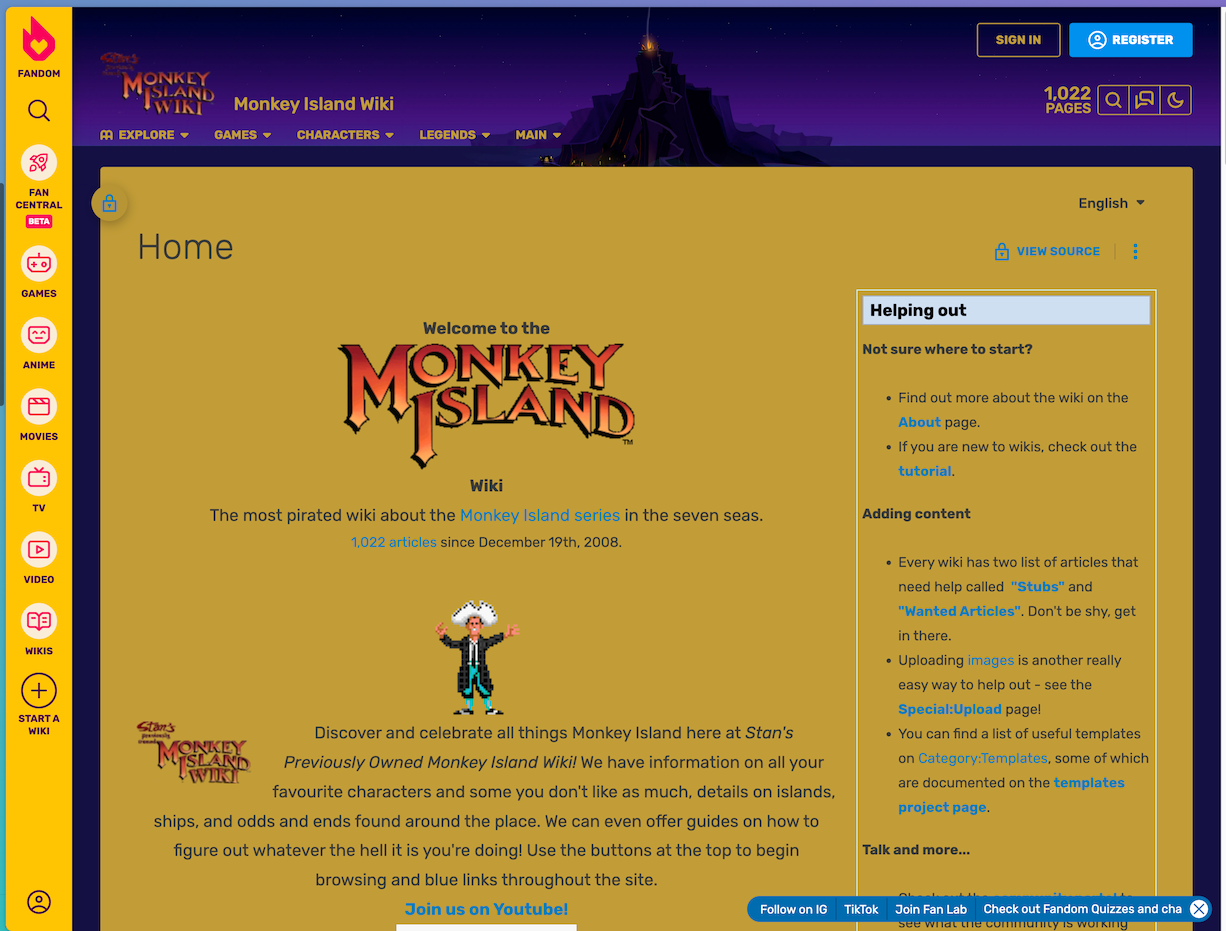
And Fandom has a wiki for Monkey Island!
Fandom runs many many wikis for different properties. And they're pretty garbage, by all accounts? It is hard to move a community at the best of times, and they actively resist moderators who attempt to move their communities away - taking over the wikis that are run there to remove any reference to the community moving. And they're good at SEO, so they stay on the top page of the results. For video game communities like Super Mario, there is an ongoing tug of war between the community run wiki and the Fandom wiki.
And to look at why these sites exist - for Fandom, the company, it's straightforward business. They gain money from the advertising on these pages, and they gain market value due to having higher traffic from many users. For people who actually write the wikis - they do it because they are in a community with other people, and they want to support that community. They want to share what they know, they want to support other people who are into the same weird thing they're into.
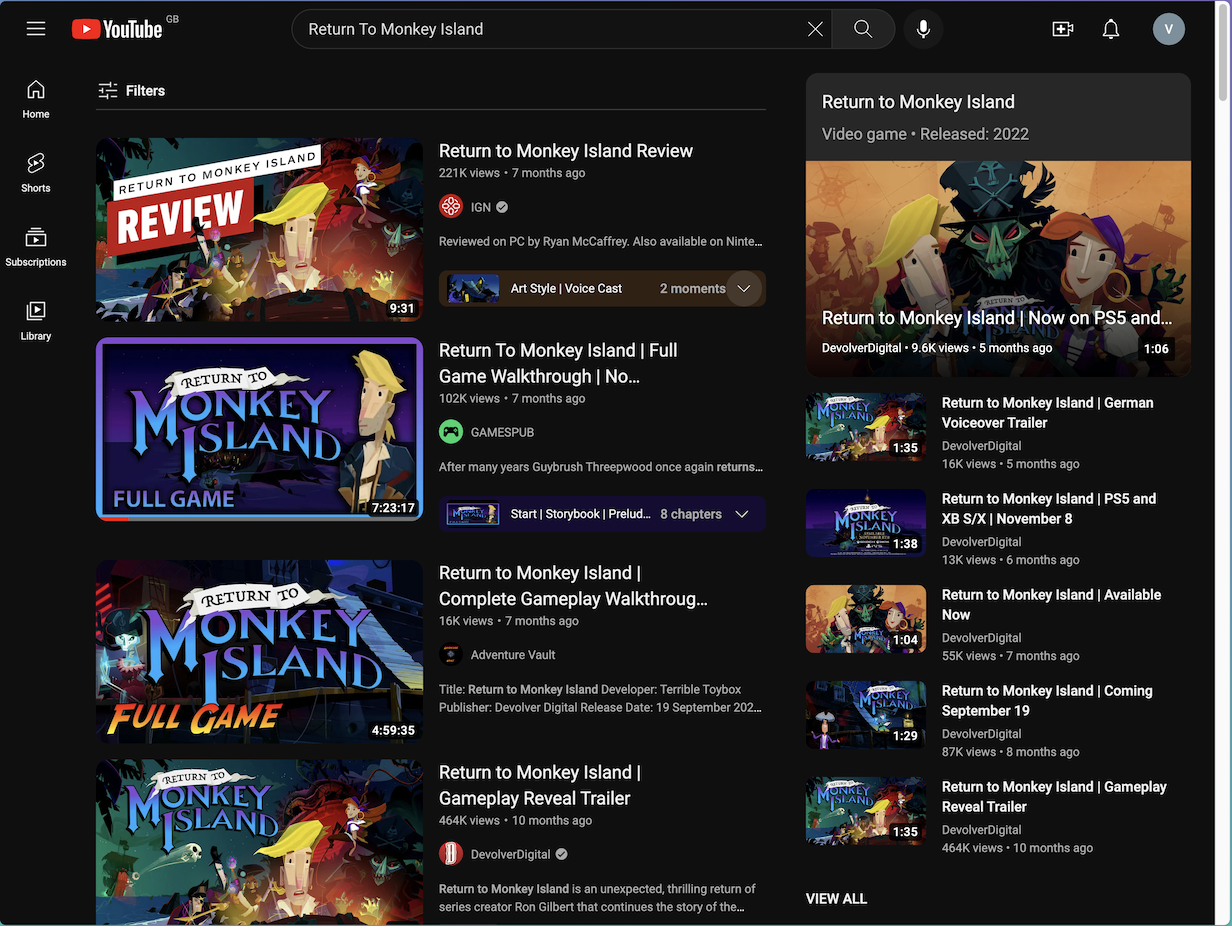
Okay, so, other ways you might find out how to solve a puzzle in Monkey Island these days. Youtube! You can go onto YouTube and find a video walking through the whole game. You can find lots of videos of people playing games on YouTube. Did you know!
It's pretty straightforward to understand why YouTube operates - they're a crucial part of Google's ad empire, which makes them a very large amount of money. Enough money they can pay the pretty considerable cost of storing and serving all those videos - I tried looking up how much storage space it takes up, and there's no real consensus, but... exabytes? ie billions of gigabytes? multiple of those.
And people who put videos on YouTube, why do they do that? Well, it's wanting to be helpful. And it's a desire for fame, or at least recognition. It feels good to have "numbers", by which I mean an indication that people have seen a thing you have done and an indication they approved. And YouTube pays money. Usually small amounts of money, but enough that I know people who make a living that way. And even if YouTube itself doesn't give you enough money to live on, getting popular on YouTube, being known - that leads to other ways of making money, like a Patreon, or commercial sponsorships for videos. But really the money is less in providing a useful service, like putting out a video showing how to beat a game, and more in providing a simulacrum of that sense of community that people like. Viewers watch at home, by themselves, but they feel like they are with someone charming and friendly and it gives them a sense of being with a friend. The term for this is "parasocial relationships", and it's really where the money is in terms of making "content" online.
And the third way you might find out how to get past a puzzle in the new Monkey Island is... you'd ask someone. And nowadays if you want to find someone who has particular knowledge, you don't have to hope to bump into them on the school playground, you can find them online. And so you can go to the Monkey Island Discord and you can ask someone for a hint
And again, why would they give you that hint. Well, it's for the same reasons we've discussed. People want that sense of community, and Discord is the place to get it. Why contribute to a wiki that's full of ads and annoying to use and makes a big company rich? Why buy a load of video gear and learn how to edit videos? If you wanna share what you know and in return receive a sense of community, it's best to do that in a small space that's hard for someone to insert capitalism into. Where you can form actual two way relationships.
And of course Discord is still a corporation and has it's own incentives - news announced this week of how they were changing usernames has been generally taken as a sign that they are moving towards being a more open platform where communities will be a bit more exposed to the light.
But this is a shift you can see across more than just games communities. In the world of social media, there is a general shift away from public-focused platforms like Twitter and Instagram and towards smaller communities built on mutual trust. In many ways I think this is a shame - there's a lot of power in having information somewhere where anyone can see it, where what you know isn't predicated on who you know. When it comes to information about how to get work, how to access things important for people's lives, making connections...
Okay! So that was last year. And now finally!! Let's talk about AI. We're in the future now!!!
So, you might have heard, but in the last decade or so, AI has been having a real resurgence. The computers have gotten big enough for neural net techniques to be applied on a large scale. And the Internet has provided the vast quantities of data that they need to be trained on. There's a bunch of different models out there, but I'm gonna focus on a type called "Large Language Models".
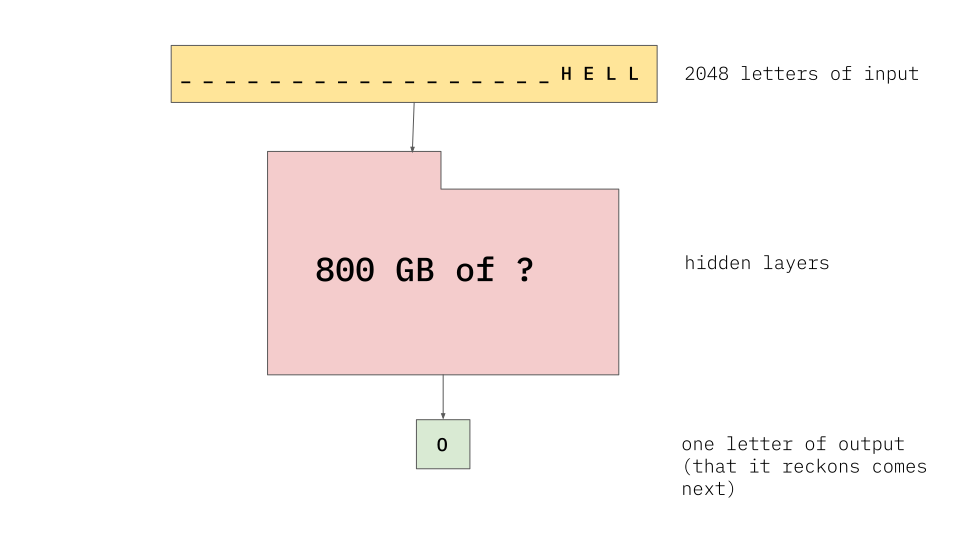
How do they work? Well, GPT works something like this:
These are basically a machine that is trained to guess the next letter in a sequence of letters. If given the sequence of letters H-E-L-L it'll probably guess "O". Or maybe a space. And the way you train them is that you give them some text, and you look at what it thinks is likely to come next, and you tweak the machine to make the thing that actually does come next very slightly more likely. And you keep doing this, repeatedly, with all the text you can find, until it is very good at it.
2048 letters of input, 800 gigabytes of connections ("hidden layers"), and one letter of output. It's honestly not that important how that middle bit works for our purposes - just connections with various strengths that end up producing the right answer, and that, if they give the wrong answer, the people training it can tweak them until they do produce the right answer.
And of course computer scientists have sweated over it a lot. How to structure that middle bit, how to turn "letters" into "math", how to tweak the structure to train it, how to structure the training data, how to make the whole thing run just about fast enough & just about cheaply enough to be practical. And the interesting thing about a lot of these answers is that often the decisions are based on trying things and seeing how well they work rather than any kind of, like, really solid theory on why a particular thing is a good idea.
And of course, once you've trained it, no-one knows where the information inside it is. It's just... 800 gigabytes of "model", there's no part of it you can point to and say "here's where it contains the word hello".
Anyway, that's the machine, it's a thing that guesses the next letter. And the thing about having a machine that is really good at guessing the next letter is that you can run it repeatedly to produce longer and longer strings of text. And if it's really good at guessing the next letter, then those strings of text will look like text that people have written. So if you start a bit of text with "If a pirate says "I got this scar on my face during a mighty struggle!", the correct reply is" then it might know that could continue with something like "I hope now you've learned to stop picking your nose.". Somewhere in that big letter-guessing machine it encoded information about Monkey Island! We dunno where or how, but it needed to learn that to get good at guessing the next letter, so it did. I think it's important to break this down a little like this, because so often people use the words "think" or "know" or "understand" and they're useful shorthands, but they're also kind of misleading when trying to understand what's actually happening. The same as whenever someone says that evolution "likes" or "wants" something. There's no desire here, there's just... fitting better to the task.
But at the same time, it's pretty extraordinary how effective this machine, that is just trained to predict the next letter, how good it is at a whole range of things. Like, we've talked a bit about how it might tell you the right answer for an insult swordfighting puzzle, but it has internalised a lot more stuff than that. I asked one about me, and it knew some facts, which is kind of wild to me. And it's not just regurgitating facts - it can obviously generate stories, poems, copy, text of all kinds. And you can also ask it to write code for you - it has digested enough code and enough tutorials that it can generate explanations of what's going on with it or write new code given questions about what's needed (assuming, in my experience, if it's seen code like that before). And you can get even more out of it by asking it to talk to itself, explain what it's doing to itself - that gives it a short term memory, and allows it to start planning things. Or if you tell it a format for interacting with the world - it will do those things, and use the information it gets back as prompts to write more.
But again. It doesn't think. It doesn't learn. It doesn't have a memory. It's just fundamentally the probability of the next letter.
(And if you're wondering what the difference is between GPT and ChatGPT, it's that ChatGPT has been finetuned (trained a bit more) to be better at completing text that's shaped a bit more like a dialogue. People aren't used to asking questions of a machine by writing the first bit of the answer and then waiting for the machine to fill in the rest of it - they prefer just asking the question and getting a response.)
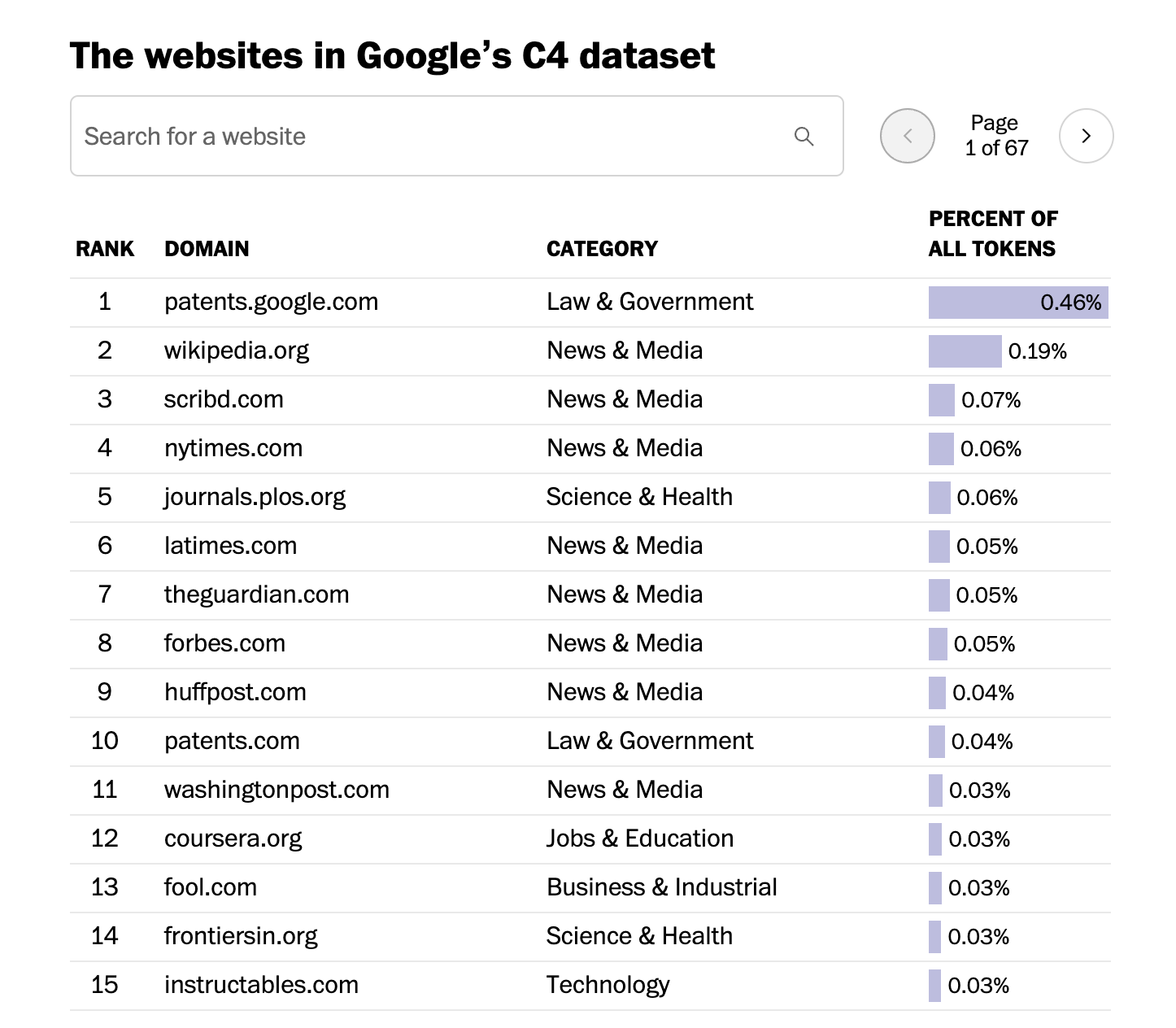
Anyway. For all this to work, we need to train the AI on a lot of text. The more text it sees, the better it gets at picking the next letter. So the companies that make these, like OpenAI and Google and Facebook, they feed it all the text they can get their hands on.
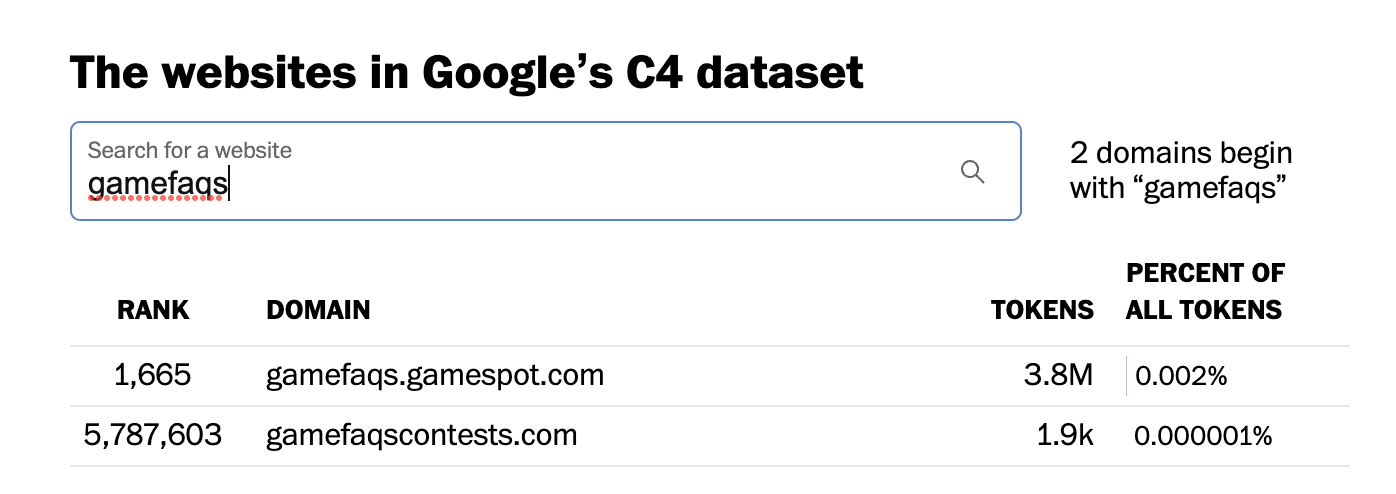
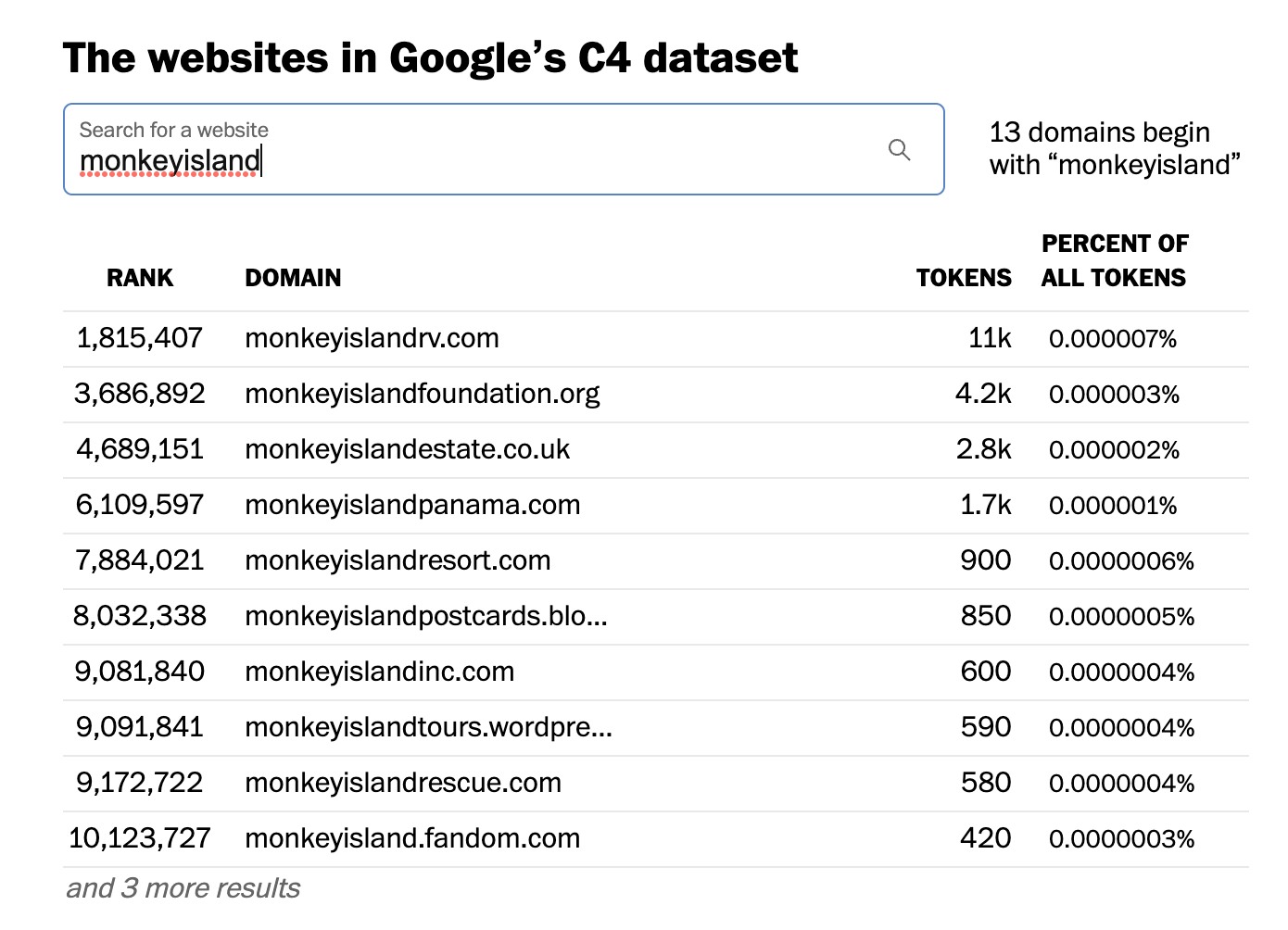
Which in this case means... pretty much everything I've discussed so far this talk. GameFAQs is in there, all the wikis are in there,
So we can see, like 3.8 million words from GameFAQs in one common training set.
And 420 words from the Fandom Monkey Island wiki.
So. To return to our Monkey Island example, when the next game comes out (and I should note that as far as I'm aware, they're not planning on making another one), and we get stuck, and we decide to ask the computer how to get past the puzzle. And we type the question into a next generation search engine that is actually just a large language model. What answer do we get? And where does it come from?
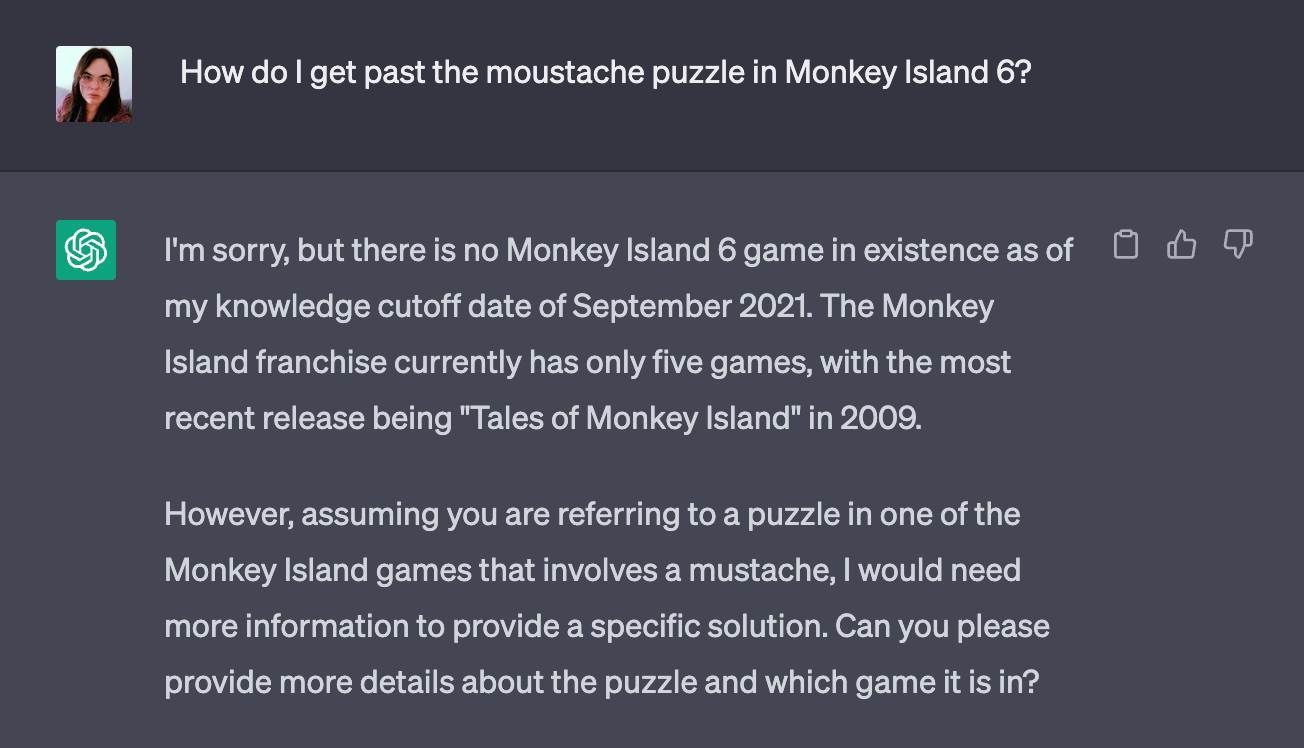
Well, maybe it'll be helpful. Or maybe... it'll just hallucinate something. And at this point in writing the talk, I tried to prompt ChatGPT to make some nonsense for me, and
It didn't fall for it. Annoying.
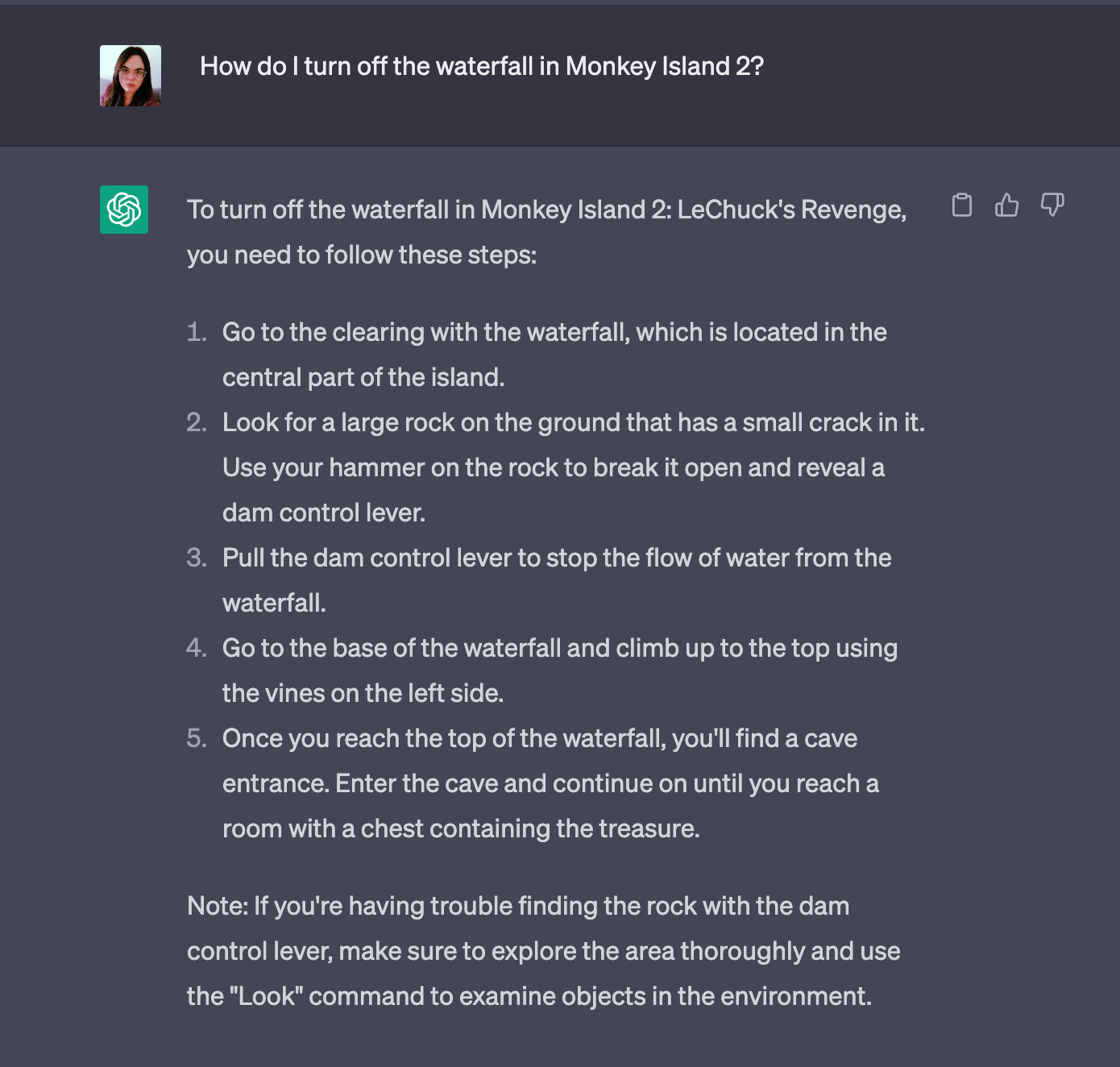
But then I tried the puzzle from before
and it happily made something up for me.
So yeah, this is actually pretty reasonable as an outcome, it "knows" what an adventure game is, and it "knows" what kind of format the answer would come in, but the actual answer is not encoded in those 800 gigabytes.
But we're setting this hypothetical in the future, not in the present. And maybe the model has gotten better. Bigger, more reliable. And, if it has read the answer somewhere online, then it can actually pick up the answer. Or maybe it has been fused with a traditional search engine, so it can look things up itself, "understand" what it reads and then return the answer to you. This is a technique many of the search engines are actually using these days, which helps with the bullshit problem, and also means it can answer questions that relate to stuff that's happened since the model was trained.
But here's where I think things get a bit screwy - the question then becomes... why does someone write the walkthrough and publish it online? There's already this shift from publishing information openly and without expecting reciprocity. And towards either a really corporate model, where you're really trying to extract money from it. Or towards a much smaller group, where you're talking within small groups of trusted friends. And neither of these groups has much incentive to write up stuff that can train AI models.
For the groups of friends on Discord, or even studios running community groups... these communities exist because they are in relative privacy. They don't want their chats to be public - in a search engine or inside a large language model. And there's a tension here where the AI companies would love to get their hands on this data, all this rich data about how people actually talk that would make their robots work so much better. So I think there's an open question about how well the companies that provide these platforms, like Discord, will shield their users from this kind of disclosure. And there's encouraging trends here, in terms of smaller group chats, like Signal and WhatsApp moving towards end to end encryption by default. And you can see greater awareness of data rights & the harms that can come from indexing on social networks like Mastodon. Obviously that's a little skewed because it's full of nerds (and full disclosure, so I am), but I think it shows the way that people are increasingly aware of this.
But of course, the flipside to this is that we lose much of the sense of the "commons" that has characterised the Internet so far. You lose a lot of the serendipity that comes from logging on and suddenly talking to someone in another country, who maybe shares an interest in adventure games with you but is otherwise quite different. And once people are in smaller groups, then in-group norms can shift and become more accentuated from each other. If these are norms that seem kind of harmless then this is called a filter bubble and journalists wring their hands in The Atlantic about how it's happening to them. And if these are norms that seem kind of racialised or scary then it's called radicalisation, and journalists wring their hands in The Atlantic about how it's happening to other people.
Anyway, that's one motivation for writing this information up somewhere where the AI can read it gone. What about the other main motivation, profit?
For the companies like Fandom or IGN, they make their money from advertising to people who visit their websites. And, like, to state the obvious, but if a robot tells you the answer then you don't have to visit the website. It is generally a pretty terrible time right now to be working for a website that tries to make it's money from selling advertising space next to well written articles. I mean, not that it has been a good time for a good while now. But while people talk a lot about the threat caused by robots writing the articles, I can't help but think that the problem of robots reading them is worse. And the kind of friction you might imagine between the AI models & the sites they're being trained on is already starting to happen. Reddit, for example, has tried to stop AI models from training on their data (at least, without paying them).
But there are other business models out there. Remember, way back when we were using the telephone to find out answers? Those lines were often run by the companies who made the games. So there's still a reason for the people who make products to make websites. Even if people don't read it, you start writing for the robots. And you see this already, don't you, the little grey text at the bottom of the shopping page that is clearly written not for people to read but for Google's crawlers? Well, no doubt the same thing is going to happen by for telling Large Language Models specific facts about the world you want them to internalise. Is it unethical to publish a lot of fake reviews for your product if you never meant any human to look at them? Is it unethical if they're fake negative reviews for your competitors? And people are doing this today, in little jokes, like:
While playing around with hooking up GPT-4 to the Internet, I asked it about myself… and had an absolute WTF moment before realizing that I wrote a very special secret message to Bing when Sydney came out and then forgot all about it. Indirect prompt injection is gonna be WILD pic.twitter.com/5Rh1RdMdcV
And there are measures the new search engines can take to try to prevent this - this text was fully invisible, but that SEO spam text has to be visibile to be picked up on. But ultimately it's an arms race between the spammers and the people running the LLMs, and I think on this one the LLM people have a bit of a disadvantage - because they don't know how their machines work, and have to discover things about them experimentally, just the same as the spammers.
And I guess this is my overwhelming message here - that the crucial thing with AI is the data it's trained on, and the crucial thing for that is the reasons people create it, and the way that it exists in a wider ecosystem. I'm pretty down on AI in this talk, and fundamentally that's because I don't see how these new AI interfaces loop back round and motivate the publication of more training data. By which I mean, people sharing what they know for other people.
And maybe AI will solve this, maybe we'll have AIs that play the games themselves and generate walkthroughs, and AIs that read scientific papers and write accurate press releases for other AIs to digest. But without the kinds of feedback mechanisms that come from having people reading other people's work, it's pretty easy to see how that could become pretty weird pretty quickly. Or maybe we'll get stuck in this kind of 2023-era, where the weird turns of phrases we use now get locked in forever, as later training sets start getting filled up with AI generated text that recreates the phrases we use now.
And the other way to look at this, really, is not about AI at all, but seeing this as the continuation of a gradual corporate incursion into the early spirit of sharing that characterised the internet. I say incursion but maybe the better word is enclosure, as in enclosure of the commons. And this positions AI as just a new method by which companies try to extract value from the things people share freely, and capture that value for themselves. And maybe the way back from this is being more intentional about building our communities in ways where the communities own them. GameFAQs was created to collate some useful stuff together for a community, and it ended up as part of a complicated chain of corporate mergers and acquisitions. But other communities experienced the kinds of upheaval that came with that, and then decided to create their own sites which can endure outside of that - I'm thinking here especially of Archive of Our Own, the biggest repository for fan-writing online. And incidentally, the source of 8.2 million words in that AI training set, larger even than Reddit.
And there's a lot more to talk about with AI, and the weird things going on in that space. Even just with LLMs, there's stuff about fine tuning for different tasks, the explosion of open source models, prompt injection attacks and how impossible they seem to be to mitigate... And outside LLMs there are obviously models that make pictures, understand video, do all kinds of different things. But I still I always return to the same question with AI - where does the training data come from? And, if this AI thing catches on, where will it come from, in the future?
So, last night Elon Musk bought Twitter! Let's talk a little bit about what I think the future holds.
He bought Twitter for more than it is worth. You can tell this is true because after making a binding commitment to acquire it, he then made a load of excuses and paid a load to lawyers to see if he could find a way to wriggle out of it. A lot of that drop in value is not really to do with Twitter per-se, as it is to do with general economic sentiment and tech companies generally being worth less now than they were a year ago. But still! Bad timing.
The reason this is a problem for people other than Elon Musk is that he is financing a bunch of the terrific sum he paid with debt. This means Twitter now has to pay around a billion dollars a year interest on that debt.[1] This is a lot of money! Twitter's projected 2022 revenue is just ("just") $1.4 billion (edit! I was wrong, that's per quarter. So I was wrong, it's 4 times that). If Twitter doesn't have the money, then either it will need new injections of capital (from Elon Musk? from other investors?) or... the banks foreclose on it? unclear, tbh, but not good.
So the purchase of Twitter is a bet that it could make a lot more money than it is currently making. How to do this? The classic private equity value extraction playbook goes something like this:
buy the company by loading it with a lot of debt (yes, this one has happened already)
slash costs (which usually means mass layoffs, and worse conditions and pay for the people who remain)
do what you can to juice the revenue (charge for more things, trade off making more money per person at the cost of decreasing satisfaction)
rely on the historical goodwill & reputation of the company
sell it ideally at the point where short term profits spike, and before the long term underinvestment starts to drag it under
The private equity model is a scourge, yes.
One rule of thumb I find useful to apply is to look at people's incentives as a guide to their future behaviour at least as much as what they say they're going to do. Elon Musk has said a lot of things about free speech, and making an "everything platform" and about reining in spam and so on. But I think the basic model of: how does he service this debt, how does he cut costs and raise revenues is probably just as informative as to the future of the company as the stuff he's said.
OK OK, enough about money
Let's look at this from another side. What does this look like for the current employees?
Well, it looks bad. You have a new boss who has done the following things:
publicly trashed, sued, etc the company he now owns
said he was going to fire 75% of staff (but then later walked that back)
started out his tenure with a weak physical pun about a sink
immediately fired the executive team, a few minutes after taking control of the company
and, importantly, decided last minute not to have the all hands meeting that had been called to actually announce these firings, leaving it instead for people to find out via the press
also just generally seems like a shitty boss from all the press about his other companies - all those reports of unnecessary factory injuries, etc
If I was at Twitter right now... I would be reaching out to people I know in other companies and seeing if there were any good roles going. Or, I mean, I guess I would've done that a few months ago. Getting out before the rush, you know? And it's worth noting that one of the classic ways that tech companies keep you when you might be tempted to leave, the prospect of stock -- well, Twitter is private now, so that lever isn't so good any more.
So, there is likely to be an exodus of talent from Twitter. And, on the other side, likely lots of layoffs in the future. What kind of impact is that going to have on the company?
worse spam prevention - which means more spam, but it also means more arbitrary false positives
more hateful and abusive content (even leaving to one side the big policy changes Musk is pushing for in the name of free speech - hello Donald Trump)
fewer new features, which is a bad thing no matter how much people dislike change. Twitter Circles, the edit button, API expansion - they seem to have just gotten up to a good velocity of shipping good features recently, and I expect that to stop
the return of the failwhale, and, more than that, random parts of the site just not working very well. Searches take longer. Follows are inconsistent. Everything feels a bit more janky.
And the thing is, most users don't really post on Twitter. They mainly log on to read from a selection of big name accounts that they do follow. (Understanding this is key to understanding a lot of otherwise baffling product decisions - algorithmic timeline, trends, automatically giving people a lastname-bunchofnumbers username rather than prompting them to pick one themselves). But the future of Twitter does kind of depend on the popular kids who sit down and write tweets for everyone else to read. And these are the people who are most engaged with the quality of the platform, the people who are thinking hardest about whether to go elsewhere. So if this gradual deterioration of the Twitter experience drives away these users, then, while the numbers might not immediately reflect this (I am sure there will be meme accounts to fill the gap for a while), the platform is still on a slow decline.
Section break! Let's zoom out a little.
The thing that makes Twitter special is that it is, to use the hackneyed metaphor, a town square. It's a place that is, sometimes uncomfortably, public. Politicians can make announcements there. The media will report on things said there. You can shame a company that's screwing you around and they will ask you to take it to DMs where other people can't see. It's a place you can "build an audience", as they say.
The default audience for a tweet is "everyone", but this is increasingly unfashionable for a social network! The big defining trend for "hanging out online" is to do it in small spaces, where you are posting only for people who you have a certain degree of trust with. This means group chats, Discord servers, Instagram close friends stories, etc etc. This is where the interesting discussion happens! Where it's safe! Where you can post your shit without worrying that lots of strangers are going to yell at you!
But the flipside here is that to get into these communities you also have to have a degree of trust with the people who are in them already. This is pretty unproblematic and good if the group chat is, like, your family group chat. But if the chat is "game dev professionals", and it's somewhere where people post job links, then those degrees of trust start to get more nepotistic. And it doesn't have to be quite as straightfoward as that - one thing that I value from an earlier version of Twitter was creative discussions being had openly, where I could lurk and absorb them.[2] I think I learned a lot, and would be a worse artist and game designer without them. And now to get those same insights, it's necessary to already be friends with the right people and hang out in the right places. And, likely enough, that means being the kind of person who shares the same kind of background and experiences with the people who have these kinds of insights.
Of course, this is kind of nostalgia for a now-vanished past, and I don't think it's as easy as just saying everyone should post all their spicy criticism publicly to solve this. They won't, there's too much scar tissue, everyone has learned not to do that. For many gamedevs, Gamergate left a lot of trauma about having a public persona that could attract hate. Similar swarms of harassment roam around even now, let alone the constant chipping of the soul of people making tedious replies or boosting hate to tear it down. I don't think we can simply go back. But this sense of "the public" is a thing that Twitter gave us, and is an element of the social media ecosystem that has value.
Here's the bit where I plug the thing I'm working on
I think a kind of interesting response to this kind of thing is a re-insistence on the value of good old fashioned email and websites.
Email was a big thing over the last few years, as Substack and the like took off - ironically driven by, on the one hand, writers fleeing the journalism jobs that private equity had hollowed out, and on the other, venture capital funding trying to turn email newsletters into a more enclosed platform (Substack). I think there is something solid amid that hype, though - a sense of a more direct connection with an audience. Something (despite Substack's efforts) less dependent on a platform, and more of a model where the platform is just a service you can switch between, taking your subscribers with you.
And websites also still exist. Even more so than with a newsletter, you can make a website take the shape you want it to. It can look how you like, it can slowly change colour, it can get updated rarely or often. There's mechanisms, although they're old fashioned, for learning when a website has added new stuff. And there are standards, although they're kind of new, for populating a comment section with things that people have said elsewhere. You are reading this on a website right now!
But the thing about websites is that you kind of have to be a nerd to make one. Sure, Wix and Squarespace and Wordpress.com exist, and do make it more accessible, but they're kind of annoying, and most of them are expensive, and they're kind of a drag to update. There's not enough joy there (unless you are a nerd). They don't feel like a place you wanna hang out, but an obligation to fulfil.
So this is (one aspect of) my big project right now. Downpour is a tool that lets you make a fun HTML thing from images (and later text), straight from your phone. It is a platform, in that there is built in hosting and following other accounts and all that. But it also has a button you can push which will export a particular project as a zip file that you can then put on a webhost of your choice. itch.io or neocities or any service that can serve some HTML.
Downpour is still a work in progress - it would be good if it was out now and I could capitalise on all the people looking for a life raft, should Twitter sink. But it's already feeling good, and I can already make things with it. Here is a visual diary I have been keeping for the last week or two. Speaking from my very biased position, but it's been fun to make? I drag images around and make a collage & set the links up, I added a few pages on the train last night, it feels easy. I'm very much looking forward to seeing what things other people will make with it.
So! If you would like to hear when it does come out, then you can put your email address in the following box:
And if you think it's an interesting idea and want to talk about it, please do get in touch.
Why does Twitter have to pay rather than Elon Musk, you might ask? And to that I would say: good question! I think the answer comes down to "because he can"↩︎
see also: the continuing complaint about projects which have a Discord in lieu of documentation, and the way that all of these private spaces resist archiving ↩︎
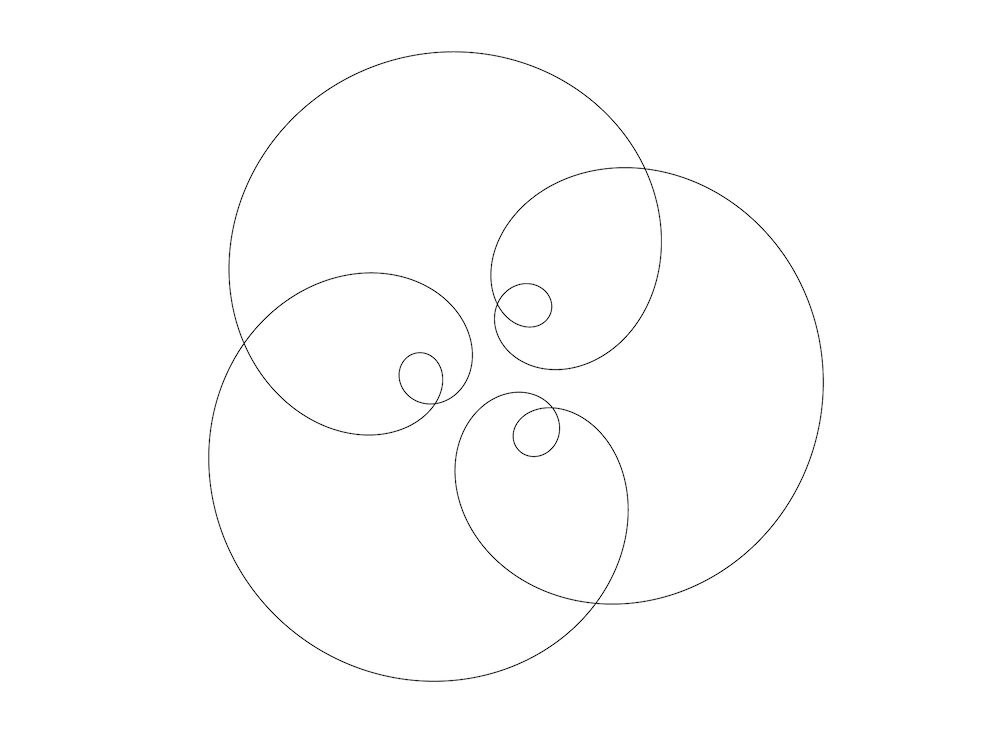
If you're wondering what an epicycle is, here's the short version: it's a pattern like a Spirograph might make. You know, those toys you might've played with as a kid. Where you put a pen tip in a plastic cog and then spin it around inside a larger plastic cog and then it makes a nice shape on the paper.
The longer version goes back to the motion of the planets. Before it was widely agreed that they orbited the Sun, people would still observe them and try to predict their movements. People have always wondered about the sky, and while most of it stays in place relative to itself, there were some bright spots that moved within a complicated pattern. Usually the planets would move forwards across the sky, but sometimes they would go backwards for a bit (the term for this is retrograde motion, which you might recognise from horoscopes). So, while inventing the concept of geometry, the ancient Greeks found that they were able to describe this motion by tracing the way a point would move if it was on a circle that was itself moving around a larger circle. Mostly it goes forwards, but sometimes (when the smaller circle is turning against the larger one) it goes backwards. And that's what an epicycle is! Wheels within wheels.
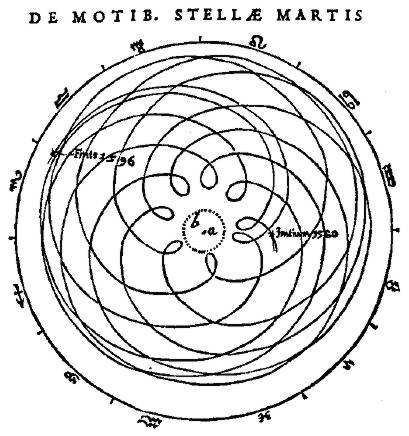
There's a lot of history I'm skipping here, but let me gesture to it with this diagram from Johannes Kepler’s 1609 treatise Astronomia Nova, which plots out the course of the planet Mars (as recorded by Tycho Brahe). The kind of shape it describes will become familiar to you if you spend a few minutes playing around with this tool.
So! This tool is a tool which will let you visualise the path taken by a point controlled by the motion of many circles combined together.
Each circle within the tool is defined by three parameters:
loops: the number of times we draw the circle going round
size: how big is the circle
phase: where on the circle do we start drawing from
And you can also toggle on a mode where the phase changes over time.
But that's it! But within that, I find it pretty remarkable the range of forms it can create. I love making tools that provide a set of simple parameters, but which can form a surprising variety of outputs. Not least, because I like to explore them myself - and even now I'm releasing this tool, I don't think I'm finished finding new things within it.
I originally started investigating epicycles in order to generate files to plot with my pen plotter - and this tool is still useful for this, in that pressing the ⇣ button in the corner will download a SVG of the currently displayed epicycle. You are free to use these SVGs to do whatever you like with - plot them, print them, use them as the basis for a art or graphic design. Credit for using a neat tool is appreciated, but ultimately this is just maths & as such belongs to everyone.
All of which sounds very serious - but really, this is a tool for messing with. Push some buttons, move some sliders, get a feel for it, and see what interesting loops you can find. Go play!
With the recent news that Twitter is being sold to Elon Musk, lots of people have been setting up or rediscovering Mastodon accounts. Much fewer than have been setting up Discords, but still... a good number.
And with this new influx, I have been seeing lots of discourse about CW warnings, their use, people complaining about people using them wrong, people complaining about people complaining about people using them wrong, etc. [1]
So I thought I would use this as an opportunity to write a little about the content warning system, and how I have seen them used in practice. Not least because they are one of the things I have been thinking about while developing Downpour.
So, what is this system? It's an optional bit of metadata you can add to a post. When activated, it gives a little textfield which is the CW, and is directly shown to a viewer. And then the viewer can click on a little SHOW MORE button to see the main part of the post.
Let's simulate it here in this post, using the built-in <details> HTML tag[2]:
writing
I am writing a blog post, and you are reading it.
The CW warned you that there was going to be a mention of writing, and there was! You could choose whether to view it or not. It is a consent system for posts.
So what kinds of things is this used for in practice?
Spoiler warnings
ofmd spoiler
ed and stede totally kiss.
This was the use-case that convinced Gargron to add CWs to Mastodon! You can talk about a show and also people who haven't yet seen the show can choose whether to see the spoilers or not.
Allowing you to talk about shit that feels a bit too heavy to talk about without the reader opting in
ph -
with the way my fatigue currently is, I think it is a bad idea to travel internationally. and I want to so bad.
("ph" stands for "physical health", as distinct from "mh". The "-" means that it is negative)
A classic use of a content warning! And helps provide an atmosphere where it can feel a bit more accepted to post about difficult stuff you might be going through (or maybe I am just in a good community, and post private).
Allowing you to talk about shit that feels a bit too boring to talk about without the reader opting in
wordle
[I don't play it, but imagine there is a Wordle results screen here. If you play Wordle and you feel like this example is some kind of burn on you... haha suck it]
This is also important! Lotta boring stuff, and yet an important part of posting is allowing you to say all of the stuff that is a little too boring for you to directly message a friend or loved one about. Because posting is for the void, and sometimes there is stuff you wanna say that only the void wants to hear.
Talking about stuff that is fine for you but might have higher than expected emotional load for other people
alc longing
i have been swearing off booze because it seems like it sets off my fatigue, but it is a fine summer's day, and i would like to drink a beer in the sun.
("alc" is short for "alcohol")
Sometimes something is fairly casual for you to post about, but you know it could be harmful for others to read. You might hesitate to post it - is saying this casual thing worth maybe ruining someone's day? But a CW can make that easier to post about. And it doesn't have to be a serious thing - necessarily day-ruining, just a moment of discomfort.
This is I think the category that causes the most controversy & strife about the use of CWs. This requires you to project out to a hypothetical audience and consider how your words will be recieved there. This is kinda hard to do, because empathy is a skill, and there is a lot to learn about what maybe-innocuous things could be unpleasant or upsetting or inaccessible to view for other people.
It's also hard because the nature of wide-broadcast social media is that a post can travel beyond the specific audience (and specific norms) that it was originally written for. This manifests on Twitter as people learning to couch their words really specifically - full of caveats and hedges because they've had the experience of getting negative replies for not considering a particular perspective when posting a short and context-depended tweet. And on Mastodon a post can be written for a small group, travel further - and now someone is asking someone to please add a CW for whatever specific thing. I don't think this is specifically a problem with CWs as much as a problem of social networks which tend to take statements and recontextualise them into broader contexts and conversations that they were not originally intended to be a part of.
Topic markers
cw uses
- spoiler warnings (the main reason Gargron added them, iirc)
- little jokes
- allowing you to talk about shit that feels a bit too heavy to talk about without the reader opting in
- allowing you to talk about shit that feels a bit too boring to talk about without the reader opting in
- talking about stuff that is fine for you but might have higher than expected emotional load for other people
[^2]
Once you are in the habit of using CWs, then you can find yourself using them just to kind of denote what you're gonna be talking about. It's a little intro to the post, a title, a subject line. "here are my thoughts on blah" => "blah blah blah"
And also this is helpful if you're not interested in the topic, it's just boring to you. It helps here that replies by default inherit the CW of the post they're responding to.
Little jokes
bing
bong
Okay, this is the one I really wanted to talk about. I love the rhythm of the CW, the way that it builds a little arc of anticipation into the process of reading a post. It makes the reader complicit in the unveiling of the post. Whatever happens after you press that button is partly your responsibility. It was my bad post, but it was you that clicked on it and chose to view it.
lewd earworm
cum on eileen
You probably clicked on that fold out bit just above automatically, didn't you? And now you have [REDACTED TO PROTECT THE INNOCENT] in your head. And is it my fault? Yes. But is it also your fault? Kinda!
And that's really the source of a lot of the humour that can be derived from CW-based jokes. And it's a source of humour that feels very videogames to me. I mean, it's a joke based on interactivity. A joke where the humour rests on the fact of interactivity, not just one that is delivered within an interactive context.
Which is why I say that CWs are an inspiration for Downpour. CWed posts are a tiny interactive experience, and derive a special type of power from that interactive nature. What if we made them... just a little bit more capable. Just a little bit more complicated. But still kept the scope nice and small. Shitpost sized. What could people make, then?
This is not quite true - I don't have a public account on there & only really follow people I am either friends with or who are on the small and close-knit server I am on. So as a result I have mainly seen a few boosts of some of the more meta commentary, from which I have deduced the presence of all the other posts. I am not about to go looking for them to confirm, because they seem annoying. ↩︎
Just want to give a little shoutout here to Everest Pipkin's work Soft Corruptor, which is built entirely out of nested <details> tags. ↩︎
Together with Viviane Schwarz, I am releasing a new social network for frogs. It's called Frog Chorus, and it's a place where all you can do is ribbit.
The initial seed of the idea and the illustrations came from Viv, and the coding & the rest of the design were done by me.
The site is a social network for frogs. Open it, and you will see yourself sitting as a frog in a pond. You can click to ribbit, and you can hold down to do a really big ribbit. And you can see and hear other frogs ribbiting in the same pond. It's the smallest satisfying online social space that I can imagine.
The last few years have been difficult, for reasons that I am sure will be familiar to many of you. Alongside the typical sense of isolation brought on by Covid precautions, I developed chronic fatigue, and have had to be very careful about my energy expenditure. This has meant I have spent a lot of time online—even more so than I usually do. And—there are a lot of opinions online. There's a lot of things people share, a lot of Takes, a lot of Content. This is, on the whole, a good thing. But sometimes, when you're tired and overwhelmed but also you still have this real thirst for connection... you want a way that you can be in the presence of people but also not have to say anything. You want to just be able to ribbit, and maybe recieve a ribbit in response. Or to leave a pond open in a tab, occasionally hear a frog plop in or ribbit, and know that someone else is around.
So that's the motivation behind the project. Why is it built the way it is?
it's designed to give you just enough control that you feel able to express yourself. You can choose when to ribbit, and you can choose how big a ribbit you want to do. And that's enough? Or at least, that's a lot. It allows you to reciprocate. Someone does a big ribbit, you respond with a big ribbit. You heard what they were saying, and you responded in kind. I am generally very sceptical of people saying particular bits of human behaviour are innate, but I am pretty sure that "repeat after me" is.
it's also designed to be very sharply limited in terms of how much expression is possible. There is a term used among designers of games where users are able to express themselves and then share that content with other players - it is "Time To Penis". As in, how long does it take a player to make something that looks like a dick and share it. Or a swastika, if they want to go for fascist abuse rather than sexual. Frog Chorus is not completely immune to this, because nothing is, but it is resistant to it. You can't choose your username, you can't choose your colour or pitch, you can't choose where you sit within the pond. I guess you could Morse code out the letters P-E-N-I-S, but that's not very satisfying.
but there's still a sense of persistent identity. Even though you might not know who the person controlling each frog is, you can still recognise that they are the same frog each time. You have a sense that you are there with specific people, and get a sense of their personalities from how they ribbit and how they respond to ribbits.
I love a minimal interface, and I love letting people discover things. Generally as a developer I have more fun figuring out the smallest set of things I need to build to make an experience compelling than I do figuring out the largest set of things I can provide without the experience collapsing under its own weight. And of course, the fact that it's much less work that way is also very appealing.
finally, and very much not least: it's funny. I'm happy with the goofy ribbit samples I recorded, I think it's fun to be a frog, I think it's good to be in a space that is playful online.
And a quick technical rundown, for those of you who are interested:
the site is running on a boring Linode VPS (that I plan to migrate my personal site to, once I get round to it)
the backend is written in Rust, pointed at by Apache running as a reverse proxy. The backend is essentially a heavily modified version of some example code showing how to use actix with websockets to make a chat room.
and the frontend is built in Typescript, using my homebrew vector utility class. There is a bit of fussing to try to keep performance reasonable — some stuff with multiple canvases and dirty flags to try to avoid re-rendering unnecessarily — because I hope that people will keep this open as they go about their day, and it's good not to waste computing power unnecessarily.
I've not set this up, but I think it would be a good idea.
The problem:
You have a NAS or a hard drive in a drawer or a second computer with some storage space. And you do backups, because that's the sensible thing to do in case your main computer breaks. But you also want to still have your data even if someone steals all your computers or your house burns down or some other calamity happens.
The easy way to solve this would be to pay a company to keep all your stuff on their servers. But that's expensive and also it kind of sucks that everything is based around paying a company money.
(Is it expensive? Backblaze costs $70 a year. Compare: About $140 for contents insurance, which would replace all my stuff in a similar situation, or $35 for a 2TB external hard drive, which could back up all my stuff in cases that are much less calamitous. Depends on how you feel about money, and how you feel about your data.)
And you have a couple of friends in a similar situation, and they have the same problem and feel similarly about paying rent to a large company.
A solution:
Everyone sets up Syncthing for their backups. Syncthing is an open source, peer to peer, encrypted program that keeps a set of files in sync between two or more computers. It does all the stuff so that the computers can talk to each other over the internet (even if they're moving around and connecting to random wifi hotspots, like a laptop or a phone would be) and also figures out what files have been changed and sends the changes between them.
This is actually a pretty good way to keep backups yourself - if you have two computers, you can set up Syncthing and stuff will keep synced between the two and you don't have to remember to do back ups manually.
But you can also set it up so that all your stuff also gets synced with your friend's computer. And now you have off-site redundancy. Maybe your friend is happy to just do this for you, because y'know, you're friends. Or maybe you agree that in return you'll let them sync their stuff onto your computer. Now, probably your friend does not have the kind of setup that can guarantee perfect uptime. Their internet might flake out, they might upgrade something and break their computer for a week, they might get all their stuff stolen. There are two answers to this. One is: this is already a secondary backup, in case something catastrophic happens to your stuff, so you can probably assume that stuff isn't going to happen at the same time something catastrophic happens to your stuff. Or you can find a third friend and divide the risk even more. Insert extra slices of swiss cheese as appropriate.
So, a final thing to address: if you upload your shit to Backblaze or Dropbox or wherever, you kinda trust that they won't go snooping through it. They have a business model which is about storing things, and about not looking at that stuff more than they are legally obliged to. But a friend does not have a business model, and might decide to snoop. Or they might have a housemate who has access (because their computer is also the thing they use to play music in the living room, say). Two answers I can see here: one is to only do this with people you have a basic level of trust with. Or with data that is important to you but not something where there are catastrophic consequences to having someone poke around. And the second is that you can use Syncthing's new encrypted mode, which stores stuff on a computer without letting the person who runs that computer see the actual contents of the files.
So. Seems like a nice idea? If you have friends who have a reasonable level of technical skill, and a preference for co-operative solutions over capitalist ones. Like I said, I haven't set this up yet, but if you have, I'd be curious to hear how it goes.
Today I announce a new project! This is the big thing I have been working on since leaving Niantic, and I am very excited about it.
It is a game making tool for phones, called Downpour. Here is what it currently looks like:
The utopian vision for the project is this: making a tool so that anyone, without prior knowledge, can make something interestingly interactive in a spare ten minutes. And without having to have access to a computer. What would you make if making a game was as easy as writing a letter?
It's inspired by seeing how an accessible tool can open up a creative space that wouldn't otherwise exist. Seeing the impact that tools like Bitsy, Twine or itch.io have had in creating spaces and genres that wouldn't exist otherwise. Or even outside of games - for example, my own Cheap Bots, Done Quick!, or musical instruments like the TB-303. The transformative power of approachability.
More specifically, though, it was inspired by my experiences making a flatgame. Flatgames are a type of game where you put together handmade images in a (flat) space you can wander through and exist within, but without focusing on traditional gamey stuff like collision or 3-D-ness or winning. As someone who is so often On The Computer, I loved the process of drawing and collaging things together... but I hated the part of the process where you had to scan things in, photoshop them and fuck around with the settings in Unity (I spend enough time fucking with things in Unity). If only there was a way to automate those annoying processes. And if only people didn't have to learn the basics of Unity and of coding to make them. So, I thought: what if you made this on your phone? A device with a camera built in, and that you already have in your pocket.
The game format has changed a little in the process. The games you can make are fundamentally hypertext - they are built around capturing images, and linking those images together. Select the door in the image, and link it to the monster that's hiding behind the door. It turns out this is enough to make expressive, interesting things! I spent a week or so at the start of the year making games with this tool, and I've not yet scratched the surface of the possibilities. And I'm not done yet.
If you want to try it out and are within reach of London, the best way is to come to the Now Play This festival between the 8th-10th April. I've made a special build for them, and there will be stations set up with crafting equipment, props, a doll house, etc. Plus, the festival is a great time, with lots of other cool & thoughtful games and artworks.
Or, of course, you can wait for the full release, which will be coming out later this year (touch wood). If you want an email when it comes out, you can sign up here: downpour.games.
This is a crosspost from my Patreon page, but with the bits thanking people for their support removed. However, if you do support me there: thank you. And if you don't and use Cheap Bots, Done Quick!, please consider doing so. It keeps the servers humming & pays for my time doing this kind of tweaking and fixing.
So, after leaving Niantic, I put a bit of time into rejuvenating and restoring CBDQ. I had neglected it a bit, what with having a full time job and falling mysteriously ill. It was running fine, but the thing about maintenance is that you can keep putting it off and it'll be fine until one day it'll just fall over. So it was a good time to go in and update and upgrade things, sand off the barnacles and apply some fresh paint.
So, to switch out of marine analogies, I migrated CBDQ from running on my server that I've had for about a decade now, and onto a fresh shiny one where everything is up to date and there are fewer weird configuration bits hanging around from this project or that. I replaced the old SVG rendering solution, as the old one was very much deprecated and was in danger of stopping working - this was kind of frustrating, as there was nothing that was a good drop in replacement. So I ended up putting together a package myself, which wraps "puppeteer".
(sidenote: SVG is a language for describing vector images. So far, so straightforward. However, SVG can also contain arbitrary bits of HTML... and in fact, if you want to do stuff like "render text, in a font, with linebreaks", you pretty soon start to make use of this functionality. So, rendering it is complicated! And in fact, the server actually does this by spinning up a little instance of Chrome for every SVG it's trying to render, loading the SVG in as a webpage, loading any images or custom fonts or whatever it might contain, taking a screenshot, and then closing again. Whew! This also means the new SVG rendering might change the output of SVGs a little - sorry if this broke your bot!)
What else? A lot of work trying to trace down an annoying bug where sometimes CBDQ's processes would get stuck, not doing all the tweets they were supposed to and also taking up system resources. But also not emitting any errors or giving any indication of what was wrong. I am still not fully convinced I've ironed it out, but I have at the least made it happen less often. And not need me to come in every so often and turn it off and on again to fix it. And as part of that I did a lot of work to make the internal error logging cleaner and more sensible. Boring work, I know, but it's this kind of thing that keeps an exciting service running. Sometimes I think making tools is like 5% exciting shiny things, and it's like 95% doing a load of boring stuff so that people who use them don't have to think about it themselves. I also went through and upgraded all the node dependencies. Fixed up the admin panel that I use to block spammers.
Here's where I talk about new features
You[1] asked, I listened! You can now set your bots to tweet every 2 hours. For when every 1 hour is too frequent, and every 3 hours too infrequent.
And this is an exciting feature that almost snuck in for free - you can now use CBDQ to post videos! Just use the vid tag to link to a video (in a format that Twitter supports), in the same way that you'd link to an image. Here's an example: {vid https://cheapbotsdonequick.com/example.mp4}.
This is a rough transcript of a talk I gave at GDC 2022, as part of the "Making Room" track. So it's written in a this-is-for-speaking style, and you should imagine the headings as slide transitions. OK! Let's go:
Hello, I'm v buckenham, and today I'm going to be talking about chronic illness and what you can do to support any of your employees who have a chronic illness.
So, first things first, I should say now that I'm going to be focusing on my own experiences as someone who has a chronic illness, as that's what I know best.
[spoiler warning]
- ask people what they need
- build an environment of trust
And as a spoiler warning for the end of the talk, I should say more broadly the important thing is to listen to your employees and find out what they need. And to build an environment of trust so that they will actually tell you about what's going on and what that is.
And the other thing I should say upfront is that my experiences are not unique.
60% of Americans have at least one chronic illness
So depending on how you define it, about 60% of adult Americans are living with at least one form of chronic illness. Chronic illness can last from several months to a lifetime and can take many forms: Long Covid, arthritis, musculoskeletal pain, diabetes, asthma, migraines, blood disorders, cancer, heart disease, irritable bowel syndrome, autoimmune diseases, and a range of mental illnesses like depression, anxiety. the list goes on.
So. Let me tell you my story.
My Story
I've worked in videogames for about a decade, much of that time in small teams, and in indie spaces. I've put on games events, including being part of organising That Party here at GDC with Wild Rumpus. I worked on a game called Mutazione for a few years, then joined a startup making a weird digital physical stacking game called Beasts of Balance, for which I did the majority of coding & game design for. We were eventually acquired by Niantic (who make Pokemon Go), where I worked as a lead designer.
So August 2020, the pandemic had hit, everyone was working from home. Obviously a weird time in general, but I was dealing okay... until one Monday morning, I woke up, got ready, sat at my desk for our normal morning let's-start-the-week meeting, and found I was kind of sliding out of my chair a bit. I'd had a migraine earlier in the year and the after effects from that were kind of similar feeling, so I wondered if it was something like that, and moved to my bed to keep working. An hour or so later, it was clear I wasn't really in any kind of state to do work. And then found I wasn't really in a good shape at all. All in all, I basically spent the next month or so in bed other than medical appointments and for quick trips to the toilet and to the kitchen.
I had a lot of investigations done
(here's me in a hospital gown about to get an MRI scan)
but none of them turned up anything concrete that would explain the fatigue.
And at this point I'm still after all this time trying to chase down a proper diagnosis, but my assumption at this point is that I have Chronic Fatigue Syndrome, which is a "diagnosis of exclusion" - basically, when you are suffering from fatigue, have been for a while, and there's no other good reason why. My symptoms seem especially triggered by being upright - standing, walking, even sitting up in a chair. Which means I also suspect PoTS, which stands for Postural Orthostatic Tachycardia Syndrome. This is basically where your heart doesn't respond appropriately to the extra challenge of pumping blood all the way from the feet up to your head. Which it turns out is more effort than pumping it around when everything is on the same level. The primary symptom I get is what's called "brain fog" - when this is bad, I can feel my eyes unfocusing, my attention starting to slide off things, my capacity to, just... think about things goes away. And this also means frustration with memory, just lots more of those "tip of the tongue" feelings. I know this, I knew this, but---
And I should say that this was really scary. It turns out a lot of my self identity was built up around being a person who can do this work, who is a sharp thinker, who exists in the world, who can run around plugging cables into things at events. It's really scary to not know what level of function you will regain, to not know if you will be able to do those things again. Ever, maybe.
Over time, I've slowly improved a little - after a month or two (and when my sick leave had ran out), I returned to work, although initially on reduced hours, and only slowly picked up the responsibilities I had beforehand. Around Christmastime that year, my health had improved to the point that I could go for like, half hour walks in the park nearby, as long as I could sit on benches along the way and rest.
And this is pretty much the state I'm still in now, 19 months later. I have left Niantic, I'm started up my own company, working on ██ █████████ ████ ████████ ████ ███ ███████ (████████! I'm announcing it next week! sneak preview!). The fatigue has gotten better and worse. At my best times, I'm able to travel into London and work in an office for a day or two or see friends - but I still have to be careful with resting before and afterwards. And there's times when I do too much, and have crashes - the worst of which was last November, which took me back for a week or so to being unable to leave my bed for more than a few minutes at a time, and which I'm still not fully recovered from. I am giving this talk from bed, now, although I would much rather have travelled out to SF, and be hanging out with all of you in Yerba Buena Gardens eating icecream.
What was helpful
So. Let me talk about some of the specific things that have helped me.
First up, just an obvious thing
Medical insurance
I'm not going to go on about the difference between US and UK healthcare systems, but I do want to state the obvious and say that not having to worry about access to healthcare is a big thing. Do what you can to make sure people don't have to stress about this. even outside of the US that might mean health insurance! Although I will say that Niantic had good coverage... but it would only cover diagnosing a chronic condition, and would stop as soon as that happened. And I'll say that the NHS is also bad at covering this stuff - literally yesterday I was on the phone, still trying to chase up a referral to a rheumatologist to get a diagnosis, years into this. So... it's not easy, and chasing up healthcare can be a job in itself.
What else?
Paid sick leave
I should say that the norms in the UK are much more generous than in the US. Here, sick leave is counted separately from holiday, and everywhere I have worked has had an allocation of paid sick leave, which (until this happened) I had never had to worry about the duration of.
This is crucial. In the case of Long Covid specifically, being able to take time off and rest in the early days is what makes a full recovery much more likely. And worrying about the financial hit is what pushes people back to work before they're ready. Before they ought to.
And I'd say as well that time off is not just limited to times when people are too ill to work, but also about getting to medical appointments. It can helpful to track this separately, and flexibility can help a lot here if people need to take random hours here and there.
Working remotely
And working remotely, which is a thing I think everyone has had to get better at over the past couple of years. Obviously, this makes a huge difference. The energy involved in commuting, the ability to work piecemeal through the day, with rest in between, the ability to work from bed...
as helpfully modelled by Pixie here.
It sounds messed up to say, but I feel so fortunate to have fallen ill during this pandemic. Comparing my experiences with people who fell ill beforehand, I don't think before this I would have been able to return to work remotely, don't think friends would've been as up for hanging out online, I wouldn't have been able to give this talk without having had to travel.
So, speaking of online...
let's talk about Zoom.
Zoom Fatigue is such a real thing. Illness has made me a fine connoisseur of exactly how tiring different activities can be. And I can really tell the difference between being on Zoom with video or audio only. Just making the "I am engaged and listening to you" face! (at this point I made the face) There are actually academic studies around this that back this up[1].
And I'd say as well, that scheduling meetings so people have time before and after to recover from them can be very important.
So, as I said before, after a year or so, I had improved to the point that I could occasionally come into the office. One thing that helped when I did come in was:
A Giant Plush Snorlax
and here you can see me, helpfully modelling it.
Because I was working at Niantic, we had Pokemon stuff around, including a giant plush Snorlax, of the size where you can sit/lie down on it. Because my fatigue is triggered a lot by posture, and lying down helps me a lot, being able to work lying on this giant Snorlax meant I could come in more and for longer than I would otherwise have been able to.
Now, I am not saying that you need to go buy your chronically ill employees a giant Snorlax plushy. And if I was coming in every day, I would've asked for a more professional setup. But the basic point here is that tailoring the office space for what people need can be helpful. Different people will need different things, be that desks, seating, computer equipment, noise cancelling headphones, whatever - ask them!
Phased return
So having a lighter schedule especially in that time when I was returning to work helped a lot. A lot of managing this illness is not being sure what your energy limits are. And if you go over them, you're really punished for it.
So, it's best to start with a light workload, and a light schedule, and then, if you feel up to it, slowly increase.
Reduced hours
Or this might just permanently mean working less. Either fewer hours per day, or maybe fewer days per week. I am very pleased to see an increasing number of studios bringing in a 4 day week, which seems like both a great move for the workers there generally, as well as specifically for people with chronic illnesses.
One thing that's important to remember is that having a fatigue condition means that you have less energy overall - so even if you can still technically work fulltime, that means you're likely cutting back a lot on things you'd be doing outside of work to keep within that energy budget. And that's just not a good way to live.
Reducing stress
So, for me, there are broadly 3 types of things that tire me out:
physical. Luckily we make software, so this is less present than with a lot of jobs
mental. This definitely is present! Hard to get around this. We have to do some thinking sometimes.
emotional. This is also a big source of fatigue. And it is something that is hard to avoid. Especially when dealing with really scary things, like fear for the future, potentially losing your income, and maybe even your source of identity.
(There's a kind of funny thing: a booklet I saw early on gave the advice to limit your worrying to a few hours a day. Just not to get too tired out.)
So it's worth thinking a lot about what sources of avoidable stress there are for your employees, and how you can try to reduce them, and let them save their energy for more existential terrors.
And the final thing that was helpful for me was:
Understanding
Just... knowing that you can ask for accommodations, knowing that you can go "I'm feeling out of it, I need to bail from this meeting". That lack of judgement if you do so. That matters a lot.
But the flipside to this is that you don't have a right to know everything that's going on with your employees. They should be able to have space to have work be about work not about their illness. So. Understanding, but without prying.
OK, but what about people who aren't me?
So. This has been some stuff that was helpful for me. But what about people who aren't me? Who don't have my particular condition. Who work in a different workplace.
Well, I already kind of gave you the answer up top. There's a lot of different illnesses, and a lot of different people experiencing those illnesses in different ways. So, I'm sorry to say:
Ask them
They will know what they need much better than I can guess at. Your workplace will be different to mine, I can't give you a perfect answer. Ask them.
[this next bit was cut for time! but you get to see it. bonus content!]
But ok ok, I'll try to be useful. Here's a few more examples for various conditions:
For people with Irritable Bowel Syndrome or Crohn's disease, if they're in the office, it can be helpful to provide sufficient access to toilets. This can also be something that affects people more or less at different times of the day, so it's also helpful to be flexible in terms of working hours. It's also worth considering that commuting in can be a anxious time, in terms of limited toilet access - shifting working hours can avoid rush hour, or maybe it's more important for them to be able to drive in.
For people with chronic migraines, again, different times of day can be better or worse. Shifting work hours can help avoid the worst times. And if people are in the office, see what you can do to remove triggers. For example, if they're set off by scents you can remove air fresheners, swap scented soap for unscented, ask people to stop wearing perfume in. If it's triggered by noise, then maybe they want to move desks to somewhere quieter, or try to dampen noise. if it's lighting then maybe swapping light fittings can help.
If you have diabetes, then you might need to inject insulin, which some people are very understandably not keen to do in public spaces. It can also be important to eat on a regular and predictable schedule - which means doing things like making sure a meeting doesn't overrun into lunch can be important.
But for a lot of these diseases - it's the same kind of thing that's needed. Providing flexibility, working to try to adjust the workplace so that it fits their needs better, giving people slack to take care of themselves.
So this is the part of the talk where I want to get a bit more real. If you're here at this session I am going to take it for granted that you want to support employees who are dealing with chronic illness. And why you might want to do that is pretty clear - ie, it makes their lives better, and that's a good thing. So I want to flip this around, and ask the harder question.
Why don't people get the support they need?
And I don't want to assume that it's just down to people being evil, cackling away in their lairs as their coworkers go through difficult times. People want to help people... and they want to think of themselves as the kinds of people who help people... but good intentions are not always enough.
So why does this happen? Let's dig into some of the reasons, and see if we can break them down a bit.
Reason one:
It's expensive.
I've described some fairly good treatment from my old employer, Niantic. But I do want to acknowledge here that Niantic is a large company with a lot of money, and most small studios... have less money. I definitely have sympathy for people who are looking at a tight budget, trying to make things work, and then finding that a core part of the team is not going to be able to work at full capacity for a while. Or ever, maybe.
But there's two things I'd say to this.
First off:
...But it's the law
it's the law. In the UK, it's the Equality Act of 2010, which says that, if you have an employee who has a disability, you are required to make "reasonable adjustments" to enable that employee to work.
And in the US, there's an equivalent provision in the ADA, which says that employers are obliged to offer accommodations unless that would impose an "undue hardship."
And I think there are similar laws in many other countries around the world. Now both have a reasonableness test, which means that you're not forced to make these accommodations if it's going to bankrupt you, but you do have try.
And for the other reason, I'm going to be a bit cynical here for a second. Making these adjustments might be painful. But that means
It's... an opportunity?
An advantage that small studios have over larger companies is that they can be much more flexible and respond to the needs of their workforce. You don't have to worry about making a single policy work for thousands of people, managing all the exceptions that can create - you know the people you're working with, and you can adapt how you work to fit them.
And... there's lots of people out there who have these kinds of invisible disabilities, who can't fit into a regular in-the-office 9-5 type schedule, who have tried that and found it doesn't work for them. And, a lot of them are really talented. So, by making your workplace somewhere where they can thrive and be happy, you can (and again, apologies for being really cynical here) hire a level of talent you might not otherwise be able to afford. Because what they value is a workplace where they can work. And work sustainably, and which supports them to have a life outside of it.
And I'd say as well, these people often have another skill that can be undervalued in the workplace, which is pacing themselves and setting boundaries and knowing what their limits are.
Ok, so, next reason you might shy away. And here we're getting a bit closer to the bone.
It seems unfair
So maybe it seems unfair. You maybe have a little niggle in the back of your mind, like -- if I put this stuff in place for one person, then how am I going to explain it to everyone else? How come one employee gets this stuff and other people don't?
Or maybe it's more than that. Maybe the reason is actually
You're jealous
Maybe you've been listening to this talk, hearing me talk about working 4 day weeks, taking time off to recover from things, lying on a big Snorlax plushy... and you've thought... damn, I'd quite like that myself. How come they get that stuff and I don't?
And to this I say. Yeah. That's fair. And if you're finding yourself with this kind of reaction, then
You deserve better too
Like, maybe you're starting to get a bit burnt out? Maybe you deserve a better work/life balance. And it's worth just really reflecting on this point, really sitting with any of this discomfort you might feel, any twinges of unfairness you might have. and really reflecting on changes you can make to make your working conditions better, and changes that might make conditions better for everyone who works there. There's nothing saying that good conditions should only be for people who have a disability.
Everyone deserves better, too
Disability is not an unique thing, it's part of the spectrum of human needs. Different people need different things in order to be happy and healthy at work. Parents need time off and flexibility for kid stuff. People going through war, people who have suffered a death in the family, people who are dealing with burnout, people whose cats got ill and they need to take them to the vet. People are people, and they have whole lives. And... you don't deserve to hear about their whole lives, but you should try to give them the space and flexibility that they need.
So this brings us onto the final reason you might not put these accommodations in place
You don't know they have it.
They haven't disclosed their disabilities to you. So. Why not? Why wouldn't they? This talk has been about the positive side of this, what you can do to support people who have disabilities, but on the flipside of this is that people can look at you differently when they learn about your disability. I was hesitant to give this talk, because I knew I would be here talking to a lot of people and being public about my weaknesses. About the ways that I am maybe a little more awkward to employ. And you can't unring that bell! You can't take it back, you can't transform yourself back into someone who isn't looked at in a different way, maybe with pity or concern.
And I want you to take a moment, and just seriously consider that someone you work with does have an illness that they struggle with, and is concealing that from you because of fear of the consequences of disclosure. Does that seem possible? Can you think of some reasons they maybe wouldn't be coming forwards?
So. How do you build an environment where people feel like they can come to you and talk about any illnesses they have. Any changes they need. There's a ton that goes into this, and more than I can talk about here, but fundamentally it comes down to a single word:
Trust.
And this is about the big things, yes, but it's also about the small things. Do you keep your word about things you casually promise? Are you sometimes dismissive about people's reasons why they might be late in or struggling with something. Do you take people's minor problems seriously, or do you dismiss them or brush them off? Can you be trusted to keep a confidence? If someone tells you about a thing they're struggling with, can they trust you to keep it to yourself, or is it going to spread around the studio? Being a leader, being someone with power over others, that means those people study you intently, and are very motivated to learn exactly what they can expect from you, and what trust they can safely place in you. So: what messages are you sending them?
OK OK OK. So. Let's sum up.
Summing up
- paid time off
- flexible working times
- working remotely
- or, adjusting the office environment
- reduce stress
There's a lot of specific things you can do to help people with invisible and chronic illnesses. Some of the big ones are giving people sick leave, giving people time for medical appointments, giving people flexibility with the timing and number of hours worked - do they need to come in late, or work part time, or what. Letting people work from home is a huge thing that is really revolutionising access to the workplace. but if people are coming in, what can you do to make the office environment less hostile to them? Maybe that's a giant Snorlax. And just generally what can you do to remove unnecessary stress from people's working lives? where are they carrying a load they don't have to?
But more fundamentally, the things people with chronic illnesses need are just more enhanced versions of what everyone needs.
- ask people what they need
- build an environment of trust
Everyone has different access needs, and the most important thing you can do to meet those needs is to ask them what they are.
But in order to have that conversation, you need to build a relationship where they will trust you. Trust that you will take this seriously, and trust that you're on their side.
I have a new webpage up! It is called r_g_b.html [warning for flashing colours].
This was developed out of my older webpage ▛▚▞▗, using the same technique that I call "iterative convolution".
As the name "r_g_b" suggests, this version is a lot more colourful. You may notice the three static dots of red, green and blue that continuously seed the pattern - everything else is just the traces of those original colours interacting with each other.
This new version is also different in that it runs on the graphics card. I had tried this before, but ironically the faster update loop and full-resolution graphics made it harder to appreciate the patterns that the convolution created. I struggled for a while to create larger colour forms, but am very pleased with where I got to. I'm especially pleased with some of the ways that I'm injecting a little bit of noise, and how it sometimes creates a crunchy, fizzy kind of texture where two colours meet. I'm slightly surprised by how analogue this thing can feel - like it is physical video feedback equipment, or a cross processed negative, rather than an entirely digital effect.
Oh, and like my other webpages, this is interactive. It responds to mouse position (or drag, on mobile) and clicks/taps. And, somewhat more hidden, but if you want to capture images from it, you can press the spacebar to pause (and return to step forwards a single frame).
I'm in the mood to chat with people. A thing I value and care about is being part of a interesting creative community, and to repeat a sentiment you have no doubt heard a lot, a pandemic makes it hard to see people in person, do international travel, etc.
Also I quit a job at a large company and now I miss meetings (???)
So, I am copying a concept I have seen others do, and setting up Open Office Hours. The way this works is, you can go to that page, pick a slot, and it will get added to my calendar (and yours!). Then when the time comes, we can meet up online and have a chat.
Here's some examples of stuff I would enjoy talking about:
you're making a creative tool and want to talk about the design
you want to compare techniques for making generative art
you're making a Twitterbot and could use some help
you think I might have something interesting to say about a videogame you're making
you want some advice on curating a show with videogames in it
you're a friend and we haven't spoken for a while and you just want to catch up
I'm someone you know from Twitter and you want to say hi and actually have a conversation
you're interested in offering me some work
(It is possible, especially if you work at a company with money, that we'll have a nice chat about me maybe doing some consulting work for you. But that sounds like a nice chat too)
If you are reading this and feeling a little shy and hesitant about reaching out, then I would say that that is often how I feel, and go on, do it, it'll be nice.
And I should also say that you are very welcome to get in touch with me outside this system (especially if you are in a timezone these slots are inconvenient for, or want to offer me some work).
The other week I saw a tweet by my friend & banging chiptune musician Chipzel, where she was giving a little guided tour through LSDJ, the premiere Gameboy music software.
It inspired me to download the demo rom, find a Gameboy emulator, and give it a go. I have had some experience with trackers before, so I found it pretty quick to get going with. And fun! It makes the good bleeps and bloops. I was pretty soon at the point where the main limitation on me making nice music is my actual musical ability.
But it also got me thinking about chorded input schemes. LSDJ is a workhorse of a program, able to do a lot of stuff. And it's designed to let you do that stuff quickly - to let you iterate fast, put down a tune fast, adjust things while you're standing on stage. But also... a Gameboy has 8 buttons - 4 directions, A, B, SELECT and START. So it has to make those buttons work hard. And that's where chording comes in.
Chording is a means of inputting commands to software by holding down multiple buttons at once. Ctrl-C is an example of a chorded command. Hold down Ctrl, then press C while you're doing it. Text copied. But you can also make chording work harder than that. So, in LSDJ:
press A: insert note on empty step
while pressing A, press RIGHT: increase the pitch of a note by one step
while pressing A, press LEFT: decrease the pitch of a note by one step
while pressing A, press UP: increase the pitch of a note by one octave
while pressing A, press DOWN: decrease the pitch of a note by one octave
(here's the manual, if you want to have a look at the other commands)
Chorded input is rare these days - the movement of software to touchscreen devices argues against it. It works best when there are physical buttons to press, where you develop muscle memory for where those buttons are. It's not great for discoverability, unlike context-specific controls - you don't know that holding SELECT and pressing B three times will do anything until you do it (fyi: it selects an entire screen of notes). You can design to mitigate this - the same commands working in different contexts, like Ctrl-C copying objects of many different types, across many programs, or those LSDJ commands above working for any type of sequence data, not just notes.
So: chorded input is useful in situations where there are no other viable choices, fine. So why am I writing about it? Because it's fun. It takes a little work to learn, but as game designers know, learning is fun. It uses muscle memory - but developing muscle memory is fun, and exercising it once you know it is, too. It is fast, once you know it, and developing that speed is satisfying. It's not discoverable - but that means it feels like secrets. It's a form of input that doesn't really need much feedback from the system, unlike touchscreen-like interfaces. You don't need to look at what you're pressing, but can input a whole sequence, with decent confidence that it'll be interpreted in the right way. You can input commands as fast as your thumbs can move! And your thumbs don't have to move far - the Gameboy is designed so that you can go in any direction, push any combination of A & B without lifting them. And the buttons are designed for tactile pleasure - but I've experienced similar joys with Teenage Engineering's Pocket Operators, where the buttons are hard little ciruitboard studs, optimized for value engineering.
All the examples I've given for chorded input come from music software, and I don't think that's a coincidence. It's an area where there's an expectation that users will invest time into learning the intricacies of the systems they're using, and that that investment is part of the joy of it. And they want to cram features in, and are happy restricting the inputs - that's basically what a musical instrument is, a device that can produce a wide range of [audio] output via subtle manipulations of the inputs. But it's not just music software: pretty much all the joys I've listed can be used to explain people getting so into learning Vim or Emacs. "It's so efficient", they say, "I barely have to move my fingers from the home row". They enjoy learning more and more arcane commands in order to use the software more efficiently. They enjoy the dance of their fingers as they perform increasingly more sophisticated operations at a speed only limited by thought. (I... don't. I can't be bothered to learn those arcane commands, I'm happy doing things inefficently. Especially because by the time I open up Vim or Emacs, I probably have enough problems already)
Finally, I guess I should mention that there are also methods of text entry that use chording. There's a whole alternate history of keyboard technology where this became dominant, where everyone wears weird gloves and twitches their fingers in place in order to enter text. As it is, this is really only mainstream among stenographers, whose job is literally all about typing fast & accurately, and where you have to take a course to learn to type.
I have been excitedly following the progress of Electric Zine Maker, by Nathalie Lawhead. It's a goofy, idiosyncratic software application that helps you make 8 page foldable zines. It has a potato tell you how things work. I wanted to try it out.
A few months ago, I was looking through a fan-wiki for some show or another, and I came across the entry for "Apple". It earnestly explained that an apple was a type of fruit, descibed an apple's typical appearance, and that various people had eaten one or mentioned one at various times and I was just really struck it. The care that had went into this entry, the seriousness with which the editors had approached an absurd task. What is an apple? Describe it in a single sentence for people who definitely know what one is already. It's important.
I was so struck by this, I decided to see what other wikis had written for "apple". And pretty soon I found myself systematically collecting the first sentence* for all the entries for "apple" in all the wikia.com wikis. This took a little while. But I now have a text file with 190 lines, each describing the place of "apple" within a fandom.
But I didn't really have a purpose for this text file, besides the feeling of having an interesting text file (underrated feeling, imo). So last night I decided to make a zine, to test out my corpus and to test out this exciting new creative zine-making tool. I asked my computer to pick 7 entries at random, and I combined them with some stock images (because they have a very similar vibe, I think) and some built in grunge-ifying filters (because this is a zine, after all).
And here it is, "Apple is a type of food that restores 4 Hunger Points.":
(* or the sentence that descibed an apple, or very occasionally I did some light editing to make it fit with the rest of the corpus. This is the magic of collecting things by hand for artistic purposes - you can just make some judgement calls as you go.)
I remember a game vividly from when I was young. It came on a shareware CD, full of scraped together Christmas things. It was a kinda real-time puzzle game - you pushed things around, there were little systems operating you had to manipulate. Breakable bits that would let out pushers, cascading off the screen.
For this jam, I thought about recreating this game. Not because it's lost, but just to understand it better.
I'm not going to try to use the same tech they used. I am pretty sure this was done as a set of windows icons, moving across the screen. Probably in C++, a language I am no good at. But it's simple enough, so I'll try to recreate it in a simple way, and hopefully the grain of the tools I use will align enough with the grain of the tools they used to give something from the process.
So, I started. I considered using this as a learning opportunity to use Rust, but I don't have enough energy for that today. So let's stick with an environment I know pretty well, HTML5 and Javascript. There's something pretty raw and pure about writing stuff with JS, especially using the low level Canvas API. It's a flat array representing pixels, and you can write into it. The same setup that has existed since the Atari (uh, obviously some stuff has changed).
Kye has a screen full of blocks, each taking up a single space. Some move by themselves, one is the player. They can push into each other, they can move other blocks, they can change as the result of collisions... But still - let's think of it as a 2D grid of blocks, and all the info we have for each block is what type of thing it is. Then, every time we update it, we can go through the grid and update anything that has changed.
Can we just do that? We can't process the entire board all at once. Starting at the top left, scanning each row, we can process each block one by one. I implemented the player character. I implemented a few other blocks...
The first bug I ran into was: if you move left, then the player moves fine. If you move right - the player disappears. Why is this? It was because if you moved right, the player block is now in a block that still has to be updated. And so when it updates, it moves right again - the right arrow key is still down!
I have fixed this by removing the ability to hold one direction to keep moving. I'll have to fix this to get the proper Kye feel... but right now, built in OS key-repeat is giving something approximating it.
I am wondering if I need to process certain types of blocks before other types of blocks. Maybe the player needs to move, and then everything else needs to move to adjust to that? It means going over the whole grid again and again... but computers are so fast these days. I check the performance stats, early as this is... yeah, everything is running fast enough not to worry.
Okay, rendering. I don't know if Kye uses windows icons, but I'm going to fallback on standard tilemaps. For development purposes, I start off with some coloured squares, because I can make those with pure code. I scatter some test blocks around...
More blocks. I am not planning these, just recreating whatever comes to mind. But I have the image of some lecels, some feelings I want to recreate, clear in my head. Blockers that move only left and right. Or up and down. Breakable ice cube blocks, which you move into to break, then stand there, keeping a flow of pushers in place til you step aside.
I pause before I get to the blocks that rotate the blocks that move autonomously.
A thing I spend a little time on is: how do I structure the player moving into a block that should then move? None of these objects have any kind of essential object permanence. They exist while they in a particular place, but when they move they are destroyed and recreated. There's no essential reason for conservation of mass, for one player object to not suddenly become two, or five. We might be pushing things around, but we're working on the same essential basis as Conway's Game of Life, the same tech you might use for wiggly little simulated bateria colonies.
Okay, but back to the problem at hand. The player block tries to move left. Before we destroy them and create them again on the block to the left, we should check some things. Is there a BLOCKER there? if there is, don't let them move (this creates the illusion that there is something in the way). Is there a PUSHABLE_LEFTIRGHT [sic]? Then... well, it depends, doesn't it? If we're going to keep the illusion that the PUSHABLE has an independent existence then we can't just replace it with PLAYER. And it's a PUSHABLE_LEFTIRGHT, after all - it should look like it's been pushed. So, let's check the cell one further left... Okay, but what if that itself is a PUSHABLE_LEFTIRGHT? Do we keep checking until it resolves? That's not a hypothetical question - we can. Look at Puzzlescript for a system that is designed to handle just this kind of recursive checking of possibilities. But, while I don't know exactly how it works out, something tickles the back of my brain telling me that the way we're going, scanning top to bottom, left to right, will mess with this approach. What if we're pushing right, and something is due to move out the way - but we haven't looked at that bit yet?
But let's back off here. We have the freedom of not having to make this decisions based on what is most interesting, most rich, most correct resolution of these problems. I am trying to feel out the shapes of the game I played when I was small. And... I feel like it didn't tackle this precise problem in a especially robust way. Definitely breakable ice cubes couldn't be broken remotely. I have a feeling, too, that pushables couldn't push other pushables. And if they couldn't, I guess that this is the reason why. And thinking of the rich history of the Sokoban genre, with that one glowing constraint - you can push one crate, but not two - it feels like it came from this problem, too. (and again - this is solvable, this has been solved, many times over... but it's more work to solve it well)
            case TILE_PUSHABLE_LEFTIRGHT:
                if (delta.x !== 0) {
                    let beyondPushable = getTile(newLoc.x + delta.x, newLoc.y);
                    if (beyondPushable === TILE_EMPTY) {
                        setTile(newLoc.x + delta.x, newLoc.y, atNewLoc);
                        setTile(newLoc.x, newLoc.y, TILE_PLAYER);
                        setTile(x,y, TILE_EMPTY);
                    }
                }

            break;
Soon it'll be time to start making proper graphics, and loading them in. What's the appropriate image editing software for this? Paint would be ideal, but I am running on a Mac. Photoshop feels disrespectful to this goal. In the end, I am using something called Slate... it's in development, and you can feel that in a couple of ways... but it lets me set colours well enough. I am drawing directly onto a spritemap, counting out tiles manually. None of this code is using a library, but also none of it really needs one.
I do actually do one performance trick. I have written some utility functions for setting particular blocks - there's a tiny smidgen of maths and I don't want to do it every time. But rather than draw the whole screen out each time, I set a flag per tile, saying that it needs redrawing when I change it. Anything that happens per pixel is 256 times more expensive than anything that happens per tile, so it feels like it's worth it. And it's fun to apply this kind of low-level optimisation, which normally gets handled for me many layers of abstraction down. Although - I might be pushing around raw pixels, and calling functions in a straightforward manner - but Chrome is turning this into highly optimised graphics card operations, and churning all my functions into a mush and recombining them in real-time to make this run faster. The simplicity I am working with is so deceptive. I wonder how much this has changed since the Kye days.
What ugly tiles I've made! But they work for now.
End of the first day. What's left to do? Better graphics, an attempt to recreate some of those sound effects (all I can really recall is a shattering sfx when the breakables went), more tile types (oooh, and getting the pushers to push past each other and pile up in those distinctive triangular cascades), the ability to load levels, and then I can recreate some levels, at least in spirit.
It's the next day. I start back on some art, trying to get tiles done for all the blocks I've implemented so far. I can't remember all the designs, but the feeling of beveled icons, shifting about... that I can replicate. And looking at a screenshot last night reminded me about the shape of the pushable things. Was there even a both-ways pushable thing? I am entirely blanking on the design, so maybe it doesn't exist. And what was the background like... Icy, sure... but how to make all the other bits of ice stand out?
(I found a bug that amuses me - because I don't check for reaching the edge of the screen, if you push something off the left, it comes back one row up. so I keep pushing a pusher through a gap and then it comes round and hits me again. This is the kind of joy I found in this game, this is the kind of joy I make games for)
I have been in a mood all of this evening, and detailing out these bevels, picking colours that are not ideal, but good as a first approximation... it's very soothing. Maybe if instead of poking at magic systems I had spent the time focused in on line and form, I would be an artist instead. Right now that seems like a soothing idea. But maybe I am always one to pick at things, to try to find the reasons and the underlying symmetries instead of having the patience to build something step by step every time. But, back to now -- I have graphics for the rotators, and for the presents you collect. Were there hazards? Enemies that chased you? I recall something like that - fires, maybe? But let's leave that to one side for now - there's one particular level I want to recreate the feeling of, and I only have a few more features to add before I'm there.
It works! The rotator works. The pusher goes pinging off into the top of the screen.
Incidentally, I always found the rotator icons confusing - which one goes which way. I think the variants I just drew are maybe a tad less confusing? But they're still bad. Authentically bad.
And I can load levels! Wow! Time to makes some!
Oh, it's beautiful.
Look at them go!
Wait, one sec while I get something that lets me capture gifs...
Honestly, I'm not sure where to go from here. This is what I remember - oh, there was a whole level here, stuff you had to do, you had to destroy it in a satisfying way and get to the present and so on... but this working, this being breakable... this is one of the things I strongly remember. And here it is.
Link on itch to the playable version
Link to the source code
The version I made has lots of obvious bugs, and doesn't even have a complete level, just a very basic tech demo. I thought about expanding it, and continuing it - the bugs are all fixable, there are other levels I remember...
But I think I should leave it here. There are new games to be made, games that take the curiosity I had with this game and bring them forward, games that hopefully drive the same feeling for others. It's nice to have a deeper insight for what made Kye work under the surface, and I hope some of that has been communicated through these notes.
This was one I really wanted to show in this year's Now Play This, but we couldn't find a space for it. I'm generally very excited about Cassie McQuater's work, and it's been great to see this sneaking onto a number of game of the year lists. This game is an unfolding of browser windows, delighting in the tactility of the web, the ways that windows can pile up, get bigger or smaller, can contain fields of content to pick through. It's a collage of recycled sprites, voids to pass through and plains scattered with discarded objects. It can be hard for work that lives in a browser to escape the general scattered attention of everyday life, the pull of the next tab over, but this definitely did for me.
Minit by Kitty Calis, Jan Willem Nijman, Jukio Kallio & Dominik Johann
My bio on Twitter used to be "i always liked broken games the best anyway". I still stand by that, and you could point to many of the games on this list to back that up... Not this one, though. This is a game that is made by masters of their crafts. Nothing is larger than it needs to be, there's no pointless repetition, everything has been worked on to add jokes in the right place, surprises in the right place, always something new to see. It's like a tasting menu at the kind of restaurant where you reserve a table at a year in advance.
I had played a bunch of Grace's previous games, and I had friends who were keen on them, but I thought they were... fine? Small little spaces with curious objects and funny characters, but I didn't really get them, y'know? And then I went to Fantastic Arcade and played this and met Grace and both experiences were delightful. For a while I was scared that this game that is so funny & full of charm was only funny & full of charm because I had met Grace and found *her* funny & full of charm. But luckily it seems to work for other people, too.
A book I keep going on about is Pilgrim in the Microworld by David Sudnow. It is from 1979 and it is still once of the best books about the experience of videogames that I've read. It attempts to describe, as straightforwardly as possible, his experiences of playing Breakout again and again, as he attempts to clear the screen with a single ball. The joy as the hand moves the stick, moves the paddle, moves the ball, moves the eye. Holedown is basically Breakout, but somehow Martin managed to find new and exciting things to do with Breakout. The most obvious thing is that he gave the corners round edges, which is a simple change that has so many consequences. Holedown is also as juicy and as satisfying as you'd expect from someone who gave the "Juice It Or Lose It" talk (with Petri Purho! who is working on Noita, below), showing all the ways you could make a game of Breakout more juicy and satisying to play.
Into The Breach by Justin Ma, Matthew Davis, Chris Avellone and Ben Prunty
The miracle of this game is the years that they spent sweating the UI design. So much dense information, packed into these chessboard-like layouts, and any one of these little details could be the hinge on which victory turns. But somehow they've made these difficult situations straightforward to read, if not to escape.
Reigns: Her Majesty by François Alliot, Arnaud de Bock, Jim Guthrie, and Leigh Alexander
This came out in December 2017, so I think by some people's standards I shouldn't be putting it on a list, but I am pretty sure I actually played it this year. I liked seeing the short and long cycles of the game play out, as you make choices you'd rather not in order to to stay alive to do the things you really quite want to that you learned about in a previous life. And I liked hearing Leigh's voice come through in the largest project of hers I've seen, with chewy takes on gender and privilege, and characters you can empathise with one moment and laugh at the next.
This is a game set inside bug tracking software. It feels like bug tracking software, too, helped by being a webpage just like most bug tracking software (a luxury that games about fictional software built in game engines must envy). And within bug tracking software there is a wide expressive potential - text field to fill out, categories to pick, and Human Errors makes good use of these. And then inside the bug tickets are these prose poems, evocative fragments of all these lives you're dealing with, touching, failing to fix.
Noita by Petri Purho, Olli Harjola and Arvi Teikari (Hempuli)
This one is kind of cheating because it isn't out yet, but I also saw this at Fantastic Arcade, and... well, you might have noticed that there's not much on this list which I am compelled towards because I like playing them over and over, acquiring muscle memory and gaining more knowledge of the systems underlying their gameplay? Y'know, that classic loop that traditonally drives someone to play videogames? I was not expecting to start getting hooked in that way at Fantastic, a festival focusing on the small and strange, but I did. (OK, but what actually is it? It's like Spelunky, but in a messy falling sand simulation world.)
I did a Twitter thread about this before, but basically, this is a Love Nikki-style dress up RPG, with hundreds of thousands of words of badly-translated text (I don't know why I like reading badly translated prose these days, but I definitely do). Pretty lacy dresses, yes, ornate and intricate and somewhat overwhelming UI, yes, but also an actually pretty heavy storyline which seems to have no desire to sell the fantasy of courtly romance. No, you're a tool of your mother's cunning, obliged to suffer and scheme and collect intelligence on your rivals. And also the splash screen art is just gorgeous.
Black Bird by Onion Games (Yoshiro Kimura, Kurashima Kazuyuki, Tom Ikeda, and maybe some other people? I'm not sure)
I was randomly assigned Million Onion Hotel as a juror for Indiecade a few years back. I had those low expectations that you have when you don't have any context for a game... and so I was very surprised to discover that it was great? and super funny, and with immediately compelling moment-to-moment gameplay and layered complexity on top of that. And since then, every game by Onion Games has lived up to that standard, even as they've shifted genres and business models. So many tiny details, so much personality!
10 Games I Did Not Play This Year But I'm Pretty Sure Are Good Anyway
This is maybe a weird thing to make a list of. But I spend a lot of time keeping up with videogames, or having friends who are making videogames, or just thinking about games, and I am pretty sure that all that time exceeds the time that I spend actually playing videogames. So it seems somehow appropriate to mark games that have passed through my life in ways other than me actually playing them.
I'm not sure I've ever played an EDF game. But I definitely approve of them, and assume I would like them if I did. This is a series about shooting giant ants with big guns. Shooting things feels good, but often people making games try to improve upon that fact. But sometimes it is better to focus on shooting things? Ideally with big guns, and ideally big things. And all the better if they are giant ants & not people who the game is also trying to make you feel bad about killing because games are a serious medium blah blah blah
Okay, a lot of this list is probably going to be me feeling bad about not playing games by people I like. But I really like what I've seen of Heather's work (we showed 10000 Years at Now Play This, and off the back of that commissioned I-35 from her for last year's), and this seems to be the project where it all comes together and forms a larger work where all the cool stuff that's been forming is fully expressed and suddenly more legible.
Honestly, I don't know much about this game. But I am imagining it as a indie-game recapitulation of wandering through grimy, abandoned houses in Silent Hill 2. Which I also didn't play this year, but I did comment on as I guested on my friends' Kat Brewster & Jack de Quidt's stream. Silent Hill 2 is still good and interesting and atmospheric. And so a modern indie version of that sounds like a good pitch for a game? And people say that this game is good? I hope those expectations meet up in the middle.
Pool Panic by Mike Robinson, Angus Dick and Grandmaster Gareth
I was in Indianapolis for GenCon this year and the commercial for this came on on the TV in the bar and I got very excited. My friends made this game! I yelled. And they did! Angus Dick is one of these illustrator types who is constantly coming up with wild ideas. I would hear them second hand from friends whod work with him, collected like people collect all the terrible names they considered giving their band. One day, he drew a pool ball with legs & a butt, and that was the one that stuck. A mere couple of years of very hard work later, this game exists. And I haven't even played it yet. Terrible.
Yeti In The House by itten games (Naotaka Shimamoto, Yoshiaki Tomioka and Nozomi Obinata)
This one is cheating for multiple reasons. It is a boardgame, and if I started counting those properly I'd have to do some jiggling and poking all over this list. And also I have a vague plan to pirate it and play it within the next 24 hours (I am currently writing this very early on New Year's Eve). So maybe I will discover whether it's good or not before the year is actually out. I could attempt to describe it, but instead I will embed the rules summary:
Right!? Looks like it's pretty much a perfect little game.
I love hearing my friend Jack de Quidt (we streamed Silent Hill 2 together this year!) be excited by this game. I liked Hitman, but I liked hearing Jack talk about why he loved it more.
This came out of early access this year. I love diving, and I think it's a really underused environment for games to be set in. You feel deliberate, you think about the constraints of air & pressure & visibility. This game apparently has a real sense of discovery, of slowly expanding the depths to which you can go, mysteries lying a hundred feet below, effectively sealed away until you can expand your capabilities. And it's artfully designed, too... there's something so special about moving through 3D spaces which have been thoughtfully designed to direct your attention.
Celeste by Matt Thorson, Noel Berry, Amora Bettany, Pedro Medeiros, Gabby DaRienzo and Lena Raine
I am sure if I had played this, I would be celebrating it in the same way I did Minit & Holedown - a space where you can relax, knowing that folks at the top of their game have thought about each detail in more depth than I would be able to. But just maybe, I would be appreciating it the rare way I did with Noita - a stone to grind myself against, and sharpen a tiny part of myself (that tiny part would be my capacity for playing Celeste).
Having been a fan of Michael's previous boiled-down Rougelikes, I am sure I would delight to the unfolding layers of strategy and tradeoffs, an evolving perception of what each particular element implies within each possible context that I'm sure this game would give me. But I want to play it on the train or on the sofa, and it's only out on iOS and computers, not Android, so... I haven't.
Another thing I saw at Fantastic Arcade! In this case, it was a real treat having Nathalie walk us through it and show us various nooks and crannies within the game. And I could've picked multiple things from Nathalie's output this year - it's been so good seeing her stuff go from strength to strength. This game feels like it rolls together a number of things elsewhere on this list. Where Black Room & Human Errors only make sense within the setting of a browser, this only makes sense within a file browser. Exploring nested folders is moving through the landscape of the castle and it's surroundings. And then, deep inside... virtual pets you can hang out with! It's messy & expressive & tropey in the way that Nathalie's work always is, and I am very excited to see where this strand of her work leads.
last night i was on a website that writes reviews of obscure retro games, and i decided to poke at it's archives to see if i could find a game that's been itching away at me. it was a golf game i remember playing from a vaguely Christmas-themed shareware CD I spent a lot of time with as a kid. to my surprise, i found it. The Greens, with a course named Scylla and Charybdis (a name that was always evocative, but a reference that completely flew over my head) and a nice pock sound as balls bounced off the walls and into holes.
it's a cosy little game, that looks good windowed. the courses are tiny, so small that you never need to power your swing up to it's fullest. they're dinky little putting greens, with lava hazards. there's obviously a lot of specific detail that had fallen out of my head in the intervening 15 years, and one thing i had forgotten was how Windows 3.1 it looked. nowadays, the fact of all those buttons, all those fiddly little details, that stands out. but i guess back then it was just normal, just how software came.
there is something delighful about the way it's framed. it's a game built into the standard Windows UI, the same way that Castle of the Winds was (Castle of the Winds was originally made as a way for the developer, Rich Saada, to get practice with Windows APIs). every control is in it's own panel, the way the green glows against the omnipresent default gray, the chunkiness and physicality of the pre-skeuomorphic buttons and insets. there's a wizard in the corner. it's cute and precise and charming, a feeling that's rare for software today.
but more than that, it speaks to something about that shareware CD. i feel like it taught me a set of values I internalised, took as normal, and now fight for in my work. the CD was a random collection of themes and games and screensavers and utility software, if memory serves only partially Christmas themed. you got the sense they filled up the disc like 70% full with Christmas stuff, then just added some extra stuff to make up the numbers. i'm sure there were categories on the disc itself, but this disc (all of these discs) never felt like it was just about games, or about screensavers or whatever. all of these categories of software mingled, and stuff could comfortably sit between. you got the sense that a single developer could dabble in any of this stuff.
The Greens speaks to that. i wouldn't call it a videogame. computer game is probably most accurate. but really, it's just software, one of hundreds of software applications that came on this disc.
what does software look like? it's gray, with rectangular buttons like flattened pyramids.
where does it come from? it accretes on CDs, it's passed around on floppies, it's downloaded over slow minutes of modem hum
what does it do? it lets you play golf
making tools is a creative act
teaching is a creative act
curating is a creative act
criticism is a creative act
community building is a creative act
manifesto writing is a creative act
making games is a creative act
(there are many more creative acts than this)
the end result of all of these things is a change in the culture we're making together. no work exists in a vacuum. think about what change you want to make in the cultures you exist in, then make the work that can best make that change.
different people are better at different things. that's okay. we're all working together, and no one way is more important than any other.
there's not one culture. there's many different cultures, and they look different from every different perspective. every culture is important and valuable to people within it. every culture is harmful to some people within it. every culture is harmful to some people outside of it. let's try to make the cultures we're part of better.
"The inferno of the living is not something that will be; if there is one, it is what is already here, the inferno where we live every day, that we form by being together. There are two ways to escape suffering it. The first is easy for many: accept the inferno and become such a part of it that you can no longer see it. The second is risky and demands constant vigilance and apprehension: seek and learn to recognize who and what, in the midst of the inferno, are not inferno, then make them endure, give them space."
there are many reasons to perform a creative act. you could do it because of money. you could do it because you enjoy the process in itself. you could do it because it is a satisfying to see people using a thing you have made. you could do it for a sense of power. you could do it to find a sense of belonging within a community. you could do it to prove a point. you could do it because you wonder what would happen if you did. you could do as a gift to another. it's good to know your reasons.
why do i stress "creative act"? the way you do these things will necessarily be inflected with your values & personality. that's a good thing. there are problems to be solved, and no-one else would solve them the way you will. there are standards & best practices, and they're often good ideas... but execution is never a case of just blindly following them.
related: there's no such thing as a neutral stance, no way of approaching a problem that will let everyone be equally welcome. that's okay; there are other people & other places. it's unhealthy to think that any of these things are owed to you. but at the same time, it's unhealthy to be arrogant about the things you're creating. the work exists as a connection between people, and only has value because of that. technology allows this connection to be massively scaled up - but doesn't change the essential fact of connection between people.
when you take an idea from someone else and execute on it honestly, it becomes your idea. i don't mean that you have ownership over the original idea - i mean that by executing on it honestly, you will create an entirely new thing.
no-one makes a thing alone. we draw from our cultures just the same as we feed into it. someone made the tools you're using, someone taught you, someone made the games you're drawing from, someone organized the meetup where you met the person who is doing the sounds when the thing happens... our strength is not our individual strength, it is the strength we have together. and credit (or blame) should be apportioned that same way.
all of these creative acts change our cultures. different acts change them in different ways, but the mapping is not always clear at the start. it's your responsibility to learn as best you can what change your acts will make.
what change do you want to make? what ways can you make that happen? how best to use your strength?
friend simulator is a videogame about virtual pets. in friend simulator, the simulated pet is not a real pet - it is a stuffed toy instead. it would be easy to recurse into an extended bit about "simulating the simulated" here, but i'm going to resist - it's not really the point of friend simulator.
instead i wanna liken it to how do you Do It? (Nina Freeman, Emmett Butler, Joni Kittaka and Decky Coss), a game about exploring your sexuality as a young child by mashing Ken and Barbie doll crotches together. both games are explicitly about capturing a moment from childhood, recalling a memory common enough it might well be a specific memory of yours. but where HDYDI has a lot of frisson (your mom is coming home! you might not understand what you're doing, but you know enough to know to feel weird about it!), friend simulator has slack. there's no urgency to the setup - no frame that gives a sense of narrative pressure. eg: the game persists state so you can close the browser tab and return later to the same situation. it's just you in there. as the title of this blog post says, "no record is kept of what you say to your friend". this is a space free from judgement.
this feels really radical in a videogame space, to me! to give you space to just be, to not put in either larger or smaller interaction loops to hook you into returning. to give you tools but also the responsibility for deciding for yourself why to use them. the things you can use on your pet differ - some fall to the floor, some stay attached, the light toggles on and off, the toys can come out of and get put back in their chest - but there's not even the small consequences that attach to, say, the combs & scissors of Toca Boca Hair Salon. the interactions available to you are verbs - but there are no consequences beyond what you yourself enact.
i guess the really novel quality is allowing boredom to enter & dominate the videogame space. boredom was such an important thing for me as a child. i remember wishing for the summer to come, a big 6 week expanse of nothing, waiting to pit myself against that emptiness. it spurred on wonderful acts of creation and fantasy (and less wonderful acts of conflict with my siblings, admittedly). as an adult, as an artist, i'm relearning the value of quiet spaces, time to burrow deeper into myself, to ask questions quietly into a void and listen to what i whisper in response. a game that celebrates that is rare, and quietly radical, and that's why i like friend simulator.
I'm still at Sensible Object! I went part time, which should hopefully allow me to have my cake (a really cool job making cool games) and eat it too (all of the other things I care about and which I was overstretching myself trying to keep up with in my spare time). I have done some cool stuff with this extra time, but I've also struggled to set good routines and habits for myself. Something to work on this year.
At Sensible Object: we launched and funded another Kickstarter, this time for a competitive mode and a bunch of expansions ($396,907!). The competitive mode will be out next year - it's went from nothing to something we're pretty sure will be good. We've also went through a lot of organisational change and growth - not always comfortable, but I think I've learnt a lot. Moving from "let's ship this thing" to building a proper team and processes and capability to do multiple things at once. And pretty soon it's looking like I'm going to be moving off primarily working on Beasts and onto Voice Originals, a series of games for Alexa and other voice devices. I'm excited!
We did our third Now Play This, and it was better than ever. Against our natural inclinations, we're continuing to try to have fewer things, more thoughtfully presented. Currently in full swing planning 2018 - here's the open call.
I launched a Patreon for Cheap Bots, Done Quick! It's doing pretty well - currently at $157 per month. In preparation for and as a consequence of this I've done a bunch of overdue background maintenance and upkeep. I guess by now I've properly internalised that it's a institution and something people care about, not just a side project of mine. Thank you everyone who has pledged, and thank you everyone who has used it. I have more plans for expansions coming soon, too!
In November took a trip out to the States (more on which later), and while I was there achieved a long-standing ambition - to collaborate with KR Pipkin on a project. The result was our NaNoGenMo entry, views on an object. It was a delight to work with them on a thing, and I'm really proud of the output.
There was an unexpected outcome from that project: while working on it, I rediscovered the nearly-complete code for the bot version of calming sphere. So over the Christmas break, I did the final little push and got it up onto Twitter.
The Unity version of calming sphere also got dug up - I reworked it for inclusion in the Zium project, a collaborative virtual art gallery. It's really cool to be in a project with so many other talented people, and fun to think about space and architecture when displaying software.
One thing I was looking forward to about going part time was working with Holly & Sophie (of Matheson Marcault, who I do Now Play This with) on other projects. And I did! As part of thier Scientific Village Fete at New Scientist Live, they had a foods of the future hook-a-duck game. And I put together a little Unity project and some hardware for scanning in these little bowls of fake food and giving you your score. It was good to work with them, and good to stretch my muscles working on a little hardware/software project. It turns out I know what I'm doing by this point? A good feeling.
In May, I went up to Bristol for a Flatgame Jam, organized by Becca Rose. While I was there I made i'm yearning for a train journey, which I think turned out really well. It was great to make, too - really good to be forced away from coding and into drawing on paper, at least for a day.
I also took part in the Slow Game Jam, organized by Rosa Carbo-Mascarell. My project (which I have not released, and am unlikely to) was an abstract digital simulation of moving stones from one bowl to another. I might pick this up later - I am still interested in slow games, calming games, games you can play whiule falling asleep or that can become part of your daily routine.
I spent an enjoyable day or two down in Margate with Marine Studios, as part of the Margate Festival. We ran Punch The Custard and some other games, and I learned how to play Nine Men's Morris.
I also gave some talks this year! The one I am most proud of was Very Quick and Very Slow at A MAZE Berlin. This is probably the most preparation I've ever put into a talk, and I think it really paid off. It was a high concept talk, where I went through a series of durations, from the very brief to the very long. Some related to videogames, some didn't. I would love to adapt the contents into a different format, or give it again somewhere - if you're interested, please let me know.
This year, I moved again, back up north of the river to Whitechapel. I miss Kat terribly, but am also nice and cosy in my new flat with Eli Rainsberry, Beck Michalak & Fede Fasce. I took up climbing (bouldering), which I love in the entirely predictable way that game designers do. And then I stopped, after an elbow injury forced me to take a break. However, in the last few days I've went again, and hopefully I'll be back on it this year. I've been reading poetry with friends every few weeks, which has been lovely (and has now escalated to us occasionally writing our own).
In terms of travel: I went to Screenshake and it was lovely. I went to AMAZE and had a great, maybe too raucous time. I didn't go to GDC and was a bit sad about it. I went to Feral Vector and had a lovely chill time - special shout out to playing The Quiet Year with kr, kb & Jack (poor Cornflower!). I went to Paris, saw Versailles & Indiecade Europe. I went to the States for PAX Unplugged, then visited Pittsburgh and New York. I saw people I care about, and met some people I'd wanted to meet for a while.
I'm not going to properly talk about relationship stuff here, but I will say: a number of good things happened.
Oh, and I came out as non-binary, a thing I alluded to in my round-up last year. "developed my personal style", hah. But then, the primary audience for these posts is myself in the future, and I know what I meant.
And that's last year! My new year's resolution is "be less tired", but also I have a sneaking hope I launch a bigger thing this year. We'll see how we go.
Last week, I recorded and put up three new episodes -- I guess they're episodes, I guess this is a podcast, and if it's a podcast then they're episodes. Or maybe I should lean into this machine-minimal aesthetic and just call them recordings? yeah, that makes more sense, who wants a 2 minute podcast, anyway? -- three new recordings of the machine gently stutters ❏❐❑❒.
The first, to ease myself into it, is of Ranjit Bhatnagar's Wolf Proverbs bot. This had been on my list for ages - there's something about the physicality of it, the fact that they're dance steps or physical instructions, something quixotically non-verbal that seemed interesting to translate into spoken word. And that came through - it was interesting trying to put the emotions suggested, the wolf-like nature into the performance. There's questions about the extent to which this is anthropomophization, the extent this is real wolf-feeling and the extent to which it plays into romantic ideas of wolves instead, the place they play in culture. I am thinking of twostories by Saki, especially. It's also worth pointing out this is the second bot by Ranjit I've performed - the first recording was Pentametron, which has a completely dissimilar feeling. This wasn't intentional, they're just really good.
Last week, I came across this remarkable article about male shame about sexual desire. It really struck a chord with me - it's a really tricky path to walk, to talk about desire as a man and not come across as creepy, or overbearing or... I keep thinking of this horrific tweet. There's a clear example of this shame in the difference in how fleshlights and dildos are percieved. Or - I have a really interesting talk in me on the really fascinating bot-economies and game design you find on Chaturbate - but I definitely feel hesitation in talking openly about this for fear of being "that dude" (I feel hesitant writing these words).
So, with all that in my mind, it's not surprising I should decide to record my flatmate Kat Brewster's excellent erotica/botany bot, @sexwithflowers. I feel like at the core of this bot is a mixing of these allusive formalized metaphors for fucking (flowers), and explicit, tangible body parts, sensations and verbs. It makes them equivalent, it flattens them out, it makes both feel just as sodden with lust. And the fragmented, decontextualized utterances (encouraged by the lack of persistent state in CBDQ, the harsh character limits of Twitter, and Kat's decision not to track pronouns and body parts) matched the way sex can often feel, shifting from aspect to aspect and between liminal states of sleeping and arousal. What I am trying to say is: this bot is really hot.
I tried a bunch of overbearing things when recording this piece. I tried capturing foley of sheets, skin, mouth sounds, breathing (too much, too much). I recorded it in bed, lying down - and I knew I was doing a good reading if I felt my legs curl. I tried doing the whole thing in a whisper - this was also too much, but I kept the soft tone and closeness to the microphone (here learning from Jarvis Cocker on the Sunday Service). I added some steamy (get it?) rainy greenhouse ambience. And over the course of those readings (more readings than I hoped for, because technology is hard), I edited the script, imposing an order and a sense of escalation to the tweets. I had some reservations doing this - in some ways, it keeps the purity of the project to extract a text and run with it with no alterations - but also, it is an always an act of interpretation, and I am necessarily doing violence to the text by taking it from it's natural home, scattered among everything else you see on Twitter, and pinning it down into a linear script and audio file.
So the final recording was one I have had on my list for a long time - I emailed for permission back in the first half of last year. It's pushing at the coundaries of what could be considered generative poetry - I think it was likely compiled by hand. It is a reading of all the comments referring to crying on the YouTube page for Stephen Malinowsky's recording (with custom visualization of the notes) of Clair de lune. This song makes lots of people cry! And YouTube comments are a genre into themselves - easily mocked, but also often moving, a raw slice of humanity.
In this case, I've tried to enhance that juxaposition by setting it over his recording of Clair de lune, which is genuinely a beautiful and moving piece of music. And this was interesting to record - the first read through, I went fast and unsatisfyingly finished a minute or two after the end of the recording. So on this take, I went slow, and tried to hit the length of two recordings. I went over, but it worked out as a happy accident because it brought new focus to the words, just in time for that last, heartbreaking, story to hit. Performing on top of music was interesting - I couldn't really edit as freely as I usually do, because the words were timed to play with the music, to get louder and more emphatic as the music does, to wait for gaps where it felt appropriate.
I think I will continue making these recordings, or at least a few more. It's been a way to stretch new muscles, a fun outlet for curation and creation that fits within the span of time I have to work on stuff outside of work (so much has to be chopped up to fit the space available - but that's always the case). The next batch I think will be from my slight collection of actual paper books of poetry composed via generative means! Maybe I will have another go at katie rose pipkin's the one movie with the cowboy and his wound, the inital spark for these readings.
Yes yes, it's February already, I know. But still! Here's what I did last year.
Shipped Beasts of Balance. You can buy it in shops! And a year ago... a year ago, we were running our Kickstarter. This was an enormous amount of work, and I think we did good. I want to thank everyone I worked on this with at Sensible Object, but I want to especially thank Jonathan Brodsky, who was there with me during the dark crunchy times just before pushing the digital side out the door.
There's kind of too much to say on this, as it took up such an amount of last year, but I think I'll leave it at: last night, as they said goodbye to me while leaving a party, someone held me by the shoulders, looked me straight in the eye, and sincerely thanked me for making a good game. That's not happened before. It feels good.
Now Play This happened again! This time, it was bigger. Possibly too big - the main thing we took away at the end of it was that it was at the limit of our capabilities, and this year it should be a bit more manageable. We'll see. I think the exhbition we put on was great, and I feel really good about working with the people I did - we all took care of each other, respected each other, and there was a surprising lack of tears and upset. We're in the thick of organizing the next one (5-7 April! Come along!), and hopefully that will all continue.
Wild Rumpus returned, with another event in London. This one was co-ordinated by Ali, who was a great addition to the team. I feel regretful I didn't quite pull my weight on this one - it had unfortunate timing with the dark days of shipping Beasts of Balance, mentioned earlier. But it was great to see rooms full of happy people playing good stuff again. And there's already vague plans in the works for another this year.
And Mild Rumpus! We did our GDC thing again. I feel kind of weird about a bunch of these things - it's not as exciting to continue on a valuable thing as it is to start a new thing, and it still takes roughly the same amount of effort. In related news, I turn thirty in about a month. It's okay.
Oh, also at GDC I finally got to go to the IGF awards! Panoramical got some nominations, and so we all got drunk on free booze in a huge hall. That was cool. And Beasts was at Alt Ctrl Play.
Cheap Bots continued to run, people to continued to make things on it. I added image support (via SVGs), and the ability to do replies, which has unlocked a whole bunch more possible bots. Shoutout (because it's recent, and v good) to @tinyspires.
And speaking of: I made some SVG bots. The first one was @manygradients (currently at 4661 followers!)
and also there's @softlandscapes (9580 followers, my most popular bot).
Soft Landscapes was then shown at an exhibition in in San Francsico, Codame, on some nice big prints (which I haven't gotten to see, actually). I got (some) money for showing visual art at a show! That's cool!
Other bot stuff: I gave a workshop at Art of Bots, which was a lovely show at Somerset House. Was also nice to see other CBDQ-based bots there, including Emma Winston doing an improvised performance of @graphicscorebot, directly enabled by the SVG possibilities in CBDQ.
I also gave a talk at Bot Summit about the joys of making tools for other people. I had been aware of Bot Summit for a good while, and it definitely felt like My People - so it was a real honour to be asked to talk. And then the next day a bunch of us went for an entirely lovely trip to Kew Gardens. I want to also say what a joy it was to hang out with katie rose pipkin, who was over for both of these events.
I also did a series of readings of procedurally generated poetry! the machine gently stutters It was nice to go back to working with audio, and to have a curatorial project that I could do solo. Maybe I'll pick this up again?
I also collaborated on A Bonfire, a short interactive vignette-game with Hannah Nicklin. It recounts the stories of the residents and activists involved in Sweets Way Resists. It was really good to collaborate with Hannah again, and to get to share these stories.
Some personal stuff notes:
Continuing on from last year, as if this was a very infrequent soap opera - me and Sheila split. It was as gentle and mutual as a break up could be, and we're still friends.
There was another relationship I'm going to keep vague, out of respect for their privacy. But it was a very important thing to me, and I'm very glad it happened.
I moved from Broadway Market down to Deptford, where I'm currently sharing a flat with Kat Brewster. It's been great to get to know her better, she's a great housemate and I'll miss her when she moves back to the States (which is imminent).
I grew my hair into a bob, developed my personal style, and started taking more selfies.
I took some holidays that weren't also conferences! Had a good time eating good food and drinking a lot of vermouth in Barcelona, and a good time eating a lot of good food and seeing people hide up chimneys at this place
So that was my year! As usual doing this post made me realize just how many things I did. Never seems so much when you're in the middle of it.
A few weeks back, Emilie Reed ran the Visual Essay Jam. This was inspired by John Berger's Ways of Seeing, and tried to encourage people to express thoughts on games in a new format. It was an exciting thing, and of course I didn't do anything in time for the official end of it. But now I have:
videogames are presented as consequence-free sandboxes. you can try things, you can run over the pedestrians, you can do a genocide run with no real world impact. i hear lack of real world consequence is a fundamental condition of play?
which makes it unsurprising that online spaces related to videogames are so bad. you add other people to the sandbox - and of course you continue on the same habits. you do things that push other people's boundaries, to see how they react, same as you did with NPCs. but of course - that's a bad way to be. there is now consequence, there is now a community that can be harmed. i mean, actually play always has some consequence - just because it happens in the real world (as everything does) between real people. play communities are powerful and dangerous things - just ask Bernie DeKoven.
and of course, this is also true for online spaces in general. attempts to enforce real name policies, to push people away from anonymity are gesturing towards this problem - it's one overemphasized channel by which they try to attach lasting consequence to your acts online. however, your name is only one of the ways consequence is attached to action - the real thing is the totality of the design & community decisions which make people feel like they are in consequence-free spaces. because: this is not all of online, despite the way it's sometimes written about. i certainly don't feel consequence free pushing the big button to submit a visa, or a tax return, or the message that asks out my crush. or even the message that asks out that good looking person on OkCupid - and, hey, look, that's an environment without a real name policy.
this is not to say everything online should be consequenceful. consequence-light space is liberating and powerful. there's a reason that play is powerful! we need space to experiment. the idea of carnival is powerful - a space where we can see what it is like to be people other than ourselves, a space where we can imagine other possibilities. 4chan is awful, but it's also alive. it gave us many good bits of culture, and it'd be dishonest of me to renounce it in totality.
so, to sum up: consequence? sometimes good, sometimes bad. let's all think carefully about things as we design the places we live.
which feels like it shouldn't say much, but the bar is so low for erotic videogames (this game does not care about those low standards. It sets it's own high standards, and then meets those instead)
it's more informative on the appeal of kink than anything else I've come across
it's really funny
it has characters that feel like real people
it's political, both in a personal-is-political kind of way and in an actually political kind of way
it's got neat innovations in narrative design - and they feel really natural and must have been a right pain to write, but totally work
like, some of the dialogue options involve being cruel to people in the kind of way that me and my friends are sometimes cruel to each other
I said it before, but it's really hot
Toca Boca Hair Salon 3. It's like Toca Boca Hair Salon 2, but with a bit more stuff. I've only just started playing it, so I can't give an Authoritative Judgement, but Toca Boca Hair Salon 2 was one of my favourite games, and this is a nice update to it. It's a game about learning how to use tools that are a bit wonky, that have their own quirks and give to them, to achieve something open ended. And it's intimate and responsive - it feels like you're touching someone's hair, and they're responding to what you're doing, not just a blank canvas for you to scribble on. And it's cute.
Ableton Live. I've not got a chance to play with this as much as I'd like, so I'm only just getting to grips with it, but it's a great toy to play with. So many sounds, so many intricacies to master. And there's a nice interplay between being in tweaking-mode and being in a jamming improvization mode.
Imbroglio. Is this pronounced like the word, or Im-brog-lio? Anyway - this is a Michael Brough game, and by this point I know what a Michael Brough game feels like. As deep as you want to go into the intricacies of the system, Michael will have been deeper. It's also funny and charming and surprising. And death could always have been avoided if you'd just paid a touch more attention a few turns ago.
Dishonoured 2. I think I am putting this on this list just because I've played a bunch of it? I don't know if I love it. Dishonoured I liked because it felt like a return to the immersive sim, and because it's art dared to be non-realistic - I think the high point of it for me was seeing a wall. It had a really good texture! it was done in gigantic brushstrokes, picked out by the specular map. And the character's faces were wonky cut-up lumps of clay. Oh, yeah, and the heart was great - a way to have story and texture to the world, without just playing cinematics at you. I've played more Dishonoured 2, if only because it's on the PS4 downstairs and it's been nice to play in parallel with my housemate Kat - but all the things that it was exciting that Dishonoured was doing, it's less exciting that Dishonoured 2 is still doing them. And I've fallen out of the world a bit, which means I see the levels as levels, all with a set format and a couple of neat twists to make you mix up your strategy from the previous ones. Ah well. It's still nice to play some expensive games every once in a while - have a long soak in a budget that could have paid for everything else on this list combined.
Viridi I have been interested in games that you check in on regularly - things that become a small part of your life, a small oasis of optionality when other things are stressful. For a good while this year, this game was this for me.
Hidden my game by mom (and others by hap Inc) This game is funny and surprising! It makes virtues of all it's weaknesses.
Ice-Bound. This is a game that's like our game, in that it's kinda complicated to explain. There's a book (no, not a digital book, a physical one), and the book has AR markers hidden in the pages, and you show the book to an AI (it's more of a fictional AI than a real AI) in the game, and the AI is editing a novel, and the novel is set in a polar research base... It's a lot of stuff to explain. And by the time you're done explaining, you then kinda say "and it's good", and that completely fails to kinda capture why it's good. But within the context of the game, all these interactions feel natural, and the layers of narrative all build on themselves in a really effective way. It's good.
Get Lost! This one is maybe kind of cheating, because we commissioned it for Now Play This. But I love S Woodson's work so much. Like all of their pieces, it delivers on a formal constraint (being quick to play at an exhibition) and layers on a light, charming, fantasy world that has the edge of real human interaction.
It's Spring Again. I can't remember if I first played this in 2015 or 2016. But anyway: it is a game that made me cry at the inevitability of winter. It's aimed at small children and adapted from a puppet show.
Devil Daggers. Seemingly every time I sit down to play this game, I discover that some part of my computer setup isn't good enough for this game. My mouse is too unreliable, or my headphones have secretly become mono, or some weird jank with display resolutions that they've now fixed. It's so... PC? So hard-edged and low latency, chunky aliased graphics and the perfect death metal monster roars. The experience of this game is plugging myself into about 90 seconds of hell and coming up gasping.
Digital Bird Playground - you're a duck and you can mess about with your friends. When you get on the bike the bell goes "ring ring!".
Push Me Pull You Oh yeah! This came out this year. I have been playing this for so long (with the Wild Rumpus crew), it feels kinda of weird that it's out and a final thing. When it was not finished, it was great, and they definitely stuck the landing. Dog mode! The free roaming bit where you can play football! Adorable menus! Australian bird noises!
Oik OS When people first start messing with a tool, there's a kind of freedom in the way they do things. They don't know what should and shouldn't be done, they layer things up messily, they show the limits and the grain of the material in a way you later learn to hide. Somehow David Kanaga is making a game like that, but with the benefit of years of incredibly deep thinking about what games are and can be. This game is Too Much.
TIS-1000 Last winter break, I holed up in bed and spent an obsessive 24 hours burning through the first half of this. I love the Zachtronics games so much because they're problems, not puzzles - like programming (which I like enough to do for a living), but without any obligation to do things "right". It's addictive in the same way a puzzlebox Netflix show is, and I hope I never play it again.
I just realized I missed a bunch out.... here's a sneaky extra 4 entries
Firewatch This was a good human story, well told by a studio who knew exactly what they were doing. Like Gone Home, this is demonstrated most effectively by their mastery of scope - it's just big enough to be delivered on time, with enough innovation to make it real and interesting, but familiar enough to be made reliably. I definitely cared about Henry & Delilah's story, and I yearned for a summer wasted out in a cabin in the woods. Also, special shoutout to the Campo Santo quarterly - if this game had no reason to be but to give them an excuse to give Duncan Fyfe money, it would have been worth it.
Stephen's Sausage Roll "A simple puzzle game". This is a masterwork - every puzzle asks something new of you, and yet the entire game operates on the same logic. Over time, you start to see things through the eyes of a sausage-pusher - every element starts reading in terms of its affordances, and everything starts chunking as a higher level plan. It's a noticeable shift in perception - similar to how Super Hexagon bent the flow of time.
Quadrilateral Cowboy This maybe shouldn't be on this list, because while I played a reasonable amount of it, I don't know I fully got the measure of it. It sketches a world, it exudes a particular style, it layers virtual space on top of virtual space, it gives you satisfying things to chew against - but it keeps switching stuff up, never establishing a formula and letting you just exist within it for a space of time. Which is definitely how I'd prefer things to be, but (like Cargo! The Quest For Gravity) means you need to actually finish the damn thing to feel like you can properly pass judgement.
Wheels of Aurelia This came out after Firewatch, but I'm still glad it was on public display early enough it was clear that they didn't rip the conversation picking mechanic from it. Like Firewatch, it's about doing a task while conversing, but where Firewatch goes the literary fiction route of being about a dude's internal feelings, Wheels of Aurelia is outward facing, and is about making strong choices and dealing with creeps and abortion and political action. It's very Italian.
Aaaaaand, cheekily, Beasts of Balance I have spent a lot of time playing this game, and longer watching others play it, and longer than that making it. I am incapable of viewing it with any distance - but I think we did well, and it is a good game.
And that was this year! I guess I played more videogames than I thought. Are there any lessons to be learned, taking the list as a whole? I guess it's that there are a lot of games out there, and many of them are good, and many of them make money. Isn't that nice? See you next year!
Some people I know can be pretty negative about VR! And I can understand their reasoning. But - personally, I'm at least cautiously optimisitic. Here are my reasons why:
I'm excited for a future of computing where you can do high-focus work standing up and moving around, rather than slumped in an office chair.
Violence is disturbing again. It feels icky to shoot people when it's this real. Maybe we'll all get over it, but right now there's actual commercial pressures not to just make games about killing people.
Everyone up and down the software-hardware stack suddenly gives a shit about latency. Latency is a painful thing, because it accumulates, so if anyone drops the ball it goes. And there's a step change in the quality of an experience when it gets to a low enough latency (which is why we pushed so hard for this in Beasts of Balance). Stuff just starts to feel real, and tangible, in a way it didn't before.
The idea of strapping a box to my face and having interesting patterns of light shone into my eyes (and sounds pumped into my ears) sounds amazing. Just… yeah. Perfect.
I was being genuine about that last point. Ilinx! A sensory overload. A post-rock gig.
GDC is now Games and VR Developers Conference (at least for now). This might take a little zooming out to explain. I think of videogames as a continuous part of a larger space of… "interactive art", maybe. "Interactive entertainment". In previous eras, the division between games and other software wasn't so rigid, and there were some interesting, beautiful things that existed between them (I'm thinking of Kate Compton's work on tools for casual creators, among other things). Maybe VR will blur those boundaries again.
When I was a kid, my most vivid dreams were of flying. VR seems like a good way to simulate that experience. Maybe?
Creating 3D stuff in a 2D interface is weird and painful (no matter how used to it we've gotten). VR allows us to use a 2.5D interface, and intuitive look controls (ie, moving your head). Humans will always be a bit shonky at thinking in 3D, but this will help.
Money. VR means there are tech companies scrabbling to build the platform that will own this particular future (this part is depressing, okay). But to do that, they're spending large sums of money on small teams with interesting ideas. This is great! I hope all my friends get paid well to make interesting things for a bit.
Because this stuff will be interesting, because old design conventions don't work. We get to do new things! We get to rethink UIs from the ground up. We get to make games without much violence, where you can walk (but only in a small area). The idea of framing everything within a rectangle is gone. Wildly new constraints. We'll have to work quite hard not to make new things, given all that.
Although it's maybe still unfashionable to say so, a thing I like is immersion. I like feeling like I am in another place, another situation. I don't know I care so much for the fictional place as for the disorienting sensation of transitioning, the flicker as the holodeck fades in (the sensation of suddenly being in a hallway in Battersea Arts Center when nipping out of a Coney production for a piss). VR is great at this. What do you do when you're there? idk. I imagine someone will figure that out.
Small teams can, for a while, compete with bigger teams. Large games companies don't really know VR better than anyone else. And they're locked into business models that don't make sense for VR. I hope the small teams that become big this time round are nice people. I also hope pushes for diversity start to get locked in a little, and a few more of them are not white men.
"What if we weren't too late with game culture, what if weirdos had a seat at the table from the beginning? What if we didn't let capitalism shit the bed so badly? What if artists and theorists were there, from its early days, to help guide popular understanding of it? " - Robert Yang
What I guess I'm reaching for is the idea that maybe games aren't what VR is for. Maybe it's a new thing. I like new things. Let's try to make this new thing good.
A while back, I became interested in the design problem of making games that would help you fall asleep. It's slightly unlikely - a common model for games is for high-intensity and high-engagement, the addictive pull of just one more turn that keeps you up too late. But there are many other charms that games can have - stories, comforting repetition, good sights and sounds, for example - and they're not incompatible with drifting off to sleep.
So. What are the basic design criteria?
They should have a low intensity. If you have to do a thing frantically, or urgently, or under time pressure, you wake up. If you even *have* to do a thing, you wake up (there's degrees, here, and framing matters. You could still have goals, and outcomes contingent of actions)
Low intensity visually, too. No flashing, sudden transitions. Best if it's not too bright, either. And apparently there's something about avoiding the colour blue, as the brain interprets it as sunlight and sets your circadians accordingly.
Yeah, also no sudden bangs? I mean, obviously enough. But : thinking about what people do fall asleep to - white noise, gentle competent human voices, soft music. Stuff like that.
No level select. I'm a bit uncertain on this one, but my intuition says that interruptions to the flow of the game are bad.
So, those are pretty sensible, but: why a game? Why not just… go to bed? Or, if you really have to, read a book, or play white noise?
When I think about the reasons I don't sleep, they're pretty stupid. I don't have issues falling asleep when I'm trying to - I have problems deciding to go to bed. I spend my evenings in this hyped up, simulation-seeking (ultimately comforting) state from which it's difficult to unwind. So I seek something that provides those anxiety-deflecting distractions, but gently winds me down until I drift off. Stopping suddenly feels like too much.
For others, they're kept awake by catastrophizing in their heads, or other anxiety loops keeping them stimulated and unable to settle. Or people suffer from starting off too hyped for other reasons, and unable to bridge the gap towards sleep. And for other reasons, of course, including many a game can't begin to touch.
But some of these reasons do suggest a role for games, for me, as a way of providing a bridge in terms of intensity of stimulation, from awake to asleep. Something that can act on both levels, but naturally guides you from one to the other. They can give you goals, or motivation to keep playing, but can fall away when you're not interested.
I've made a first attempt in this direction.
As you may know, I make twitterbots (and run a popular twitterbot platform, Cheap Bots, Done Quick!). One bot I run that has achieved some measure of popularity, is called @manygradients. It posts a circle filled with a random gradient. A lot of people find it quite soothing, especially mixed into a stressful Twitter feed. Just… colours. Sometimes ugly, sometimes pretty, existing for their own sake.
A while back, I tweaked the generation of many gradients to include more radial gradients. A thing I kind of wanted was the sensation of it being a sphere - but I think either the gradient options within SVG are too limited, or I didn't work hard enough to achieve it. I did expand the range of outputs and add lots of new variety. But still there was an itch.
many gradients itself was born out of an excess of energy when we reached the end of our Kickstarter for Beasts of Balance (then Fabulous Beasts). Suddenly, I had time and headspace and wanted to make something. Something I could finish within a day or two. And a few weeks ago I got done with a stressful bit of work getting Beasts of Balance ready to ship. I felt a similar surge of creativity coming back. So I decided to make a twitterbot that would be like many gradients, but spherical (and rotating slowly, because that's makes sense)
The technical details were a bit too long and torturous to go into here, but suffice it to say that I eventually could run a thing on the command line and get a pretty gif as an output! And then just before I did the boring bit and hooked it up to twitter, I got distracted and made it as an app.
It pretty immediately changed the context it was experienced in, and the form it ought to take. It matched to my free-floating aspirations to make a falling-asleep thing. So I committed to that route and designed it with that in mind, slowing and slowing the rotations and the transitions to match the inherent pace. A small touch is blocking you from hurrying a transition when it's started, forcing you even at your most frantic from interacting more than once every 10 seconds. That builds the significance of the gradients you are shown, focusing you down on the slow wash of the colours changing. You invest in predicting where the gradient will end up, the axis of the rotation, making small theories and seeing them confirmed or not. And every gradient you do see matters more - the same hook that keeps you interested in @manygradients, of "what will happen next?". @manygradients is even slower, of course, a durational performance that happens without your intervention, threaded through other accounts in your feed. This is more direct, more intimate, more solemn, floating against the black with no sense if scale. There are no options or other controls to distract you, only staring into it and watching it slowly rotate.
It's not only useful as a thing to fall asleep to, of course. I think it's valuable as an aesthetic experience in it's own right (I'd love to exhibit it somewhere). I also think it's useful as a pocket oasis throughout the day, a thing to flick open and poke at instead of refreshing social media.
After the wonderful and inspiring Bot Summit last weekend and Art of Bots this weekend, it feels like there's a critical mass of botmakers and associated folks in London. So: we should start meeting up in person every once in a while, rather than just talking on the Internet.
To that end, I propose the first Robot Picnic, to happen from 3pm on Sunday the 8th of May, in Victoria Park (near the West Boating Lake, about here). Bring food and/or drink if you want to eat and/or drink it. And if it's raining or otherwise awful we'll go the People's Park Tavern instead.
This event is open to everyone interested in the use of computers for artistic purposes, no matter the level of interest, skill or accomplishment.
For more details or if you've got any questions, on the day or otherwise, you can reach me on Twitter @v21 or on the phone at +447962403825.
I've been reading other people's year-in-reviews, and I thought maybe I should do one, before it's quite too late for that to make sense as a thing to do. Here's the things that made up my 2015:
I started dating Sheila. We've been seeing each other for coming up to a year now, and it's really lovely.
Fabulous Beasts turned from a vague idea, to a team, to a prototype, to a prototype people cooed over, to an opportunity, to a company, to a much better (but reasonably different) game, to a draft Kickstarter page and source of nervous tension. It's been a wild ride. Onwards!
I released Cheap Bots, Done Quick!, a website that hosts Twitter bots for people. It did better than I dared hope - we're at over 400 bots made by this point. And (okay okay, I did it in 2016) I just added hashtag support and the ability to generate images via generating SVG files. Mainly I feel happy to have joined the friendly and welcoming #botALLY community, and to have enabled others to do stuff that seems very fulfilling for them.
Panoramical came out! It feels weird, because I did most of the work on my scene so long ago, and it's only now that people are playing it. But I've had some lovely feedback, and I feel really proud of what me and Jukio did there. (And it's a privilege to be part of Panoramical itself, which since I started writing this post got 3 IGF nominations).
I put together a totally credible bid for The Space to make a Tamagotchi-like game-toy thing. We were shortlisted, and waited, and waited... and then didn't get it. Ah well. It's good knowing that putting a application like that together is something I'm capable of. Thanks to Mink (who I applied with), and everyone else who helped.
Mutazione won some money from the EU Narrative Games fund... and I had to drop out of the project, due to Fabulous Beasts taking off. Still sorry about how this worked out, and I wish them all the best with finishing that game, and making it everything I hope it can be.
I Digitally Curated, and also generally helped on the first ever Now Play This, a weekend of games and play at Somerset House. I feel very proud of what we accomplished - it was a great selection of interesting (and varied!) things, presented beautifully. And much love to everyone I worked with on this - Holly, Jo, Sophie and Louie especially.
I've started doing visuals for live music! I did visuals at Screenshake (with Fernando <3), at our Wild Rumpus party (apologies Alice), and for the Hyperwave chiptune night (cheers Mikey!).
And as a kind of spin off from that and kind of as a continuation of the work that led to my Panoramical scene, I've been messing around with some convolutionnoisegenerators. Fun little toys, which I'm still tinkering with.
I made a game for the Wellcome Late - Shadow Photocopier. A fun little experiment, in the classic Sandpit style.
With Hannah Nicklin, won a bid to make an interesting narrative thing about the Sweets Way community. In progress!
I went to Zoo Machines, and helped make a game about feeding a monster in an extra-dimensional portal. Hard to document, as the experience hinged on making your hand feel strange and alien with time delay on the visual feedback you get. Shoutout to my team there, and for Zoo Machines for inviting me over.
Did a bit of electronics for the Oubliette Escape Rooms and Adventure Shop. Though I mainly mention this here to encourage you to go visit them. They're open! It's a great experience.
Embed With came out, and I saw lovely words about me in a published book. Still feel very lucky to have been included in this project.
Hannah Nicklin did a talk about me in her wonderful Psychogeography of Games series. I feel that a number of my strands of thought were tied together much more convincingly than I would have been able to do on my own.
I remember reading about how the advent of computers into math had changed what it meant to prove a theorem. If you could reduce a problem down to a mere few billion possible cases, then you could just have a machine check all of them, and bing: there's your answer. They all pass, or you've found your counterexample. No need for tiresome decomposing of a problem down to a tractable human scale. (One response: "Well, that just proves it wasn't an interesting problem after all")
There's a recent Katie Rose Pipkin interview, where she crystallizes something I've felt about my work in procedural art.
"To expand; the goal of work-by-generation is a fundamentally similar, but shifted process from that of work-by-hand; rather than identifying and chasing the qualities of a singular desired artwork, one instead defines ranges of interesting permutations, their interpersonal interactions, how one ruleset speaks to another. Here, the cartographer draws the cliffs that contain a sea of one hundred thousand artworks. And then one searches for the most beautiful piece of coral inside of their waters.
So, I suppose this is where bots are truly interesting to me. Because this kind of making (the looking for the best moment in a sea of automated possibilities) is a methodology of construction that feels, in some ways, new."
When working on a bot in Tracery, it feels like building poetry, but poetry comprised of possibilities and probabilities. You're not just sculpting a phrase, but the shape of all possible phrases. Where are the contours? What's the worst case? I don't know if it's a new process, but it's one I find very invigorating.
There's an idea, most famously associated with Borges, that the idea of a story can be enough, without needing the substance. Why build the Library of Babel, when there's a perfectly good construction of it in the mind of a reader? But I'm not sure this is true. For me, there's an excitement about the knowledge that all of the permutations exist, or are in the process of coming into existence, or are not, but could be. The joke is better if the library exists.
But the library cannot literally exist. In all of these cases, a crucial part of the work is the part of the work that does not exist, that will not exist. It's a rare generated text that, explored deeply enough, does not end up eventually comprehensible, predictable, understood (if only in it's formlessness). It's entropy is exhausted, and we are left with a sketch of the full shape and texture of it's possibilities. It hangs inside our head, filleted and diagrammed. We can see the shape of the cliffs.
That's okay. That's maybe the point. If the task of the procedural writer is to sketch the parameters and constraints of the eventual outputs, maybe it's the task of the reader to sample those outputs and feel the grain within them, feel the shape of the hole the puddle fills.
I thought about how easily I thought about other people. I thought about my relationship. I thought about the morning. I thought about being in. I suppose I thought about the afternoon. I thought about that statement. I thought about the books. I thought about my visit. I thought about her and. I thought about leaving her. I thought about things like I thought about the guy. I thought about other people. I thought about the hours. I thought about a girl.
I thought about it calmly.
I thought about going home.
I thought about this girl.
It feels like any three consecutive sentences of this evoke a wonderful fragment of story. Sometimes this will continue on, sometimes even to the limit of semantic satiation, but then it bursts, and you're released.
I mean, I love this, but I'd love to read the v2 that's only a page long. Or the poem.
“Playing-cards, chessboards, a nice hardback copy of the Grettir Saga, a classy cerulean gym suit that is new this season, a classy ash gray stovepipe that is available with free shipping, a contemporary silver bluebonnet that is available with free shipping, subtle cerise outerwear that is available with free shipping, a fashionable steel gray two-piece suit that is on sale today only, a rustic dapple-grey greengrocery that is now 10% off, a fashionable ochre gaberdine that is new this season, a modern sage green kerchief that is now 10% off, an understated snuff-color ice machine that is significantly reduced in price,
I like jokes. I like the joke that this novel tells. I like it in part because I like jokes where the punchline is delivered through an absence.
And this joke is enhanced by me having read the source only just before, and having appreached the text like a NanoGenMo entry - that is to say, my eyes are skipping over the text already, looking for repetition and structure before I look for words.
- An with big A space entry space for space National with big N space Novel with upper case N space Generation with capital G space Month with upper case M space starting round bracket, NaNoGenMo close parenthesis, with upper case N, N, G and M, space two oh one five dot and then a new line. - Mhmm. - The with capital T space plot colon space someone space needs space a space computer space program space but space the space network single quote s space down comma then a new line. - Say that again. - The with capital T space plot colon space someone space needs space a space computer space program space but space the space network single quote s space down comma then a new line. - Keep going. - So space a space second space person space has space to space tediously space read space it space out space over space the space telephone fullstop and then a new line. - Sorry, missed that bit. - It went: So space a space second space person space has space to space tediously space read space it space out space over space the space telephone fullstop and then a new line. - Carry on. - Hilarity with capital H space ensues fullstop and then a new line. - Say that again. - Hilarity with capital H space ensues fullstop and then a new line. - Can you repeat that? - I said: Hilarity with capital H space ensues fullstop and then a new line. - Keep going. - quote
I was totally prepared to not care about this joke, but I do. I think I like this novel only when it achieves a certain level of psychological realism, when it hits the same combination of grey polyester cubicle apathy with Beckettian doggedness that My New Filing Technique Is Unstoppable hit. The rest of the novel is still funny, but this part hits those heights even better because you feel for the characters so much more when they are so close to understanding the terrible joke they are trapped within.
- Hilarity with capital H space ensues fullstop and then a new line.
The Tao is ever his work. The more he gives to the left of the world. The person who is not full of his body. The more it could be a beginning of life and fame or a state of the world. I do not know its name. It is the beginning of all things. It is because they are able to be self-more and some are strong. This is called the source of the world. It is the beginning of the master of all under Heaven. The man of the sage acts as the source of the world. The wise man is like the state of death. The world is forgotten, and the people will be beneficial. The people will be taught and strong. It is because they are able to act as a carriage of the world. To know the constant is the mother of all things. It is the foundation of the state with the subtle essence of the same and weak and weak are hungry. It is because they are skillful and weak. The world is forever and so deep and some are forguted. It is because they are able to be able to be strong.
The world will be self-assertive. The more he gives to the left of the world.
Therefore, the sage produces them. It is the beginning of the store. The state of the world.
Char-RNNs are magical! Look at how wonderfully it captures both low-level and high-level structure! Human-like pacing and rhythmic variation, with repeated refrains and longer detail sentences. And (though the internal workings shouldn't matter to the evaluation of the output), it doesn't even operate on the word level, but can even synthesize new words entirely - look at that "forguted" in the quote there. Plausible English word, in a plausible context. Char-RNNs are magical.
This book was generated by searching 47,000 plain-text public domain works for lines that contained no alphanumeric characters. The lines were then deduped and sorted. The complete source code for this book is:
According to the wc command, Alphabetical Order is about 110,000 words long.
This is beautiful.
This was my bot of the day for Nov 20th 2015. I wrote: "a testament to the manual effort underlying any large dataset". This is a collection of chisel marks left on the Pyramids.
I've realized recently that I seem to have made a lot of games have both digital and physical components. And having realized this, I felt I should have learnt something and have some kind of generalizable lessons about making them to share. So it is that I present this list of universal, always-applicable and entirely transferable principles for the design of games with both a physical and a digital component. Ready? Okay, here we go:
You get to design the entire experience
I come from videogames, where traditionally you a) make some software and then b) you sell it to people. The hardware, the input mechanisms, the expectations people have when going in: all of these you have only very limited and distant control over.
So digital/physical games are great! You get to design pretty much all of:
the software
the hardware
and the context it's experienced in
As I've said before: If you have some control over it, and it affects the player's experience, you should either design it, or think very hard about why you're not going to. When designing one of these elements, you can fix problems or reinforce things happening in another element. Defects in the experience can slip between layers. For example, in Fabulous Beasts, there are some pieces that have very powerful effects in the digital boardgame. One reason they're not overpowered is the physical design of the pieces make them really difficult to place on top of a wobbly tower. The task of balancing these pieces (in the game-design sense) happens across both the physical design of the pieces and their digital effects.
Another example: we wanted to explain how to play Doom Piano. The traditional way to convey this in a videogame would be onscreen prompts that explain the control mappings. But modding Doom is a pain to do, and people who can't play piano won't know what the keys are called anyway. So we just wrote the controls above the keys with a marker pen (on some tape, so as not to permanently damage the piano. It's a rubbish old piano, though, so it doesn't really matter). That's a simple fix that's a bit of a bodge - but it works perfectly. Similarly, one of the keys on the piano had busted strings and only made a "thonk" sound when hit. We made that key the "use" key (I did say it was a rubbish old piano).
Including, importantly, the framing
There's a quote I first heard from Tassos Stevens that I love:
"A play begins when you first hear of it, and ends when you forget it"
This also applies to games where you don't get control over the hardware: but when you do, it's common to have a lot more control over it. Ultimately, you're not designing a game, you're designing the experience of playing it. When I gave this talk I was still in the pink apron I wear when I run Punch The Custard - I wear it because it enhances the sense of occasion when approaching the table to play. That's also why I put stray wooden spoons, bright cheery tablecloths, and leftover tin foil on the table - it adds to the sense of an out-of-context kitchen experiment. It's a much more distinctive thing to approach than "a weird game which uses custard".
To use a mainstream example: Guitar Hero is more fun when you play it standing up and play-acting a bit than when you play it sitting down on a sofa by yourself. It gets even more fun if you're on a stage and people are cheering as you play (or so I imagine, anyway). It's the same software and the same hardware in both cases, but the context has shifted - resulting in a vastly different experience. We can take inspiration from playground games - they're as much about the rituals, the "eenie-meenie-miney-mo", the lining up and preparing to play as they are about the actual game that lives in the centre of them. Often, what you're really trying to achieve with a game is to provide a social experience, with the game as an excuse. The game is just the grit in the oyster that the pearl forms around.
Tell a good joke
Games are generally best when they're built around a single appealing concept. If everything else has to build on, or support, that single idea, then you have a very useful tool for deciding what work is important or necessary, and what work is unnecessary or is a distraction. In my case, I find it clarifying to think of my games as jokes, and then decide what's worth doing based on whether it makes the joke funnier.
Doom Piano is basically a joke. It's the experience of being able to play Doom on a piano. I think that's funnier if you can use every single key of the piano to do something - so I argued for that and consequently ended up spending a few hours soldering wires onto endless strips of copper tape.
Punch The Custard is also a joke (it's also a game with a deadpan, straightforward title. Apparently I make a lot of these). The hardware is shonky and could do with being improved (when your reliability is improved by shoving in a sock, you're not operating at a high level). The software and graphics were bodged together quickly. I've not improved them : partly because it wouldn't make the joke funnier, and partly because I'm quite lazy, and Punch The Custard is a small game and only likely to be run at events.
They're usually small, because they're usually made for events
This is even less universal than the other non-universal principles in this list of universal principles. But most of the games I've made have been made for events. The reasons for this are largely economic - it's hard to make a physical thing, and it's even harder to make lots of them at a price that a consumer could pay. It's hard to sell a thing, too. This leads to a local maxima, where lots of these games are built for novelty - they're small, they're weird, and they're jokes.
Fabulous Beasts, which we're developing now, is an attempt to break out of this, and build a game that's large, deep, and can be actually sold to players. I'm excited for the new problems we're already tackling. For most of the games I've made, though, they're made for events, and as such, ought to be good games-to-run-at-events. That means answering questions like these:
does it attract players from across the room?
is it fun to watch people playing?
how much do you need to know before you can start playing?
how long does it take to learn?
can you learn from watching it?
how many people can play at once?
how long does a game last for?
does it need to be constantly staffed? (this is tiring to do)
does the structure of the game encourage the circulation of players?
I'm going to take a quick digression and talk about this using the example of Doug Wilson's game JS Joust, even if it's not technically using custom hardware. When you play JS Joust at an event, you typically play for a few rounds and then bow out. At large events, a natural circle forms - everyone stands, watching the players face off against each other inside this arena. While you're watching, you're getting the idea of the game. You might not quite twig that the sensitivity depends on the speed of the music, but you'll at least get the aim (and it's likely that a nearby spectator will fill you in on any details you've missed). When a player feels like they're been playing too long, they can just offer up their controller to the people standing around the circle, and step out and become a spectator. There's continuity between players from round to round (which is important, so you can form grudges against the other players), but there's constant circulation of players. And the atmosphere the circle creates is wonderful - right now, I am smiling remembering the magical experience I had playing and watching Joust in the front storage hold of an ex-German fishing trawler. I can't imagine you could design upfront such a beautiful emergent behaviour for your game, but you can absolutely do your best to give one the space to emerge, and then tend to it if it does.
Where should I look?
At any one time, people are generally capable of attending to about one thing. They can sometimes keep an eye on another thing, and they can often switch between things quite quickly and fluidly, but they're only usually attending to one thing. If you're making a game that's got multiple interesting things to attend to at once (for example, on the screen and also in your hands) then you need to deal with this. This applies to typical videogames, too, but the problem wears off: once you're expert, using the controller becomes second nature and your attention can focus entirely on the screen. It can take a long time to become expert, mind - typical game controllers are not comfortable things for people who aren't from games - and mouselook is really confusing until you're used to it. It can be simpler for touch screen games where there's a one-to-one input mapping or a simple (approaching one-button) control scheme. My game A Bastard is an example of competing demands - the controls need attention, the minimap needs attention, the first person view needs attention and your opponent needs attention. The game is very much about trying to decide what's worth attending to at any particular moment (and also squabbling over the controls). This extends up into high level play - attention is the ultimate resource to be managed in Starcraft.
The simplest way to deal with this problem is to clearly indicate where attention should be paid. In Jumpotron there's a single place you should be attending to at any one time, and everything else becomes inert to avoid distracting you. You go from adjusting values using the controls and the screen (the split there isn't problematic, because there's no time pressure and there's an immediate 1-to-1 mapping) to pressing the big "Prime" button to jumping on the pad to watching your robot jump to receiving a receipt printout. At any one time there's only one thing you can be doing, and it's clear what that is - even at the expense of allowing more people to play the game in parallel. This wasn't an accident - when we were designing the game flow it was with this principle in mind.
Punch The Custard plays with attention. As you're putting the effort into punching and your attention is shifting entirely onto keeping your weary arm moving, you can be caught out by the instruction flipping from "PUNCH" to "DON'T PUNCH". There's a number of reasons for the split in attention - it keeps the focus on the videogame part of the game, it means you're paying attention to your respective scores, it's funny to get caught out, you need breaks or else your arm would fall off and it's more exciting if there are peaks and troughs of intensity. But if you become overwhelmed or distracted and you stop paying attention to the screen, your attention can be called back when score-up sound effect changes to a score-down sound effect or when your opponent stops. And if you still fail to notice the state change the game fails open - you'll lose some points, but you can carry on just fine and you'll still end with a positive score. Ultimately, this mild split in attention is there to mildly overload your ability to pay attention - this feels exciting, and intense, and the experience is short enough it never becomes irritating.
Tenya Wanya Teens goes the whole hog (though I can't claim design credit here). You have too many things to pay attention to - moving your character around on screen, remembering what the button mappings are - and then on top of that you have to look down at the controller, so you're sure they haven't just changed out from underneath you. It's a very silly game, and it's deliberately overwhelming - which nicely captures the feeling of being an awkward, uncertain teen boy.
Magic
You can also think of these games as a magic trick. You approach a technology that's implicitly promising an experience, and it does something unexpected and wonderful and outside of your everyday experience. That's a satisfying thing! If you can smooth out the rough edges of the interaction, then you absolutely should do so. This was a guiding principle in our work on the prototype of Fabulous Beasts.
But there's another way that magic tricks can be satisfying - hearing how it's done. Penn & Teller have made this a trademark - first you show the trick, and that's pretty thrilling, and then you show how it's done, and that's a different sort of enjoyment. When people see Punch The Custard, their follow-up questions are always about how it works. Doom Piano is an impressive object to approach and interact with, but there's also another sort of impressive once you unbuckle it and show all the shining copper and dangling wires (and bits of sticky tape) on every single hammer inside. Also, there's a neat trick where we use the brass soundboard as a common ground for all 88 hammer-switches. Still pleased about that! Don't be afraid to get technical with people, if they seem interested.
Mind, I'm not arguing for a tech-first approach, here - focus on building the experience you want, as straightforwardly as possible. But if that technology is non-obvious, then there might be satisfaction in seeing your workings.
Actually making stuff: boxes are hard
The hardest part of making the Tenya Wanya Teens controllers was just building two wooden boxes. Enclosures are difficult. If you can find a way to not make them, go for it. Shove your electronics in an old custard can (then add a sock to keep them in place), or bolt them into an upright piano.
Electronics are easy
Punch The Custard could just be a Makey Makey board (it's an Arduino with Firmata on it and a few resistors in a breadboard instead). Tenya Wanya Teens is just LED buttons and boards bought from Ultimarc (highly recommended for arcade controls). Jumpotron was a matter of first looking up how to wire up encoders, then doing that. None of the skills you need are ones you can't pretend you have after an afternoon of Googling.
Programming is ... alright?
I dunno. It depends what you're doing. Hard stuff is hard, easy stuff is easy, things are generally simple until they suddenly get very complex. Try to keep your requirements simple, and get the most effect possible from the simplest code.
I come from a background as a programmer on videogames, so I probably have a skewed point of view on the difficulty of coding. For me, programming is easy, and making boxes is hard. I'm envious of the skills of carpenters. Design your project around the skills you have or can stretch to. Use what you know - the obscurest skill or interest could be the germ of a great game. There's no standardized skill set for making this stuff.
Despite what I said at the start, please don't take any of this as prescriptive. I hope it has offered up new ways to think about making these exciting hybrids of hardware and software. It's very much biased by the games I've made and the things I am interested in. I'm not sorry. When you're designing for the whole stack, and trying to create something truly new, received wisdom is even less useful than it usually is.
As always, the important thing, and the most practical and universal advice I can give is:
think quite hard about the problem you're trying to solve
This weekend I ran two workshops of botmaking at the always fantastic Feral Vector (this time, tucked away in a gorgeous valley in Yorkshire). This is the reason I made Cheap Bots, Done Quick, so it was a treat to see so many people take the tool and run with it in so many different directions.
I have just released a tool for making Twitterbots, called Cheap Bots, Done Quick. I feel pretty pleased with it, and it provides a good context for talking about my approach for making tools for novices (a disclaimer - most of the heavy lifting was done by Kate Compton, in developing the Tracery syntax and library. I don't speak for her, though). First up, I should say that this doesn't apply to all tools, but I do think it's useful if you're making a tool that aims to democratize some aspect of creation. Please don't remake Unity along these principles.
The main principle is that the tool should be as simple as possible when first approached. This means, of course, removing all unnecessary options and making as many decisions as you can for the user. But it goes deeper - it also means giving them a simple, consistent (but still powerful) conceptual metaphor to bind everything to. Take the example of Twine - the conceptual stuff you need to onboard is the concept of nodes, the concept of links, and a few details like stories always starting at Start. These are reified visually, making these organizing concepts the most prominent things - this helps immensely in making these concepts comprehensible quickly to naive users. With CBDQ, the important concepts are that of random selection from a list, and #hash markers# expanding out to the matching symbols. There's no nice visual representation, but I do the next best thing by having a simple example to start from that implicitly explains these two rules (plus the fiddly one about starting from origin).
There's more advanced functionality in both of these tools. Tracery has modifiers and variables, Twine has macros. But in both cases (less so with Twine 2 than Twine 1) these extensions are awkward and kinda hidden away. More advanced users will use them and find them, but by that point they're committed to this tool, and they can endure awkwardness and unintuitive logic. This obviously connects to Worse Is Better, but I think an even more powerful perspective is Olia Lialina's Turing Complete User. People will always find their own uses for things if you give them sufficiently powerful tools, and they will apply ingenuity to that purpose. Simplify the tools too radically, bury them in slick UI that doesn't interoperate with anything else - and there's no purchase for them to dig into. I've made a series of scripts that take Twine source files and mangles them and produces C# equivalents that can run in Unity. I've used Sublime Text's extensive Find and Replace features to take corpuses and convert them to JSON representation for feeding into CBDQ. Users find their own way of working with things, if you just give them enough points of friction to attach to.
There's a way of looking at this that considers this game design - designing the learning curve that users of a tool can go on. It should start out as accessible as possible - you should be able to dive in immediately and start seeing results. But the ideal learning curve is not necessarily low and shallow - there's satisfaction to be found progressing up, learning how to manipulate probabilities first one way, then another. Refining your results, learning the grain of the material - and then discovering the advanced features like complicated variable tracking macros or symbol expansion or automatic pluralizing. None of which is hidden, per se - in CBDQ's case, it's clearly linked from the introductory text on the same page you're working in. But reading the instructions is high-level play, if the example is enough to get you working. Unnecessary complication is bad - but given a tradeoff of a slight increase in complexity at the start, or a large increase in awkwardness for a pro feature, the answer is obvious for me.
And then there's always the escape valve that's also linked up there at the top. If you want to self-host, if you want to take the bot you've worked on and add features the tool doesn't support - then you can, and you can start from where you were at with CBDQ (uh, once you get everything working reliably, which is a non-trivial feat of sys-adminning. Which is why CBDQ exists at all). Ultimately the aim of CBDQ is to make bot-making accessible for everyone - for people who just want to quickly tinker and will only make a single thing, for people who will stay with the tool and start to learn all it's quirks and corners, for people who will soon outgrow it and start out on their own path of making beautiful generative art and poetry.
Many moons ago, I ran a workshop at Screenshake called Tying Stories Together With Twine. The plan for the workshop was to explore various ways that narrative could be structured within a game/hypertext fiction/Twine, and how that interacts with the writing and form of a story. I think we succeeded in that goal! I didn't mention this to the participants, but this was my first time running a workshop, so it was as much a learning experience for me as it was for them. I am going to move "running a workshop" from "things I'm probably able to do" to "things I consider myself able to do".
There were some technical hitches at the start - the standard stuff about getting a legible projection and getting Wifi working in a conference venue - which delayed getting things going properly, and meant. I was surprised (possibly pleased?) at how many people hadn't come across Twine before the workshop. I gave a quick overview at the start of what Twine is, and basic concept of a nodemap and then people dived off and played through some of the example Twines I'd put up before. These were *waves copy-paste wand*
which I had chosen to give a wide range of different ways of structuring a story, and a reasonable variety in writing styles and worlds (and also expose some people to some Twines I enjoy, of course). People played through a few of these - I warned them in advance that there wouldn't be time to play them through completely, so they should feel free to ruin the experience somewhat by skipping through. We then went through them in turn and discussed what they did and how they were structured. Here's the questions I wrote for myself ahead of time to prompt discussion: "What do you think? Did you like it? What's the structure of this game? How does that structure interact with the text? Did you feel like you had agency? Was the game about you or the character you were playing? How many times did you replay each game? How clear was the node structure? Was there a sense of place?". Everyone had really thoughtful answers, with a good number of insights that hadn't occured to me. Which is always the best.
Then we got the Twine editor set up on people's machines (sidenote : lots of people downloaded the offline Twine 2 editor, then were confused by it not being a executable file, but rather a web page. Then I went and told them to download the old 1.4.2 version, and that was fine) and I gave a super quick 5 minute rundown of editing Twine files by basically reading Anna Anthropy's tutorial out loud (and then linking them to it, obviously). I gave them a few possible writing prompts from a randomized list I'd prepared in the form of a Twine file earlier. And then they sat down and made Twine games! I circled round every so often, and answered some questions (largely "yeah, Twine is a bit unclear with feedback here, you're not fucking up" and teaching people who were interested how to use the <<replace>>...<<becomes>>something<<endreplace>> macro and syntax). I also made my own game! Then finally, we played through all the results on the projector.
People made some great stuff! There was stuff that was moving, funny, suspenseful, dreamy - people had a bit over an hour to make something with no previous experience (in a foreign language, too!), and there was obviously a lack of polish and some dead ends - but there was also the germs of some really interesting stuff. And really there were really diverse results, too.
But you don't just have to take my word for it - here are the resulting games!
(Participants : if you want me to take any of these down or change/add proper attribution or credit, then let me know at vtwentyone@gmail.com).
Some retrospective thoughts on the workshop:
Ahead of time, I fretted over whether to teach Twine 1.4 or Twine 2. But it turns out this wasn't worth worrying about, because pretty much anything we did could have worked fine with either. In fact, one participant made a game with Twine 2 because she only had a tablet with her, and not a proper computer. Other than the pain of typing on a touchscreen, it worked fine.
I wish I'd made a point of making people fill out their StoryAuthor fields, so I could give them proper credit straight off the bat
Everyone was really quiet! It was really difficult to know if people were enjoying themselves or following along. This is apparently a pretty common experience, though.
Apparently, the workshop has inspired Twine to be taught at a university by a non-games lecturer. That feels good.
Hullo! This is a dump of links for people doing my workshop at Screenshake! If that is you, welcome. If not, then this may lack some context.
Here is where to download the Twine editor: http://twinery.org/ - you want the older version, 1.4.2 (in the post-it in the top right hand corner). Or one of these direct links : Windows or OS X
You can view the source of any of the above Twine files by :
Opening the game in your browser
Right clicking "Save Page As..."https://vbuckenham.com/"Save As..." and saving to somewhere on your local machine
Opening Twine
Creating a new story (File/New Story)
Importing in the HTML file (File/Import/Compiled HTML File..., then find the html file you just saved
And click "OK" when it asks you if you want to overwrite existing passages (such as "Start", "StoryAuthor" and "StoryTitle")
And your screen should now fill up with little nodes and links connecting them! This process is not entirely reliable - I have found a couple of links have got mangled, and you lose the layout of nodes that the original author used (which can make the resulting nodemap difficult to untangle).
And here is a handy tutorial (by Anna Anthropy - she also made Queers In Love At The End Of The World, listed above): http://www.auntiepixelante.com/twine/
materials required : - a walk home and - a stopwatch
as you leave, push "start" on the stopwatch and walk home (don't look at the stopwatch) just before you open your front door, stop the stopwatch
make a note of the time
the next day, as you leave, push "start" on the stopwatch and walk home (don't look at the stopwatch) just before you open your front door, stop the stopwatch
if the time is the same as yesterday (to within a second, say) you have won
Okay okay, so I've not played it, but apparently there is a couple's boardgame thing called Monogamy. It gives you stupid tasks to do which are supposed to spice up your sex life. It is apparently awful? I have learnt all these things secondhand, and after doing so, I thought about how I might redeem it. So here's a gamepoem that attempts to do that.
MONOGAMY - a game for lovers
Required materials : Monogamy (the game), these rules
First, we need some characters. Everyone should think of a name, and then 1-2-3-say-it-out-loud. Try as hard as you can not to create any more of these characters beyond the name at this stage.
These characters have bought the game Monogamy, and have just sat down to play. Open the box yourself!
Begin playing Monogamy. Decide which character goes first. Describe what they do. How does it play out? Decide this collectively, interrupt freely, be interrupted with good grace, make a point of not matching characters to players.
Before playing the next turn, add a piece of backstory to your characters. Just a sentence, describing a thing that has happened in their lives to bring them to this point. Try to add the detail to a character you didn't name.
Now play the next turn. What happens? Do they enjoy it? Does it go right? (it doesn't seem like it's likely to, but you never know)
Now add more backstory. Try to add a detail to a character you didn't just add a detail to.
Keep going! Play more cards, add more backstory. Continue until Monogamy concludes, or at least your characters have.
Some advice for playing and general ethos:
start slow. At the beginning of the game, your characters are likely to be nervous and awkward. Let them warm up as you warm up as storytellers.
no-one owns a character. If you feel like you are more invested with one character than another, then feel free to say so out loud, and stop making any decisions about that character for a while.
the meat of the emotional arc is in the interplay between the backstory and the current story. What secrets are they hiding? Are they revealed over the course of playing Monogamy? How does playing this game change their relationship?
there are three general tones this game could take, all of which are valid:
comedic. Monogamy sounds awful, and like it could be played by awful people. That's fine. If it's going that way, then just go for it. Feel free to turn this into a Tom Sharpe farce. This is totes valid.
sexy. You are describing fictional people maybe doing it with each other while with someone you maybe do it with. You could get actually turned on. That's fine. Feel free to keep playing with fewer clothes on. Or get distracted entirely...
emotional. You are talking about people uncovering emotional truths with their partners while in the company of a lover. This is fine. If, as they say after TV programmes, you are affected by an issue raised by this game, then decompression afterwards is the most important thing. When you are done, talk about your characters, talk about who they reminded you of, talk about what your hopes for them were. Care for each other.
Okay! That's my game. I wonder if Monogamy works the way I have assumed...
Depending on how you drink it, it becomes more or less dry -- and as you do so, it turns from a slush to a solid "sandy" substance, with this kind of weathering on the corners that's really great.
It's a really warm day today, and it's made of ice.
It has a straw with a spoon on the end!
You can totally play with it, get bored, and then wait a bit and it melts and then it changes form again.
It is totally made of sugar.
There is nothing healthy about it, it is just purely to be had because you enjoy it.
I got it from the bagel shop, and I am predisposed to like bagel shops.
It makes me feel like a small child, but I am pretty sure I never had multicoloured slush as a child. But I would have been excited then, and I'm excited now.
Some residual sense of exoticism from it being an American thing, but here in Britain. This is very weak nowadays, but you can still feel it under the layer of nostalgia and despair around Mr Wimpys.
One of the flavours is clearly just "blue". Blue! I love blue flavoured stuff. I have no idea what that is.
Also "red" and "yellow".
Which are also all bright great colours.
That form a gradient! Look at it!
In short, multicoloured slush is a great game and I very much recommend it.